

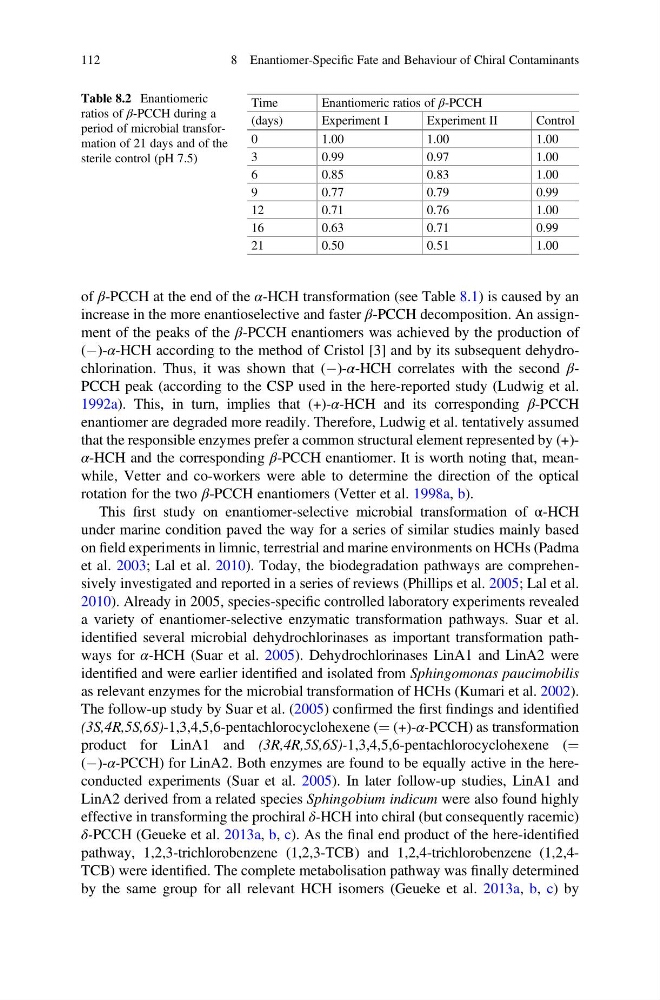
of β-PCCH at the end of the α-HCH transformation (see Table 8.1) is caused by an
increase in the more enantioselective and faster β-PCCH decomposition. An assignment of the peaks of the β-PCCH enantiomers was achieved by the production of
(À)-α-HCH according to the method of Cristol [3] and by its subsequent dehydrochlorination. Thus, it was shown that (À)-α-HCH correlates with the second βPCCH peak (according to the CSP used in the here-reported study (Ludwig et al.
1992a). This, in turn, implies that (+)-α-HCH and its corresponding β-PCCH
enantiomer are degraded more readily. Therefore, Ludwig et al. tentatively assumed
that the responsible enzymes prefer a common structural element represented by (+)α-HCH and the corresponding β-PCCH enantiomer. It is worth noting that, meanwhile, Vetter and co-workers were able to determine the direction of the optical
rotation for the two β-PCCH enantiomers (Vetter et al. 1998a, b).
This first study on enantiomer-selective microbial transformation of α-HCH
under marine condition paved the way for a series of similar studies mainly based
on field experiments in limnic, terrestrial and marine environments on HCHs (Padma
et al. 2003; Lal et al. 2010). Today, the biodegradation pathways are comprehensively investigated and reported in a series of reviews (Phillips et al. 2005; Lal et al.
2010). Already in 2005, species-specific controlled laboratory experiments revealed
a variety of enantiomer-selective enzymatic transformation pathways. Suar et al.
identified several microbial dehydrochlorinases as important transformation pathways for α-HCH (Suar et al. 2005). Dehydrochlorinases LinA1 and LinA2 were
identified and were earlier identified and isolated from Sphingomonas paucimobilis
as relevant enzymes for the microbial transformation of HCHs (Kumari et al. 2002).
The follow-up study by Suar et al. (2005) confirmed the first findings and identified
(3S,4R,5S,6S)-1,3,4,5,6-pentachlorocyclohexene (¼ (+)-α-PCCH) as transformation
product for LinA1 and (3R,4R,5S,6S)-1,3,4,5,6-pentachlorocyclohexene (¼
(À)-α-PCCH) for LinA2. Both enzymes are found to be equally active in the hereconducted experiments (Suar et al. 2005). In later follow-up studies, LinA1 and
LinA2 derived from a related species Sphingobium indicum were also found highly
effective in transforming the prochiral δ-HCH into chiral (but consequently racemic)
δ-PCCH (Geueke et al. 2013a, b, c). As the final end product of the here-identified
pathway, 1,2,3-trichlorobenzene (1,2,3-TCB) and 1,2,4-trichlorobenzene (1,2,4TCB) were identified. The complete metabolisation pathway was finally determined
by the same group for all relevant HCH isomers (Geueke et al. 2013a, b, c) by
Table 8.2 Enantiomeric
ratios of β-PCCH during a
period of microbial transformation of 21 days and of the
sterile control (pH 7.5)
Time
Enantiomeric ratios of β-PCCH
(days)
Experiment I
Experiment II
Control
0
1.00
1.00
1.00
3
0.99
0.97
1.00
6
0.85
0.83
1.00
9
0.77
0.79
0.99
12
0.71
0.76
1.00
16
0.63
0.71
0.99
21
0.50
0.51
1.00
112
8 Enantiomer-Specific Fate and Behaviour of Chiral Contaminants
increase in the more enantioselective and faster β-PCCH decomposition. An assignment of the peaks of the β-PCCH enantiomers was achieved by the production of
(À)-α-HCH according to the method of Cristol [3] and by its subsequent dehydrochlorination. Thus, it was shown that (À)-α-HCH correlates with the second βPCCH peak (according to the CSP used in the here-reported study (Ludwig et al.
1992a). This, in turn, implies that (+)-α-HCH and its corresponding β-PCCH
enantiomer are degraded more readily. Therefore, Ludwig et al. tentatively assumed
that the responsible enzymes prefer a common structural element represented by (+)α-HCH and the corresponding β-PCCH enantiomer. It is worth noting that, meanwhile, Vetter and co-workers were able to determine the direction of the optical
rotation for the two β-PCCH enantiomers (Vetter et al. 1998a, b).
This first study on enantiomer-selective microbial transformation of α-HCH
under marine condition paved the way for a series of similar studies mainly based
on field experiments in limnic, terrestrial and marine environments on HCHs (Padma
et al. 2003; Lal et al. 2010). Today, the biodegradation pathways are comprehensively investigated and reported in a series of reviews (Phillips et al. 2005; Lal et al.
2010). Already in 2005, species-specific controlled laboratory experiments revealed
a variety of enantiomer-selective enzymatic transformation pathways. Suar et al.
identified several microbial dehydrochlorinases as important transformation pathways for α-HCH (Suar et al. 2005). Dehydrochlorinases LinA1 and LinA2 were
identified and were earlier identified and isolated from Sphingomonas paucimobilis
as relevant enzymes for the microbial transformation of HCHs (Kumari et al. 2002).
The follow-up study by Suar et al. (2005) confirmed the first findings and identified
(3S,4R,5S,6S)-1,3,4,5,6-pentachlorocyclohexene (¼ (+)-α-PCCH) as transformation
product for LinA1 and (3R,4R,5S,6S)-1,3,4,5,6-pentachlorocyclohexene (¼
(À)-α-PCCH) for LinA2. Both enzymes are found to be equally active in the hereconducted experiments (Suar et al. 2005). In later follow-up studies, LinA1 and
LinA2 derived from a related species Sphingobium indicum were also found highly
effective in transforming the prochiral δ-HCH into chiral (but consequently racemic)
δ-PCCH (Geueke et al. 2013a, b, c). As the final end product of the here-identified
pathway, 1,2,3-trichlorobenzene (1,2,3-TCB) and 1,2,4-trichlorobenzene (1,2,4TCB) were identified. The complete metabolisation pathway was finally determined
by the same group for all relevant HCH isomers (Geueke et al. 2013a, b, c) by
Table 8.2 Enantiomeric
ratios of β-PCCH during a
period of microbial transformation of 21 days and of the
sterile control (pH 7.5)
Time
Enantiomeric ratios of β-PCCH
(days)
Experiment I
Experiment II
Control
0
1.00
1.00
1.00
3
0.99
0.97
1.00
6
0.85
0.83
1.00
9
0.77
0.79
0.99
12
0.71
0.76
1.00
16
0.63
0.71
0.99
21
0.50
0.51
1.00
112
8 Enantiomer-Specific Fate and Behaviour of Chiral Contaminants