

reported for the degradation of 2,4-D by terrestrial micro-organisms (Mercurio et al.
2016; Botero et al. 2017; Carboneras et al. 2017).
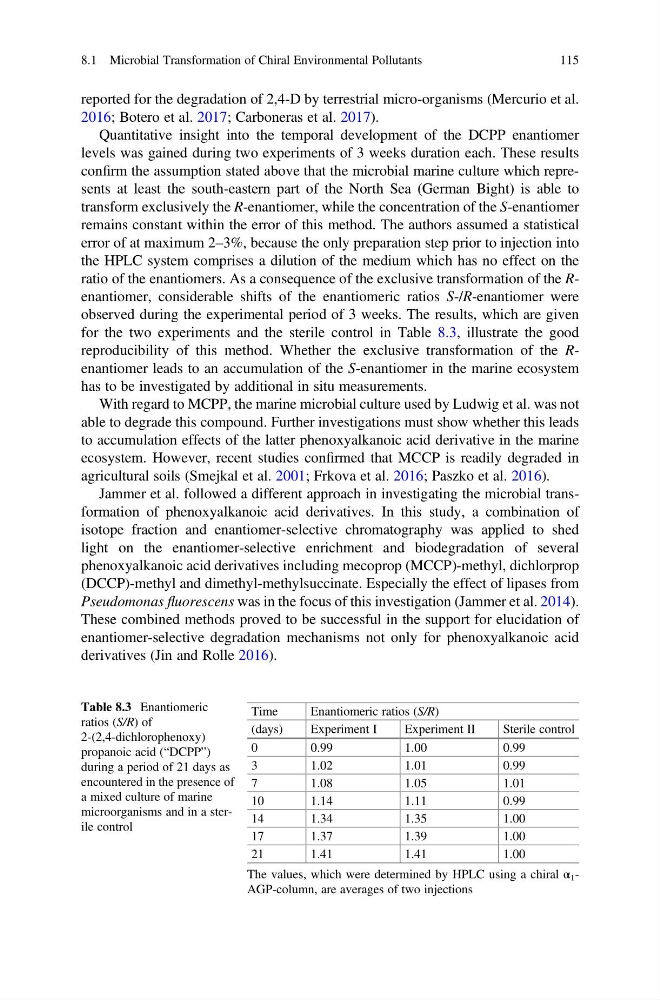
Quantitative insight into the temporal development of the DCPP enantiomer
levels was gained during two experiments of 3 weeks duration each. These results
confirm the assumption stated above that the microbial marine culture which represents at least the south-eastern part of the North Sea (German Bight) is able to
transform exclusively the R-enantiomer, while the concentration of the S-enantiomer
remains constant within the error of this method. The authors assumed a statistical
error of at maximum 2–3%, because the only preparation step prior to injection into
the HPLC system comprises a dilution of the medium which has no effect on the
ratio of the enantiomers. As a consequence of the exclusive transformation of the Renantiomer, considerable shifts of the enantiomeric ratios S-/R-enantiomer were
observed during the experimental period of 3 weeks. The results, which are given
for the two experiments and the sterile control in Table 8.3, illustrate the good
reproducibility of this method. Whether the exclusive transformation of the Renantiomer leads to an accumulation of the S-enantiomer in the marine ecosystem
has to be investigated by additional in situ measurements.
With regard to MCPP, the marine microbial culture used by Ludwig et al. was not
able to degrade this compound. Further investigations must show whether this leads
to accumulation effects of the latter phenoxyalkanoic acid derivative in the marine
ecosystem. However, recent studies confirmed that MCCP is readily degraded in
agricultural soils (Smejkal et al. 2001; Frkova et al. 2016; Paszko et al. 2016).
Jammer et al. followed a different approach in investigating the microbial transformation of phenoxyalkanoic acid derivatives. In this study, a combination of
isotope fraction and enantiomer-selective chromatography was applied to shed
light on the enantiomer-selective enrichment and biodegradation of several
phenoxyalkanoic acid derivatives including mecoprop (MCCP)-methyl, dichlorprop
(DCCP)-methyl and dimethyl-methylsuccinate. Especially the effect of lipases from
Pseudomonas fluorescens was in the focus of this investigation (Jammer et al. 2014).
These combined methods proved to be successful in the support for elucidation of
enantiomer-selective degradation mechanisms not only for phenoxyalkanoic acid
derivatives (Jin and Rolle 2016).
Table 8.3 Enantiomeric
ratios (S/R) of
2-(2,4-dichlorophenoxy)
propanoic acid (“DCPP”)
during a period of 21 days as
encountered in the presence of
a mixed culture of marine
microorganisms and in a sterile control
Time
Enantiomeric ratios (S/R)
(days)
Experiment I
Experiment II
Sterile control
0
0.99
1.00
0.99
3
1.02
1.01
0.99
7
1.08
1.05
1.01
10
1.14
1.11
0.99
14
1.34
1.35
1.00
17
1.37
1.39
1.00
21
1.41
1.41
1.00
The values, which were determined by HPLC using a chiral α 1 -
AGP-column, are averages of two injections
8.1 Microbial Transformation of Chiral Environmental Pollutants
115
2016; Botero et al. 2017; Carboneras et al. 2017).
Quantitative insight into the temporal development of the DCPP enantiomer
levels was gained during two experiments of 3 weeks duration each. These results
confirm the assumption stated above that the microbial marine culture which represents at least the south-eastern part of the North Sea (German Bight) is able to
transform exclusively the R-enantiomer, while the concentration of the S-enantiomer
remains constant within the error of this method. The authors assumed a statistical
error of at maximum 2–3%, because the only preparation step prior to injection into
the HPLC system comprises a dilution of the medium which has no effect on the
ratio of the enantiomers. As a consequence of the exclusive transformation of the Renantiomer, considerable shifts of the enantiomeric ratios S-/R-enantiomer were
observed during the experimental period of 3 weeks. The results, which are given
for the two experiments and the sterile control in Table 8.3, illustrate the good
reproducibility of this method. Whether the exclusive transformation of the Renantiomer leads to an accumulation of the S-enantiomer in the marine ecosystem
has to be investigated by additional in situ measurements.
With regard to MCPP, the marine microbial culture used by Ludwig et al. was not
able to degrade this compound. Further investigations must show whether this leads
to accumulation effects of the latter phenoxyalkanoic acid derivative in the marine
ecosystem. However, recent studies confirmed that MCCP is readily degraded in
agricultural soils (Smejkal et al. 2001; Frkova et al. 2016; Paszko et al. 2016).
Jammer et al. followed a different approach in investigating the microbial transformation of phenoxyalkanoic acid derivatives. In this study, a combination of
isotope fraction and enantiomer-selective chromatography was applied to shed
light on the enantiomer-selective enrichment and biodegradation of several
phenoxyalkanoic acid derivatives including mecoprop (MCCP)-methyl, dichlorprop
(DCCP)-methyl and dimethyl-methylsuccinate. Especially the effect of lipases from
Pseudomonas fluorescens was in the focus of this investigation (Jammer et al. 2014).
These combined methods proved to be successful in the support for elucidation of
enantiomer-selective degradation mechanisms not only for phenoxyalkanoic acid
derivatives (Jin and Rolle 2016).
Table 8.3 Enantiomeric
ratios (S/R) of
2-(2,4-dichlorophenoxy)
propanoic acid (“DCPP”)
during a period of 21 days as
encountered in the presence of
a mixed culture of marine
microorganisms and in a sterile control
Time
Enantiomeric ratios (S/R)
(days)
Experiment I
Experiment II
Sterile control
0
0.99
1.00
0.99
3
1.02
1.01
0.99
7
1.08
1.05
1.01
10
1.14
1.11
0.99
14
1.34
1.35
1.00
17
1.37
1.39
1.00
21
1.41
1.41
1.00
The values, which were determined by HPLC using a chiral α 1 -
AGP-column, are averages of two injections
8.1 Microbial Transformation of Chiral Environmental Pollutants
115