

61
factors is well-portrayed in literature. It has been proved in many studies that due to
pathologic conditions changes occur in morphology and number of mitochondria in
different body organs such as heart and skeletal muscles [1].
Fission and Fusion Balance of Mitochondria
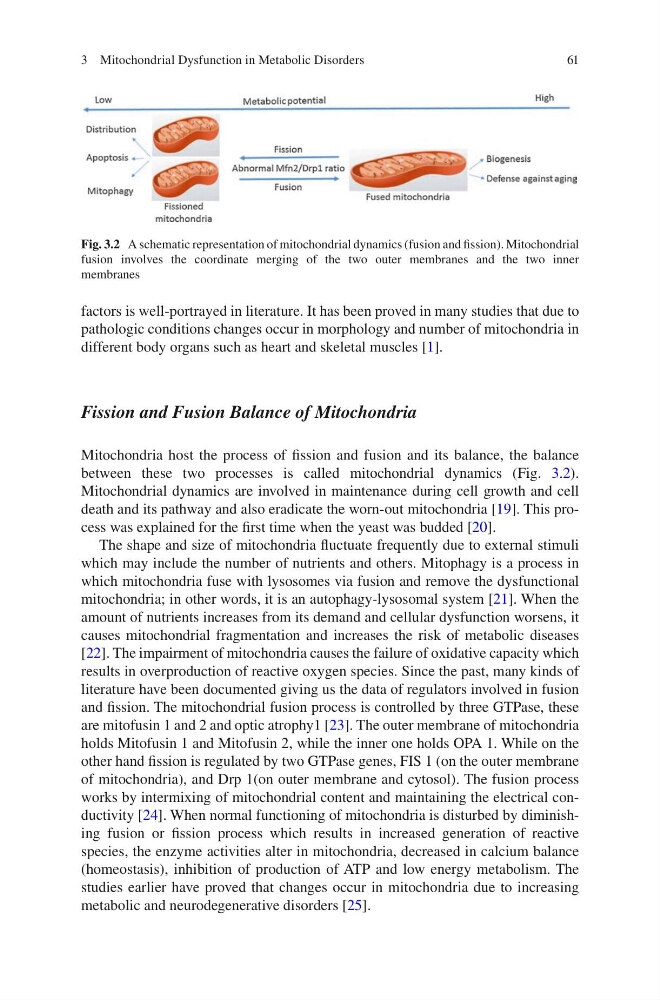
Mitochondria host the process of fission and fusion and its balance, the balance
between these two processes is called mitochondrial dynamics (Fig. 3.2).
Mitochondrial dynamics are involved in maintenance during cell growth and cell
death and its pathway and also eradicate the worn-out mitochondria [19]. This process was explained for the first time when the yeast was budded [20].
The shape and size of mitochondria fluctuate frequently due to external stimuli
which may include the number of nutrients and others. Mitophagy is a process in
which mitochondria fuse with lysosomes via fusion and remove the dysfunctional
mitochondria; in other words, it is an autophagy-lysosomal system [21]. When the
amount of nutrients increases from its demand and cellular dysfunction worsens, it
causes mitochondrial fragmentation and increases the risk of metabolic diseases
[22]. The impairment of mitochondria causes the failure of oxidative capacity which
results in overproduction of reactive oxygen species. Since the past, many kinds of
literature have been documented giving us the data of regulators involved in fusion
and fission. The mitochondrial fusion process is controlled by three GTPase, these
are mitofusin 1 and 2 and optic atrophy1 [23]. The outer membrane of mitochondria
holds Mitofusin 1 and Mitofusin 2, while the inner one holds OPA 1. While on the
other hand fission is regulated by two GTPase genes, FIS 1 (on the outer membrane
of mitochondria), and Drp 1(on outer membrane and cytosol). The fusion process
works by intermixing of mitochondrial content and maintaining the electrical conductivity [24]. When normal functioning of mitochondria is disturbed by diminishing fusion or fission process which results in increased generation of reactive
species, the enzyme activities alter in mitochondria, decreased in calcium balance
(homeostasis), inhibition of production of ATP and low energy metabolism. The
studies earlier have proved that changes occur in mitochondria due to increasing
metabolic and neurodegenerative disorders [25].
Fig. 3.2 A schematic representation of mitochondrial dynamics (fusion and fission). Mitochondrial
fusion involves the coordinate merging of the two outer membranes and the two inner
membranes
3 Mitochondrial Dysfunction in Metabolic Disorders
factors is well-portrayed in literature. It has been proved in many studies that due to
pathologic conditions changes occur in morphology and number of mitochondria in
different body organs such as heart and skeletal muscles [1].
Fission and Fusion Balance of Mitochondria
Mitochondria host the process of fission and fusion and its balance, the balance
between these two processes is called mitochondrial dynamics (Fig. 3.2).
Mitochondrial dynamics are involved in maintenance during cell growth and cell
death and its pathway and also eradicate the worn-out mitochondria [19]. This process was explained for the first time when the yeast was budded [20].
The shape and size of mitochondria fluctuate frequently due to external stimuli
which may include the number of nutrients and others. Mitophagy is a process in
which mitochondria fuse with lysosomes via fusion and remove the dysfunctional
mitochondria; in other words, it is an autophagy-lysosomal system [21]. When the
amount of nutrients increases from its demand and cellular dysfunction worsens, it
causes mitochondrial fragmentation and increases the risk of metabolic diseases
[22]. The impairment of mitochondria causes the failure of oxidative capacity which
results in overproduction of reactive oxygen species. Since the past, many kinds of
literature have been documented giving us the data of regulators involved in fusion
and fission. The mitochondrial fusion process is controlled by three GTPase, these
are mitofusin 1 and 2 and optic atrophy1 [23]. The outer membrane of mitochondria
holds Mitofusin 1 and Mitofusin 2, while the inner one holds OPA 1. While on the
other hand fission is regulated by two GTPase genes, FIS 1 (on the outer membrane
of mitochondria), and Drp 1(on outer membrane and cytosol). The fusion process
works by intermixing of mitochondrial content and maintaining the electrical conductivity [24]. When normal functioning of mitochondria is disturbed by diminishing fusion or fission process which results in increased generation of reactive
species, the enzyme activities alter in mitochondria, decreased in calcium balance
(homeostasis), inhibition of production of ATP and low energy metabolism. The
studies earlier have proved that changes occur in mitochondria due to increasing
metabolic and neurodegenerative disorders [25].
Fig. 3.2 A schematic representation of mitochondrial dynamics (fusion and fission). Mitochondrial
fusion involves the coordinate merging of the two outer membranes and the two inner
membranes
3 Mitochondrial Dysfunction in Metabolic Disorders