

62
Oxidative Damage to Mitochondria Triggering Its Dysfunction
The imbalance between two antagonistic forces is referred to as oxidative stress
which causes the production of ROS and minimizes antioxidants. It is also a wellknown fact that the damaging effect of reactive oxygen species is more as compare
to compensatory. Mitochondrial dysfunction is a series of events that occur in mitochondria which involve dysfunction in mitochondrial biogenesis, changes produced
in the membrane potential, and the decrease in size, number, and oxidative proteins
of mitochondria [26]. In the body, it is a routine process of generating reactive oxygen species by oxygen metabolism in which mitochondria have the lead role in
generating these reactive species [12]. These reactive species when interacting with
other cellular components like DNA, protein, lipids, etc. in the OXPHOS process
result in mitochondrial dysfunction [27]. Metabolic syndrome involves many diseases such as hypertension, obesity, hyper-dyslipidemia, and others. Changes in
mitochondrial functions increase the risk of diseases like diabetes, obesity, dyslipidemia, and cardiovascular diseases. The abnormal cell metabolism causes the
irregular generation of energy and its consumption, which are the main cause of
metabolic syndromes [28]. Morphological changes occur due to enhanced glucose
levels and increased reactive species [29]. When the signaling pathway of insulin is
inhibited it causes the accumulation of fatty acids and lipids which can also be the
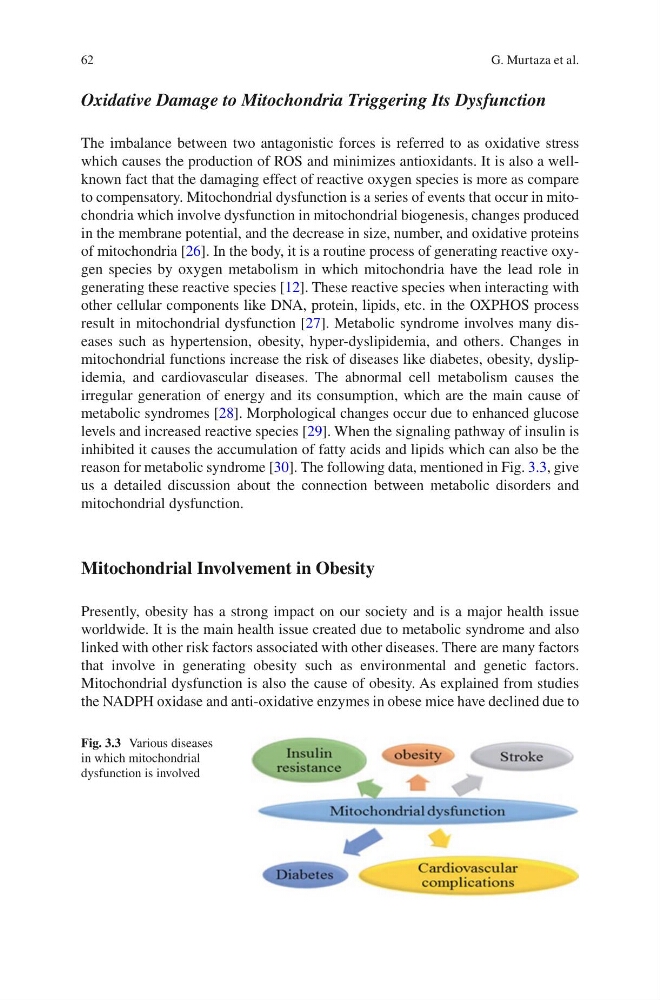
reason for metabolic syndrome [30]. The following data, mentioned in Fig. 3.3, give
us a detailed discussion about the connection between metabolic disorders and
mitochondrial dysfunction.
Mitochondrial Involvement in Obesity
Presently, obesity has a strong impact on our society and is a major health issue
worldwide. It is the main health issue created due to metabolic syndrome and also
linked with other risk factors associated with other diseases. There are many factors
that involve in generating obesity such as environmental and genetic factors.
Mitochondrial dysfunction is also the cause of obesity. As explained from studies
the NADPH oxidase and anti-oxidative enzymes in obese mice have declined due to
Fig. 3.3 Various diseases
in which mitochondrial
dysfunction is involved
G. Murtaza et al.
Oxidative Damage to Mitochondria Triggering Its Dysfunction
The imbalance between two antagonistic forces is referred to as oxidative stress
which causes the production of ROS and minimizes antioxidants. It is also a wellknown fact that the damaging effect of reactive oxygen species is more as compare
to compensatory. Mitochondrial dysfunction is a series of events that occur in mitochondria which involve dysfunction in mitochondrial biogenesis, changes produced
in the membrane potential, and the decrease in size, number, and oxidative proteins
of mitochondria [26]. In the body, it is a routine process of generating reactive oxygen species by oxygen metabolism in which mitochondria have the lead role in
generating these reactive species [12]. These reactive species when interacting with
other cellular components like DNA, protein, lipids, etc. in the OXPHOS process
result in mitochondrial dysfunction [27]. Metabolic syndrome involves many diseases such as hypertension, obesity, hyper-dyslipidemia, and others. Changes in
mitochondrial functions increase the risk of diseases like diabetes, obesity, dyslipidemia, and cardiovascular diseases. The abnormal cell metabolism causes the
irregular generation of energy and its consumption, which are the main cause of
metabolic syndromes [28]. Morphological changes occur due to enhanced glucose
levels and increased reactive species [29]. When the signaling pathway of insulin is
inhibited it causes the accumulation of fatty acids and lipids which can also be the
reason for metabolic syndrome [30]. The following data, mentioned in Fig. 3.3, give
us a detailed discussion about the connection between metabolic disorders and
mitochondrial dysfunction.
Mitochondrial Involvement in Obesity
Presently, obesity has a strong impact on our society and is a major health issue
worldwide. It is the main health issue created due to metabolic syndrome and also
linked with other risk factors associated with other diseases. There are many factors
that involve in generating obesity such as environmental and genetic factors.
Mitochondrial dysfunction is also the cause of obesity. As explained from studies
the NADPH oxidase and anti-oxidative enzymes in obese mice have declined due to
Fig. 3.3 Various diseases
in which mitochondrial
dysfunction is involved
G. Murtaza et al.