

494
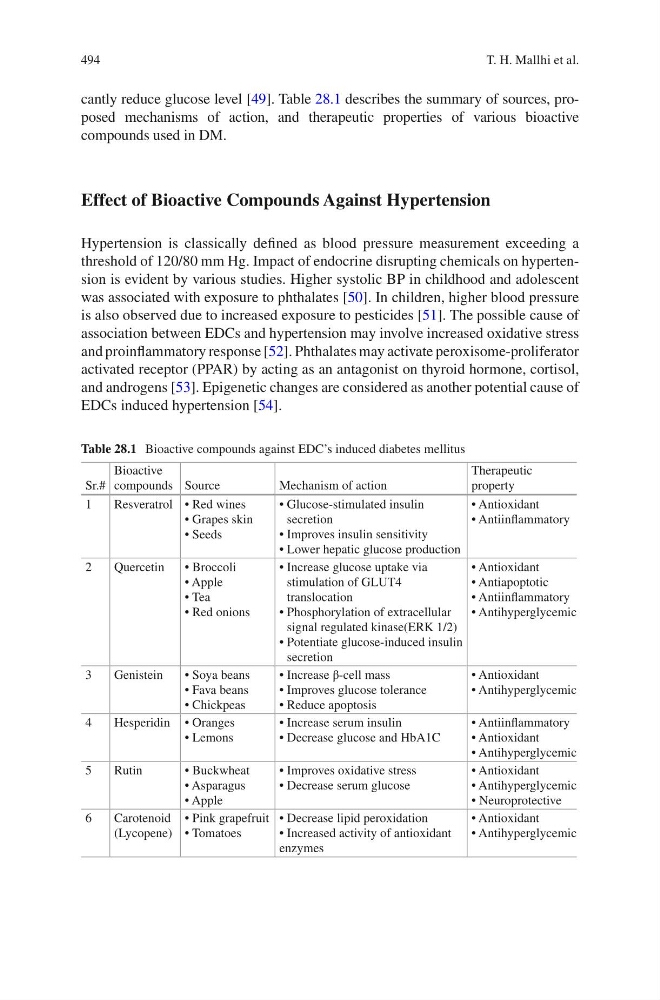
cantly reduce glucose level [49]. Table 28.1 describes the summary of sources, proposed mechanisms of action, and therapeutic properties of various bioactive
compounds used in DM.
Effect of Bioactive Compounds Against Hypertension
Hypertension is classically defined as blood pressure measurement exceeding a
threshold of 120/80 mm Hg. Impact of endocrine disrupting chemicals on hypertension is evident by various studies. Higher systolic BP in childhood and adolescent
was associated with exposure to phthalates [50]. In children, higher blood pressure
is also observed due to increased exposure to pesticides [51]. The possible cause of
association between EDCs and hypertension may involve increased oxidative stress
and proinflammatory response [52]. Phthalates may activate peroxisome- proliferator
activated receptor (PPAR) by acting as an antagonist on thyroid hormone, cortisol,
and androgens [53]. Epigenetic changes are considered as another potential cause of
EDCs induced hypertension [54].
Table 28.1 Bioactive compounds against EDC’s induced diabetes mellitus
Sr.#
Bioactive
compounds Source
Mechanism of action
Therapeutic
property
1
Resveratrol • Red wines
• Grapes skin
• Seeds
• Glucose-stimulated insulin
secretion
• Improves insulin sensitivity
• Lower hepatic glucose production
• Antioxidant
• Antiinflammatory
2
Quercetin
• Broccoli
• Apple
• Tea
• Red onions
• Increase glucose uptake via
stimulation of GLUT4
translocation
• Phosphorylation of extracellular
signal regulated kinase(ERK 1/2)
• Potentiate glucose-induced insulin
secretion
• Antioxidant
• Antiapoptotic
• Antiinflammatory
• Antihyperglycemic
3
Genistein
• Soya beans
• Fava beans
• Chickpeas
• Increase β-cell mass
• Improves glucose tolerance
• Reduce apoptosis
• Antioxidant
• Antihyperglycemic
4
Hesperidin • Oranges
• Lemons
• Increase serum insulin
• Decrease glucose and HbA1C
• Antiinflammatory
• Antioxidant
• Antihyperglycemic
5
Rutin
• Buckwheat
• Asparagus
• Apple
• Improves oxidative stress
• Decrease serum glucose
• Antioxidant
• Antihyperglycemic
• Neuroprotective
6
Carotenoid
(Lycopene)
• Pink grapefruit
• Tomatoes
• Decrease lipid peroxidation
• Increased activity of antioxidant
enzymes
• Antioxidant
• Antihyperglycemic
T. H. Mallhi et al.
cantly reduce glucose level [49]. Table 28.1 describes the summary of sources, proposed mechanisms of action, and therapeutic properties of various bioactive
compounds used in DM.
Effect of Bioactive Compounds Against Hypertension
Hypertension is classically defined as blood pressure measurement exceeding a
threshold of 120/80 mm Hg. Impact of endocrine disrupting chemicals on hypertension is evident by various studies. Higher systolic BP in childhood and adolescent
was associated with exposure to phthalates [50]. In children, higher blood pressure
is also observed due to increased exposure to pesticides [51]. The possible cause of
association between EDCs and hypertension may involve increased oxidative stress
and proinflammatory response [52]. Phthalates may activate peroxisome- proliferator
activated receptor (PPAR) by acting as an antagonist on thyroid hormone, cortisol,
and androgens [53]. Epigenetic changes are considered as another potential cause of
EDCs induced hypertension [54].
Table 28.1 Bioactive compounds against EDC’s induced diabetes mellitus
Sr.#
Bioactive
compounds Source
Mechanism of action
Therapeutic
property
1
Resveratrol • Red wines
• Grapes skin
• Seeds
• Glucose-stimulated insulin
secretion
• Improves insulin sensitivity
• Lower hepatic glucose production
• Antioxidant
• Antiinflammatory
2
Quercetin
• Broccoli
• Apple
• Tea
• Red onions
• Increase glucose uptake via
stimulation of GLUT4
translocation
• Phosphorylation of extracellular
signal regulated kinase(ERK 1/2)
• Potentiate glucose-induced insulin
secretion
• Antioxidant
• Antiapoptotic
• Antiinflammatory
• Antihyperglycemic
3
Genistein
• Soya beans
• Fava beans
• Chickpeas
• Increase β-cell mass
• Improves glucose tolerance
• Reduce apoptosis
• Antioxidant
• Antihyperglycemic
4
Hesperidin • Oranges
• Lemons
• Increase serum insulin
• Decrease glucose and HbA1C
• Antiinflammatory
• Antioxidant
• Antihyperglycemic
5
Rutin
• Buckwheat
• Asparagus
• Apple
• Improves oxidative stress
• Decrease serum glucose
• Antioxidant
• Antihyperglycemic
• Neuroprotective
6
Carotenoid
(Lycopene)
• Pink grapefruit
• Tomatoes
• Decrease lipid peroxidation
• Increased activity of antioxidant
enzymes
• Antioxidant
• Antihyperglycemic
T. H. Mallhi et al.