

427
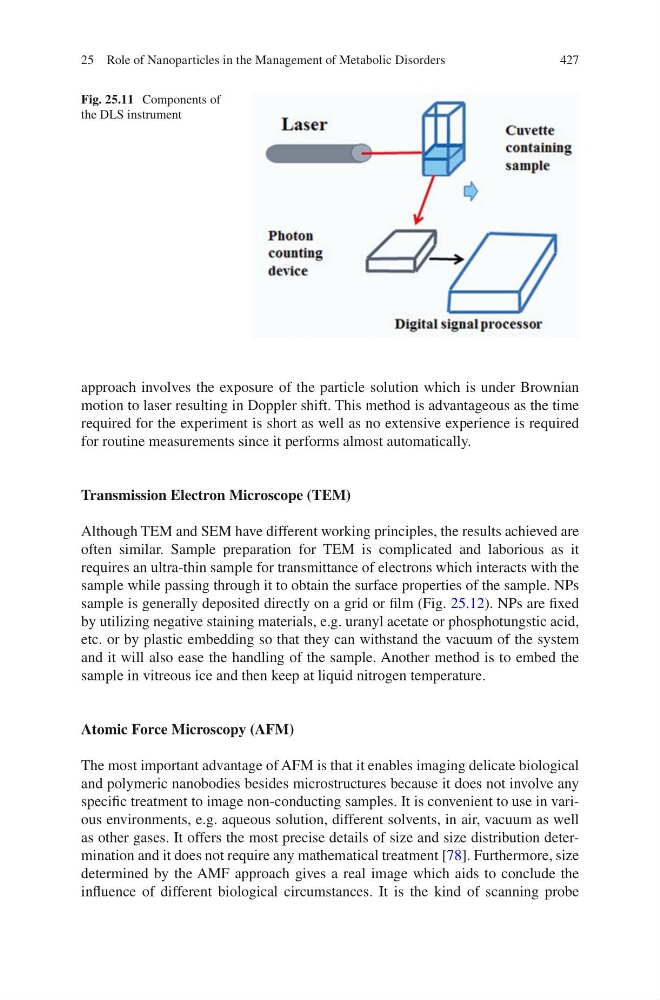
approach involves the exposure of the particle solution which is under Brownian
motion to laser resulting in Doppler shift. This method is advantageous as the time
required for the experiment is short as well as no extensive experience is required
for routine measurements since it performs almost automatically.
Transmission Electron Microscope (TEM)
Although TEM and SEM have different working principles, the results achieved are
often similar. Sample preparation for TEM is complicated and laborious as it
requires an ultra-thin sample for transmittance of electrons which interacts with the
sample while passing through it to obtain the surface properties of the sample. NPs
sample is generally deposited directly on a grid or film (Fig. 25.12). NPs are fixed
by utilizing negative staining materials, e.g. uranyl acetate or phosphotungstic acid,
etc. or by plastic embedding so that they can withstand the vacuum of the system
and it will also ease the handling of the sample. Another method is to embed the
sample in vitreous ice and then keep at liquid nitrogen temperature.
Atomic Force Microscopy (AFM)
The most important advantage of AFM is that it enables imaging delicate biological
and polymeric nanobodies besides microstructures because it does not involve any
specific treatment to image non-conducting samples. It is convenient to use in various environments, e.g. aqueous solution, different solvents, in air, vacuum as well
as other gases. It offers the most precise details of size and size distribution determination and it does not require any mathematical treatment [78]. Furthermore, size
determined by the AMF approach gives a real image which aids to conclude the
influence of different biological circumstances. It is the kind of scanning probe
Fig. 25.11 Components of
the DLS instrument
25 Role of Nanoparticles in the Management of Metabolic Disorders
approach involves the exposure of the particle solution which is under Brownian
motion to laser resulting in Doppler shift. This method is advantageous as the time
required for the experiment is short as well as no extensive experience is required
for routine measurements since it performs almost automatically.
Transmission Electron Microscope (TEM)
Although TEM and SEM have different working principles, the results achieved are
often similar. Sample preparation for TEM is complicated and laborious as it
requires an ultra-thin sample for transmittance of electrons which interacts with the
sample while passing through it to obtain the surface properties of the sample. NPs
sample is generally deposited directly on a grid or film (Fig. 25.12). NPs are fixed
by utilizing negative staining materials, e.g. uranyl acetate or phosphotungstic acid,
etc. or by plastic embedding so that they can withstand the vacuum of the system
and it will also ease the handling of the sample. Another method is to embed the
sample in vitreous ice and then keep at liquid nitrogen temperature.
Atomic Force Microscopy (AFM)
The most important advantage of AFM is that it enables imaging delicate biological
and polymeric nanobodies besides microstructures because it does not involve any
specific treatment to image non-conducting samples. It is convenient to use in various environments, e.g. aqueous solution, different solvents, in air, vacuum as well
as other gases. It offers the most precise details of size and size distribution determination and it does not require any mathematical treatment [78]. Furthermore, size
determined by the AMF approach gives a real image which aids to conclude the
influence of different biological circumstances. It is the kind of scanning probe
Fig. 25.11 Components of
the DLS instrument
25 Role of Nanoparticles in the Management of Metabolic Disorders