

426
they have disadvantages of offering limited information regarding size distribution
as well as true population average. To perform SEM analysis, the NPs solution is
first required to be converted in form of dry powder followed by mounting it on a
holder to coat with gold (conductive metal) by employing a sputter coater, leading
to the analysis of the sample by using the probe. Interaction of electron beam with
sample generates various signals. Appropriate detectors are applied to analyze these
signals. It is necessary that NPs have the ability to endure vacuum as well as the
electron beam which can cause degradation of the polymer [76]. Results obtained
by SEM and dynamic light scattering for size are comparable. These techniques
have some disadvantages such as the sample preparation for SEM is laborious,
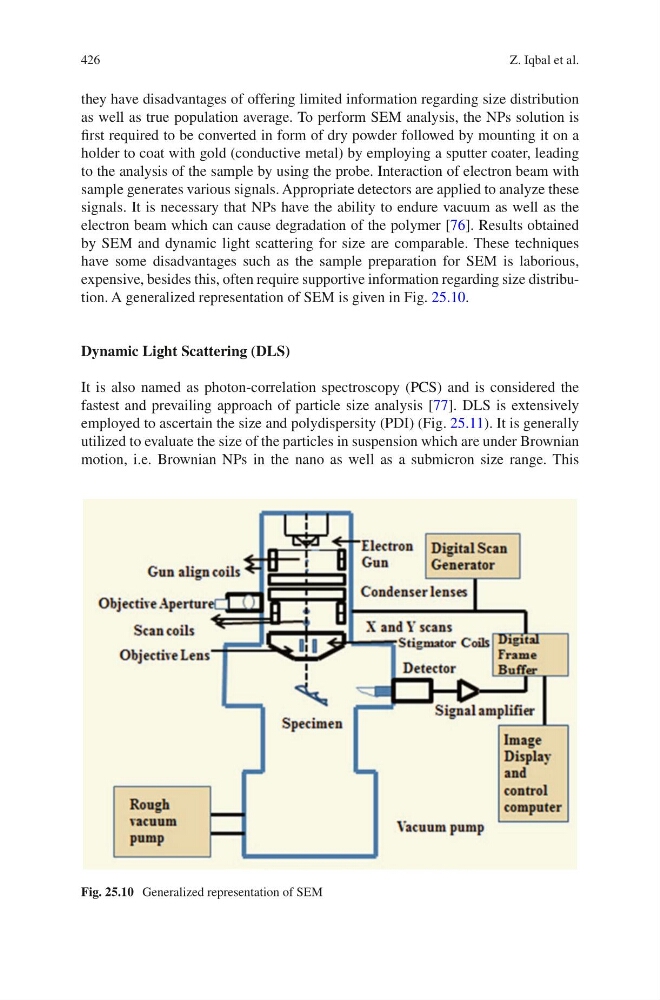
expensive, besides this, often require supportive information regarding size distribution. A generalized representation of SEM is given in Fig. 25.10.
Dynamic Light Scattering (DLS)
It is also named as photon-correlation spectroscopy (PCS) and is considered the
fastest and prevailing approach of particle size analysis [77]. DLS is extensively
employed to ascertain the size and polydispersity (PDI) (Fig. 25.11). It is generally
utilized to evaluate the size of the particles in suspension which are under Brownian
motion, i.e. Brownian NPs in the nano as well as a submicron size range. This
Fig. 25.10 Generalized representation of SEM
Z. Iqbal et al.
they have disadvantages of offering limited information regarding size distribution
as well as true population average. To perform SEM analysis, the NPs solution is
first required to be converted in form of dry powder followed by mounting it on a
holder to coat with gold (conductive metal) by employing a sputter coater, leading
to the analysis of the sample by using the probe. Interaction of electron beam with
sample generates various signals. Appropriate detectors are applied to analyze these
signals. It is necessary that NPs have the ability to endure vacuum as well as the
electron beam which can cause degradation of the polymer [76]. Results obtained
by SEM and dynamic light scattering for size are comparable. These techniques
have some disadvantages such as the sample preparation for SEM is laborious,
expensive, besides this, often require supportive information regarding size distribution. A generalized representation of SEM is given in Fig. 25.10.
Dynamic Light Scattering (DLS)
It is also named as photon-correlation spectroscopy (PCS) and is considered the
fastest and prevailing approach of particle size analysis [77]. DLS is extensively
employed to ascertain the size and polydispersity (PDI) (Fig. 25.11). It is generally
utilized to evaluate the size of the particles in suspension which are under Brownian
motion, i.e. Brownian NPs in the nano as well as a submicron size range. This
Fig. 25.10 Generalized representation of SEM
Z. Iqbal et al.