

416
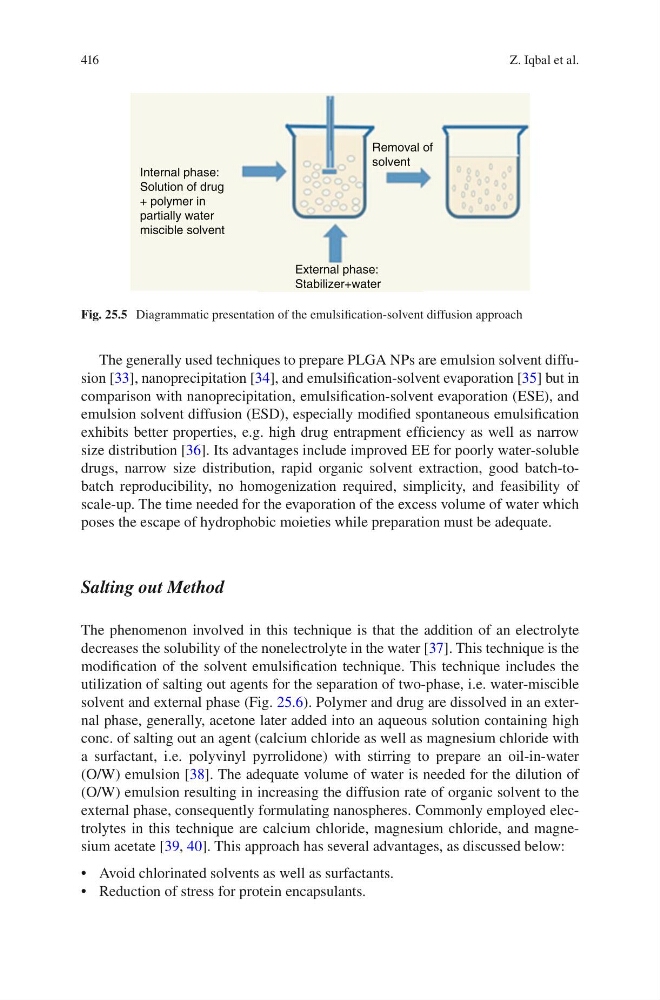
The generally used techniques to prepare PLGA NPs are emulsion solvent diffusion [33], nanoprecipitation [34], and emulsification-solvent evaporation [35] but in
comparison with nanoprecipitation, emulsification-solvent evaporation (ESE), and
emulsion solvent diffusion (ESD), especially modified spontaneous emulsification
exhibits better properties, e.g. high drug entrapment efficiency as well as narrow
size distribution [36]. Its advantages include improved EE for poorly water-soluble
drugs, narrow size distribution, rapid organic solvent extraction, good batch-tobatch reproducibility, no homogenization required, simplicity, and feasibility of
scale-up. The time needed for the evaporation of the excess volume of water which
poses the escape of hydrophobic moieties while preparation must be adequate.
Salting out Method
The phenomenon involved in this technique is that the addition of an electrolyte
decreases the solubility of the nonelectrolyte in the water [37]. This technique is the
modification of the solvent emulsification technique. This technique includes the
utilization of salting out agents for the separation of two-phase, i.e. water-miscible
solvent and external phase (Fig. 25.6). Polymer and drug are dissolved in an external phase, generally, acetone later added into an aqueous solution containing high
conc. of salting out an agent (calcium chloride as well as magnesium chloride with
a surfactant, i.e. polyvinyl pyrrolidone) with stirring to prepare an oil-in-water
(O/W) emulsion [38]. The adequate volume of water is needed for the dilution of
(O/W) emulsion resulting in increasing the diffusion rate of organic solvent to the
external phase, consequently formulating nanospheres. Commonly employed electrolytes in this technique are calcium chloride, magnesium chloride, and magnesium acetate [39, 40]. This approach has several advantages, as discussed below:
• Avoid chlorinated solvents as well as surfactants.
• Reduction of stress for protein encapsulants.
Internal phase:
Solution of drug
+ polymer in
partially water
miscible solvent
External phase:
Stabilizer+water
Removal of
solvent
Fig. 25.5 Diagrammatic presentation of the emulsification-solvent diffusion approach
Z. Iqbal et al.
The generally used techniques to prepare PLGA NPs are emulsion solvent diffusion [33], nanoprecipitation [34], and emulsification-solvent evaporation [35] but in
comparison with nanoprecipitation, emulsification-solvent evaporation (ESE), and
emulsion solvent diffusion (ESD), especially modified spontaneous emulsification
exhibits better properties, e.g. high drug entrapment efficiency as well as narrow
size distribution [36]. Its advantages include improved EE for poorly water-soluble
drugs, narrow size distribution, rapid organic solvent extraction, good batch-tobatch reproducibility, no homogenization required, simplicity, and feasibility of
scale-up. The time needed for the evaporation of the excess volume of water which
poses the escape of hydrophobic moieties while preparation must be adequate.
Salting out Method
The phenomenon involved in this technique is that the addition of an electrolyte
decreases the solubility of the nonelectrolyte in the water [37]. This technique is the
modification of the solvent emulsification technique. This technique includes the
utilization of salting out agents for the separation of two-phase, i.e. water-miscible
solvent and external phase (Fig. 25.6). Polymer and drug are dissolved in an external phase, generally, acetone later added into an aqueous solution containing high
conc. of salting out an agent (calcium chloride as well as magnesium chloride with
a surfactant, i.e. polyvinyl pyrrolidone) with stirring to prepare an oil-in-water
(O/W) emulsion [38]. The adequate volume of water is needed for the dilution of
(O/W) emulsion resulting in increasing the diffusion rate of organic solvent to the
external phase, consequently formulating nanospheres. Commonly employed electrolytes in this technique are calcium chloride, magnesium chloride, and magnesium acetate [39, 40]. This approach has several advantages, as discussed below:
• Avoid chlorinated solvents as well as surfactants.
• Reduction of stress for protein encapsulants.
Internal phase:
Solution of drug
+ polymer in
partially water
miscible solvent
External phase:
Stabilizer+water
Removal of
solvent
Fig. 25.5 Diagrammatic presentation of the emulsification-solvent diffusion approach
Z. Iqbal et al.