

417
• Use for heat-labile substances because high temperature is not needed in this
technique.
• High encapsulation efficiency.
• High yield and purity.
• The simplicity of the operation.
• Easy scaling up.
The disadvantages of this modality are stated below:
• The possibility of incompatibility between salts and drugs.
• Exclusive applicability to lipophilic drug.
• Needs extensive NPs washing steps to achieve purity.
Coacervation Phase Separation
Fong in 1979 was the first to report the coacervation method to formulate polyester
microspheres [41] and its modifications are employed today for the fabrication of
NPs. This method involves the precipitation of the polymer. Precipitation happens
on adding the third compound to the internal phase or it can be due to some other
physical ways. Two liquid phases have to be formed, coacervates rich in polymer
and polymer depleted supernatant liquid phase. This technique involves two steps,
firstly, depending upon the solubility parameters of the polymer, liquid droplets of
the polymer from the external phase are formed and secondly, the removal of the
polymer solvent subsequently causes the hardening of the polymer droplets.
Organic solvents employed as the solvent, cooperating agents, and hardening
agents are dichloromethane, isopropanol, and heptane. This method can be employed
to entrap both hydrophobic as well as hydrophilic drugs but with varying drug
EE. The hydrophilic drug is solubilized in the aqueous phase and later, this external
phase is added to the internal phase containing polymer (W/O emulsion). On the
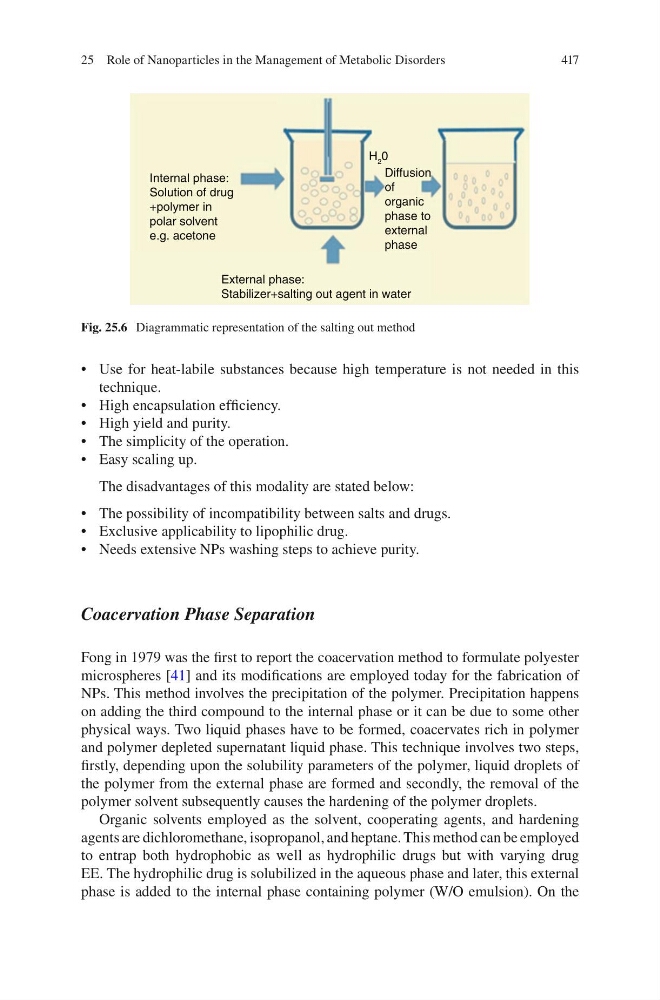
Internal phase:
Solution of drug
+polymer in
polar solvent
e.g. acetone
H 2 0
Diffusion
of
organic
phase to
external
phase
External phase:
Stabilizer+salting out agent in water
Fig. 25.6 Diagrammatic representation of the salting out method
25 Role of Nanoparticles in the Management of Metabolic Disorders
• Use for heat-labile substances because high temperature is not needed in this
technique.
• High encapsulation efficiency.
• High yield and purity.
• The simplicity of the operation.
• Easy scaling up.
The disadvantages of this modality are stated below:
• The possibility of incompatibility between salts and drugs.
• Exclusive applicability to lipophilic drug.
• Needs extensive NPs washing steps to achieve purity.
Coacervation Phase Separation
Fong in 1979 was the first to report the coacervation method to formulate polyester
microspheres [41] and its modifications are employed today for the fabrication of
NPs. This method involves the precipitation of the polymer. Precipitation happens
on adding the third compound to the internal phase or it can be due to some other
physical ways. Two liquid phases have to be formed, coacervates rich in polymer
and polymer depleted supernatant liquid phase. This technique involves two steps,
firstly, depending upon the solubility parameters of the polymer, liquid droplets of
the polymer from the external phase are formed and secondly, the removal of the
polymer solvent subsequently causes the hardening of the polymer droplets.
Organic solvents employed as the solvent, cooperating agents, and hardening
agents are dichloromethane, isopropanol, and heptane. This method can be employed
to entrap both hydrophobic as well as hydrophilic drugs but with varying drug
EE. The hydrophilic drug is solubilized in the aqueous phase and later, this external
phase is added to the internal phase containing polymer (W/O emulsion). On the
Internal phase:
Solution of drug
+polymer in
polar solvent
e.g. acetone
H 2 0
Diffusion
of
organic
phase to
external
phase
External phase:
Stabilizer+salting out agent in water
Fig. 25.6 Diagrammatic representation of the salting out method
25 Role of Nanoparticles in the Management of Metabolic Disorders