

415
The important aspects affecting the physicochemical characteristics of the formulated NPs are (1) organic solvent with the external phase miscibility; (2) the
degree of polymer solubility in the organic solvent; and (3) the conc. of the polymer
in the polymer solvent. It is a relatively simple technique that involves the use of
nontoxic solvents and does not involve the use of high shear stress, surfactants, or
stabilizers. Evaporation of solvent can be time-consuming. Its other shortcoming is
its low encapsulation efficiency (EE) of hydrophilic drugs.
Emulsification-Solvent Diffusion
This technique is also named as emulsification-solvent displacement. Drug loaded
controlled release NPs with desired characteristics can be formulated by solvent
evaporation, solvent extraction, solvent diffusion, or any modification in the basic
principle of the emulsification process [29]. This low energy method has been usually employed for the formulation of the solid lipid NPs (SLN) [30]/SLNs exhibit a
novel potential class of colloidal drug carrier systems [31]. The drug and polymer
are generally dissolved in a partial water-miscible organic solvent, e.g. propylene
carbonate, methyl acetate, isopropyl acetate, ethyl acetate, butyl lactate, benzyl
alcohol, and methyl ethyl ketone. The external phase may comprise of surfactants,
i.e. pluronic, PVA, and sodium taurocholate, while the internal phase sometimes has
emulsifiers such as soy lecithin (Fig. 25.5). The first step is the dissolution of the
polymer in an organic solvent that is partially miscible with water, after saturation
of this phase with external phase to achieve the primary thermodynamic equilibrium
of liquids, then dilution with a volume of water in excess to cause the diffusion of
the organic solvent out from the internal phase droplets to cause the polymer precipitation to lead to the fabrication of the NPs as shown in Fig. 25.5. Prior to the
removal of the solvent by evaporation, the organic solvent should first diffuse out
into the aqueous phase [32]. Finally, the organic solvent is removed depending upon
the evaporation temperature of the organic solvent.
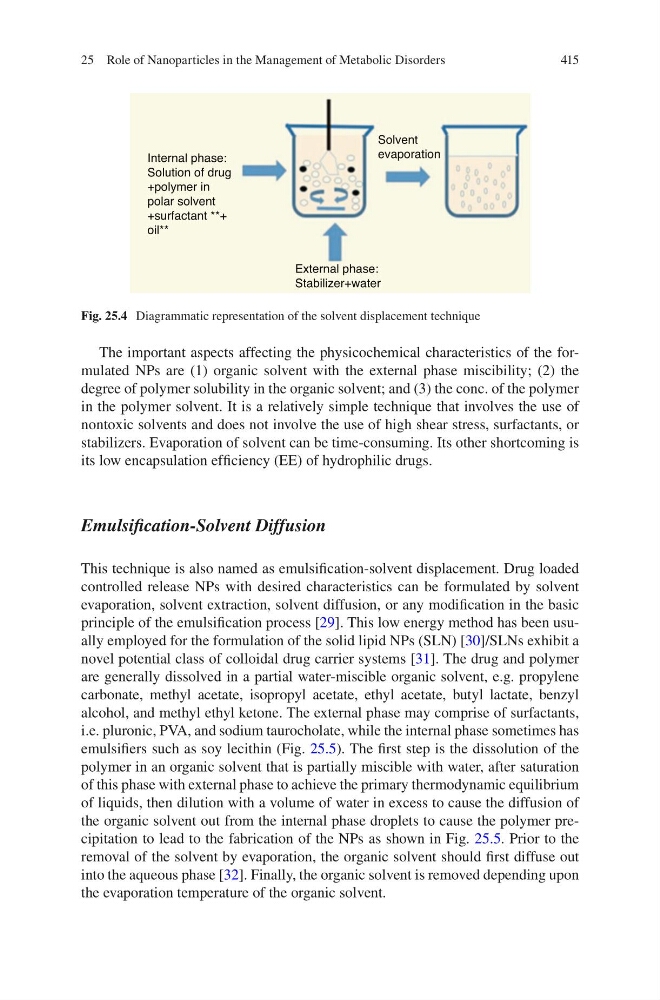
Internal phase:
Solution of drug
+polymer in
polar solvent
+surfactant **+
oil**
External phase:
Stabilizer+water
Solvent
evaporation
Fig. 25.4 Diagrammatic representation of the solvent displacement technique
25 Role of Nanoparticles in the Management of Metabolic Disorders
The important aspects affecting the physicochemical characteristics of the formulated NPs are (1) organic solvent with the external phase miscibility; (2) the
degree of polymer solubility in the organic solvent; and (3) the conc. of the polymer
in the polymer solvent. It is a relatively simple technique that involves the use of
nontoxic solvents and does not involve the use of high shear stress, surfactants, or
stabilizers. Evaporation of solvent can be time-consuming. Its other shortcoming is
its low encapsulation efficiency (EE) of hydrophilic drugs.
Emulsification-Solvent Diffusion
This technique is also named as emulsification-solvent displacement. Drug loaded
controlled release NPs with desired characteristics can be formulated by solvent
evaporation, solvent extraction, solvent diffusion, or any modification in the basic
principle of the emulsification process [29]. This low energy method has been usually employed for the formulation of the solid lipid NPs (SLN) [30]/SLNs exhibit a
novel potential class of colloidal drug carrier systems [31]. The drug and polymer
are generally dissolved in a partial water-miscible organic solvent, e.g. propylene
carbonate, methyl acetate, isopropyl acetate, ethyl acetate, butyl lactate, benzyl
alcohol, and methyl ethyl ketone. The external phase may comprise of surfactants,
i.e. pluronic, PVA, and sodium taurocholate, while the internal phase sometimes has
emulsifiers such as soy lecithin (Fig. 25.5). The first step is the dissolution of the
polymer in an organic solvent that is partially miscible with water, after saturation
of this phase with external phase to achieve the primary thermodynamic equilibrium
of liquids, then dilution with a volume of water in excess to cause the diffusion of
the organic solvent out from the internal phase droplets to cause the polymer precipitation to lead to the fabrication of the NPs as shown in Fig. 25.5. Prior to the
removal of the solvent by evaporation, the organic solvent should first diffuse out
into the aqueous phase [32]. Finally, the organic solvent is removed depending upon
the evaporation temperature of the organic solvent.
Internal phase:
Solution of drug
+polymer in
polar solvent
+surfactant **+
oil**
External phase:
Stabilizer+water
Solvent
evaporation
Fig. 25.4 Diagrammatic representation of the solvent displacement technique
25 Role of Nanoparticles in the Management of Metabolic Disorders