

414
Nanoprecipitation Method
It is feasible, reproducible, and widely employed techniques for the fabrication of
nanospheres. This approach is also named as the solvent displacement method [22]
and was first reported by [23]. This approach has been employed for the loading of
moieties (hydrophobic and hydrophilic). This approach employs polymer, solvent
for the polymer, and non-solvent for the polymer.
To improve the drug entrapment efficiency (EE) or to reduce the size of the NPs,
a modified nanoprecipitation method was used employing a co-solvent. The choice
of the organic solvents as polymer solvents (hexane, ethanol, dioxane, or acetone)
depends upon the characteristics of the solvent, i.e. water miscibility and easy
removal by evaporation. Therefore, in this approach the solvent that is usually
employed is acetone. The first step is the dissolution of the polymer and drug in a
water-miscible internal phase having intermediate polarity, e.g. ethanol/acetone.
The second step is the dropwise injection of the organic phase having drug and
polymer into a stirred external phase having a surfactant. NPs are formed instantaneously during the spontaneous diffusion of the organic phase into the external
phase, as revealed in Fig. 25.4. The common solvents used (ethanol, THF (tetrahydrofuran), and acetone) are usually removed by the evaporation process under
reduced pressure since their boiling points are lower than that of water [24]. Several
polymeric materials, i.e. PCL [25], PLA (polylactic acid) [26], and PLGA [27, 28]
have been employed in this technique.
Inner
aqueous
phase
(Drug+
Water)
W1
0
W1/0
Formation of the
primary(W1/0)
emulsion
Organic
phase
(Polymer
+Solvent)
External aqueous
phase
(Water+
Surfactant)
W2
Formation of the double
emulsion (W1/0/W2)
Solvent evaporation
W1/0/W2
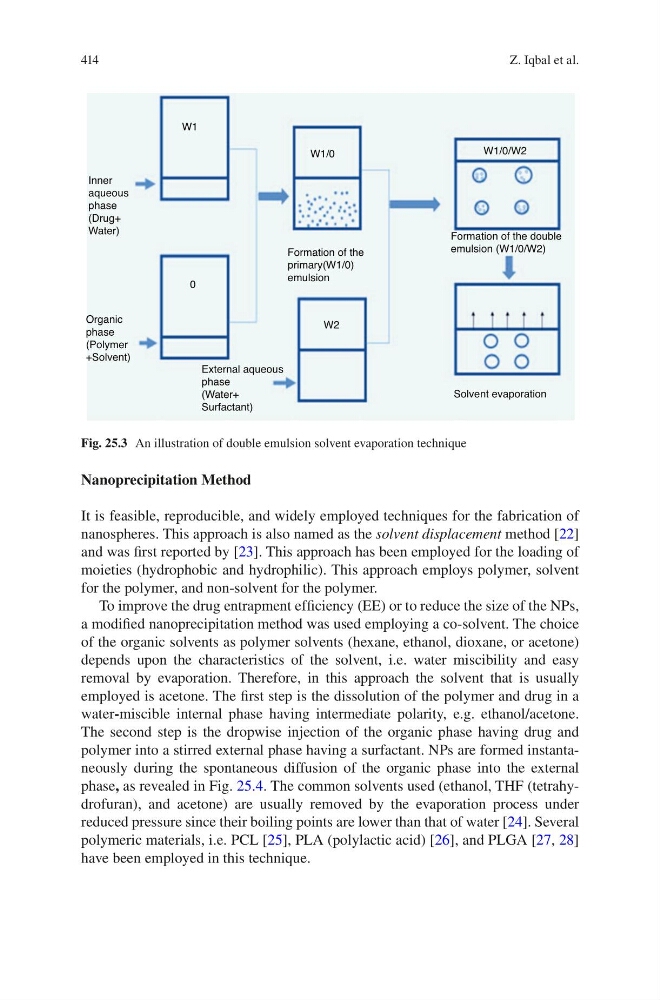
Fig. 25.3 An illustration of double emulsion solvent evaporation technique
Z. Iqbal et al.
Nanoprecipitation Method
It is feasible, reproducible, and widely employed techniques for the fabrication of
nanospheres. This approach is also named as the solvent displacement method [22]
and was first reported by [23]. This approach has been employed for the loading of
moieties (hydrophobic and hydrophilic). This approach employs polymer, solvent
for the polymer, and non-solvent for the polymer.
To improve the drug entrapment efficiency (EE) or to reduce the size of the NPs,
a modified nanoprecipitation method was used employing a co-solvent. The choice
of the organic solvents as polymer solvents (hexane, ethanol, dioxane, or acetone)
depends upon the characteristics of the solvent, i.e. water miscibility and easy
removal by evaporation. Therefore, in this approach the solvent that is usually
employed is acetone. The first step is the dissolution of the polymer and drug in a
water-miscible internal phase having intermediate polarity, e.g. ethanol/acetone.
The second step is the dropwise injection of the organic phase having drug and
polymer into a stirred external phase having a surfactant. NPs are formed instantaneously during the spontaneous diffusion of the organic phase into the external
phase, as revealed in Fig. 25.4. The common solvents used (ethanol, THF (tetrahydrofuran), and acetone) are usually removed by the evaporation process under
reduced pressure since their boiling points are lower than that of water [24]. Several
polymeric materials, i.e. PCL [25], PLA (polylactic acid) [26], and PLGA [27, 28]
have been employed in this technique.
Inner
aqueous
phase
(Drug+
Water)
W1
0
W1/0
Formation of the
primary(W1/0)
emulsion
Organic
phase
(Polymer
+Solvent)
External aqueous
phase
(Water+
Surfactant)
W2
Formation of the double
emulsion (W1/0/W2)
Solvent evaporation
W1/0/W2
Fig. 25.3 An illustration of double emulsion solvent evaporation technique
Z. Iqbal et al.