

286
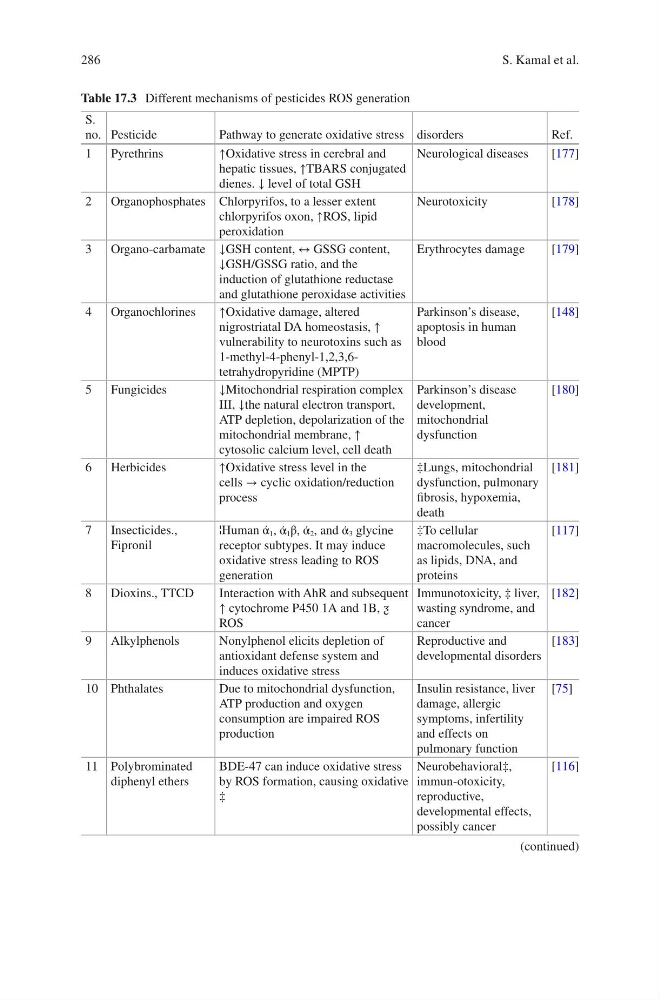
Table 17.3 Different mechanisms of pesticides ROS generation
S.
no. Pesticide
Pathway to generate oxidative stress disorders
Ref.
1 Pyrethrins
↑Oxidative stress in cerebral and
hepatic tissues, ↑TBARS conjugated
dienes. ↓ level of total GSH
Neurological diseases
[177]
2 Organophosphates Chlorpyrifos, to a lesser extent
chlorpyrifos oxon, ↑ROS, lipid
peroxidation
Neurotoxicity
[178]
3 Organo-carbamate ↓GSH content, ↔ GSSG content,
↓GSH/GSSG ratio, and the
induction of glutathione reductase
and glutathione peroxidase activities
Erythrocytes damage
[179]
4 Organochlorines
↑Oxidative damage, altered
nigrostriatal DA homeostasis, ↑
vulnerability to neurotoxins such as
1-methyl-4-phenyl-1,2,3,6tetrahydropyridine (MPTP)
Parkinson’s disease,
apoptosis in human
blood
[148]
5 Fungicides
↓Mitochondrial respiration complex
III, ↓the natural electron transport,
ATP depletion, depolarization of the
mitochondrial membrane, ↑
cytosolic calcium level, cell death
Parkinson’s disease
development,
mitochondrial
dysfunction
[180]
6 Herbicides
↑Oxidative stress level in the
cells → cyclic oxidation/reduction
process
‡Lungs, mitochondrial
dysfunction, pulmonary
fibrosis, hypoxemia,
death
[181]
7 Insecticides.,
Fipronil
¦Human ά 1 , ά 1 β, ά 2 , and ά 3 glycine
receptor subtypes. It may induce
oxidative stress leading to ROS
generation
‡To cellular
macromolecules, such
as lipids, DNA, and
proteins
[117]
8 Dioxins., TTCD
Interaction with AhR and subsequent
↑ cytochrome P450 1A and 1B, ƺ
ROS
Immunotoxicity, ‡ liver,
wasting syndrome, and
cancer
[182]
9 Alkylphenols
Nonylphenol elicits depletion of
antioxidant defense system and
induces oxidative stress
Reproductive and
developmental disorders
[183]
10 Phthalates
Due to mitochondrial dysfunction,
ATP production and oxygen
consumption are impaired ROS
production
Insulin resistance, liver
damage, allergic
symptoms, infertility
and effects on
pulmonary function
[75]
11 Polybrominated
diphenyl ethers
BDE-47 can induce oxidative stress
by ROS formation, causing oxidative
‡
Neurobehavioral‡,
immun-otoxicity,
reproductive,
developmental effects,
possibly cancer
[116]
(continued)
S. Kamal et al.
Table 17.3 Different mechanisms of pesticides ROS generation
S.
no. Pesticide
Pathway to generate oxidative stress disorders
Ref.
1 Pyrethrins
↑Oxidative stress in cerebral and
hepatic tissues, ↑TBARS conjugated
dienes. ↓ level of total GSH
Neurological diseases
[177]
2 Organophosphates Chlorpyrifos, to a lesser extent
chlorpyrifos oxon, ↑ROS, lipid
peroxidation
Neurotoxicity
[178]
3 Organo-carbamate ↓GSH content, ↔ GSSG content,
↓GSH/GSSG ratio, and the
induction of glutathione reductase
and glutathione peroxidase activities
Erythrocytes damage
[179]
4 Organochlorines
↑Oxidative damage, altered
nigrostriatal DA homeostasis, ↑
vulnerability to neurotoxins such as
1-methyl-4-phenyl-1,2,3,6tetrahydropyridine (MPTP)
Parkinson’s disease,
apoptosis in human
blood
[148]
5 Fungicides
↓Mitochondrial respiration complex
III, ↓the natural electron transport,
ATP depletion, depolarization of the
mitochondrial membrane, ↑
cytosolic calcium level, cell death
Parkinson’s disease
development,
mitochondrial
dysfunction
[180]
6 Herbicides
↑Oxidative stress level in the
cells → cyclic oxidation/reduction
process
‡Lungs, mitochondrial
dysfunction, pulmonary
fibrosis, hypoxemia,
death
[181]
7 Insecticides.,
Fipronil
¦Human ά 1 , ά 1 β, ά 2 , and ά 3 glycine
receptor subtypes. It may induce
oxidative stress leading to ROS
generation
‡To cellular
macromolecules, such
as lipids, DNA, and
proteins
[117]
8 Dioxins., TTCD
Interaction with AhR and subsequent
↑ cytochrome P450 1A and 1B, ƺ
ROS
Immunotoxicity, ‡ liver,
wasting syndrome, and
cancer
[182]
9 Alkylphenols
Nonylphenol elicits depletion of
antioxidant defense system and
induces oxidative stress
Reproductive and
developmental disorders
[183]
10 Phthalates
Due to mitochondrial dysfunction,
ATP production and oxygen
consumption are impaired ROS
production
Insulin resistance, liver
damage, allergic
symptoms, infertility
and effects on
pulmonary function
[75]
11 Polybrominated
diphenyl ethers
BDE-47 can induce oxidative stress
by ROS formation, causing oxidative
‡
Neurobehavioral‡,
immun-otoxicity,
reproductive,
developmental effects,
possibly cancer
[116]
(continued)
S. Kamal et al.