

278
P450 superfamily (CYPs) involved in phase I metabolism. Other enzymes like flavin
monooxygenases, amine oxidases, xanthine oxidases, peroxidase cause the oxidation
of different functional groups whereas hydrolytic reactions are carried out by epoxide
hydrolase and carboxylases (Fig. 17.6).
After phase I, the products do not eradicate quickly, but have to go towards other
successive reactions in which substrate like glucuronic acid, sulfuric acid, acetic
acid, or an amino acid joins with the exposed functional group to synthesize highly
polar molecules that makes their excretion very easy [55]. Enzymes are classified
into phase I oxidative, phase II conjugative, or phase III transporters on the basis of
pesticide degradation mechanism in the human body. Enzymes of phase I produce
such functional groups that may provide exposed site for conjugation by UDPglucuronosyltransferases (UGT), sulfotransferases (SULT), glutathione
S-transferase (GST), and N-acetyltransferase (NAT) of phase II enzymes.
Enzymatic metabolism of pesticides is an indispensable process for transformation
of lipophilic foreign compound into water-soluble products that can be easily
excreted in urine. Expression of phase III transporters such as P-glycoprotein
(Pgp), multidrug resistance associated proteins (MRPs), and organic anion transporting polypeptide 2 (OATP2) can be visualized in the liver, intestine, kidney, and
brain where they play a crucial role in pesticide distribution, absorption, and
excretion.
In addition to phase I and phase II reactions, induction, inhibition, or pretreatment with many inducers along with various inhibitors exhibit the change in the
expression of phase III transporters, leading to final elimination of pesticides from
the body. Exposure of pesticides to phase I, phase II, and phase III inducers may
cause the activation of cellular stress that boost the gene expression, which facilitates the removal of pesticides [56].
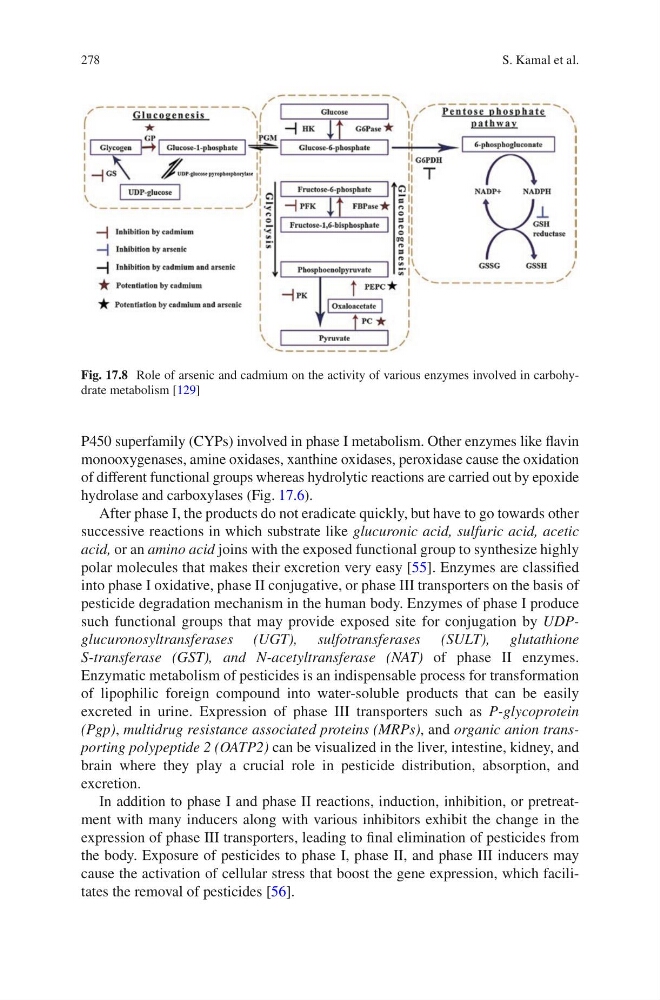
Fig. 17.8 Role of arsenic and cadmium on the activity of various enzymes involved in carbohydrate metabolism [129]
S. Kamal et al.
P450 superfamily (CYPs) involved in phase I metabolism. Other enzymes like flavin
monooxygenases, amine oxidases, xanthine oxidases, peroxidase cause the oxidation
of different functional groups whereas hydrolytic reactions are carried out by epoxide
hydrolase and carboxylases (Fig. 17.6).
After phase I, the products do not eradicate quickly, but have to go towards other
successive reactions in which substrate like glucuronic acid, sulfuric acid, acetic
acid, or an amino acid joins with the exposed functional group to synthesize highly
polar molecules that makes their excretion very easy [55]. Enzymes are classified
into phase I oxidative, phase II conjugative, or phase III transporters on the basis of
pesticide degradation mechanism in the human body. Enzymes of phase I produce
such functional groups that may provide exposed site for conjugation by UDPglucuronosyltransferases (UGT), sulfotransferases (SULT), glutathione
S-transferase (GST), and N-acetyltransferase (NAT) of phase II enzymes.
Enzymatic metabolism of pesticides is an indispensable process for transformation
of lipophilic foreign compound into water-soluble products that can be easily
excreted in urine. Expression of phase III transporters such as P-glycoprotein
(Pgp), multidrug resistance associated proteins (MRPs), and organic anion transporting polypeptide 2 (OATP2) can be visualized in the liver, intestine, kidney, and
brain where they play a crucial role in pesticide distribution, absorption, and
excretion.
In addition to phase I and phase II reactions, induction, inhibition, or pretreatment with many inducers along with various inhibitors exhibit the change in the
expression of phase III transporters, leading to final elimination of pesticides from
the body. Exposure of pesticides to phase I, phase II, and phase III inducers may
cause the activation of cellular stress that boost the gene expression, which facilitates the removal of pesticides [56].
Fig. 17.8 Role of arsenic and cadmium on the activity of various enzymes involved in carbohydrate metabolism [129]
S. Kamal et al.