

277
[WHO, 2012] different types of cancer, i.e., prostate, breast, testicular cancer,
etc., [43] increased risks of testicular germ-cell tumors [44], female reproductive
dysfunction [45], decreased semen quality, hypospadias, and behavioral or cognitive deficits are associated with chronic exposure of lower concentration of
pesticide [46]. However, othet behavioral and cognitive deficits are related with
severe deficiencies of thyroid hormone which are strongly associated with
bisphenol A, phthalates, PBDEs, perfluorinated chemicals, and PCBs [47].
International Agency for cancer research investigated that pesticides like lindane
(g-hexachlorohexane, HCH), OCs, and DDT are potent carcinogens [48].
Pesticides as EDCs
Organochlorine pesticides including DDT, lindane, chlordane, dieldrin, etc., influencing the nervous system, reproductive and immune system are actually endocrine-disrupting chemicals (EDCs) [49]. Very strong evidence regarding relationship
between metabolic disorders and pesticide is present. EDCs (Fig. 17.5) are associated with obesogens, higher body weight, NIDDM, metabolic syndromes, hypertension, atherosclerosis, increased TGs [50]. Approximately 31% fungicides, 46%
herbicides, and 21% herbicides are identified as EDCs [51]. Ten EDCs like maneb,
zineb, penta chloronitrobenzene, prodiamine, amitrole, etc., are strong inhibitors of
thyroid hormone [52].
Metabolism of Pesticides
Enzymatic catalysis converts pesticides into hydrophilic intermediates via phase I and
phase II [53, 54]. Enzymes in phase I are usually the members of cytochrome P450
family, e.g., heme-thiolate proteins are the major enzymes belong to cytochrome
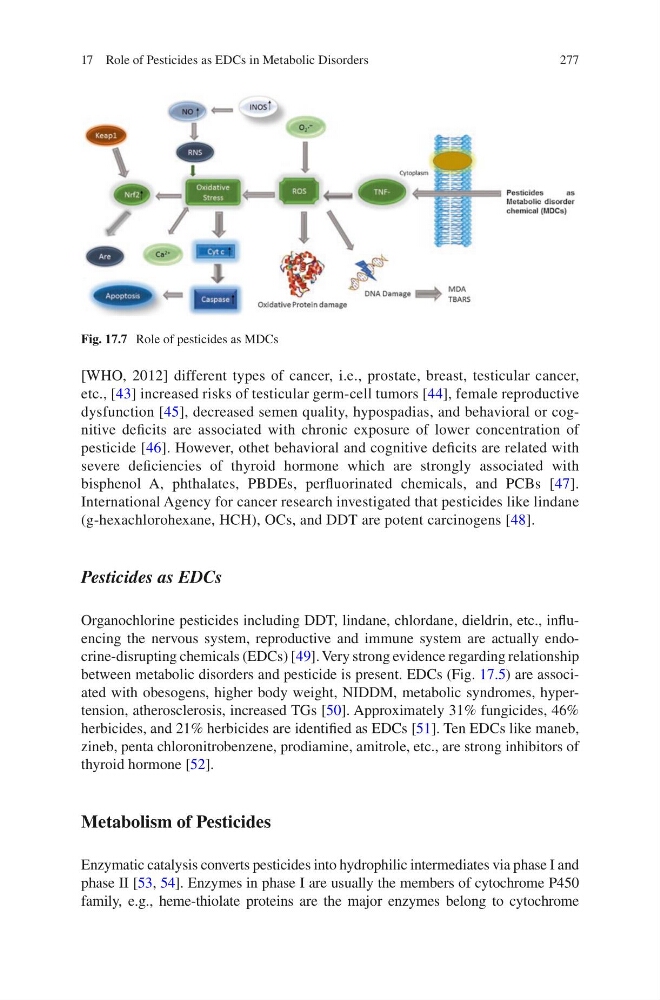
Fig. 17.7 Role of pesticides as MDCs
17 Role of Pesticides as EDCs in Metabolic Disorders
[WHO, 2012] different types of cancer, i.e., prostate, breast, testicular cancer,
etc., [43] increased risks of testicular germ-cell tumors [44], female reproductive
dysfunction [45], decreased semen quality, hypospadias, and behavioral or cognitive deficits are associated with chronic exposure of lower concentration of
pesticide [46]. However, othet behavioral and cognitive deficits are related with
severe deficiencies of thyroid hormone which are strongly associated with
bisphenol A, phthalates, PBDEs, perfluorinated chemicals, and PCBs [47].
International Agency for cancer research investigated that pesticides like lindane
(g-hexachlorohexane, HCH), OCs, and DDT are potent carcinogens [48].
Pesticides as EDCs
Organochlorine pesticides including DDT, lindane, chlordane, dieldrin, etc., influencing the nervous system, reproductive and immune system are actually endocrine-disrupting chemicals (EDCs) [49]. Very strong evidence regarding relationship
between metabolic disorders and pesticide is present. EDCs (Fig. 17.5) are associated with obesogens, higher body weight, NIDDM, metabolic syndromes, hypertension, atherosclerosis, increased TGs [50]. Approximately 31% fungicides, 46%
herbicides, and 21% herbicides are identified as EDCs [51]. Ten EDCs like maneb,
zineb, penta chloronitrobenzene, prodiamine, amitrole, etc., are strong inhibitors of
thyroid hormone [52].
Metabolism of Pesticides
Enzymatic catalysis converts pesticides into hydrophilic intermediates via phase I and
phase II [53, 54]. Enzymes in phase I are usually the members of cytochrome P450
family, e.g., heme-thiolate proteins are the major enzymes belong to cytochrome
Fig. 17.7 Role of pesticides as MDCs
17 Role of Pesticides as EDCs in Metabolic Disorders