

279
Role of Pesticides as EDC in Metabolic Disorders (MDs)
Various pesticides like DDT, DDE, HTPE have ability to significantly amend the
gene expression, alter the secretion of hormones, volume or number of adipocytes,
body weights and function of adipose tissues, location of cells, signaling pathways
after exposure [57]. Altered genes lead to improper balance between different cell
types, organ structure, hormonal signaling, variation in cell number that increases
the susceptibly to dysfunctions or diseases throughout the life (Fig. 17.7). Growth
factors and hormones are chiefly responsible for the developmental process; therefore, developing organisms are extremely sensitive to agitations created by these
pesticides [58]. Most pronounced adverse effects of these pesticides are seen in
development with far below levels of pesticides than in adulthood. The sensitivity in
development stage is due to the absence of protective mechanisms, i.e., fully functional immune system, detoxify enzymes, blood–brain barriers in newborns [59].
Furthermore, high metabolic rates in development stage may also aggravate the
process of toxicity [60]. Another important reason for sensitivity in developmental
stages for pesticides is the epigenetic signaling which provides the biochemical
basis for the adverse effects of pesticides during maturation [61]. Effect of pesticides on epigenetic signaling, e.g., histone markers, DNA methylation, chromatin
remolding, etc., may alter the tissue programming causing obesity [62]. As gene
expression is altered due to growth factors, irregular/untimed expression of genes
but epigenetics causes the permanent change in gene expression [60]. Strong evidences are present to correlate many chronic diseases including NIDDM, MetS, and
obesity with epigenetic amendments under the influence of environmental factors,
i.e., chemicals, stress, nutrition, drugs, etc. [63].
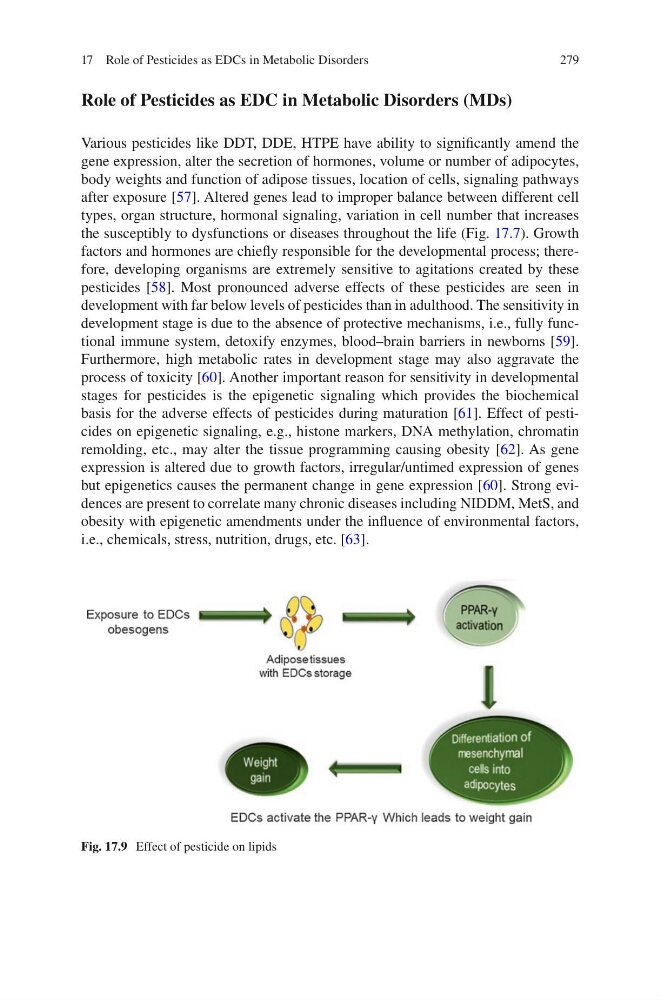
Fig. 17.9 Effect of pesticide on lipids
17 Role of Pesticides as EDCs in Metabolic Disorders
Role of Pesticides as EDC in Metabolic Disorders (MDs)
Various pesticides like DDT, DDE, HTPE have ability to significantly amend the
gene expression, alter the secretion of hormones, volume or number of adipocytes,
body weights and function of adipose tissues, location of cells, signaling pathways
after exposure [57]. Altered genes lead to improper balance between different cell
types, organ structure, hormonal signaling, variation in cell number that increases
the susceptibly to dysfunctions or diseases throughout the life (Fig. 17.7). Growth
factors and hormones are chiefly responsible for the developmental process; therefore, developing organisms are extremely sensitive to agitations created by these
pesticides [58]. Most pronounced adverse effects of these pesticides are seen in
development with far below levels of pesticides than in adulthood. The sensitivity in
development stage is due to the absence of protective mechanisms, i.e., fully functional immune system, detoxify enzymes, blood–brain barriers in newborns [59].
Furthermore, high metabolic rates in development stage may also aggravate the
process of toxicity [60]. Another important reason for sensitivity in developmental
stages for pesticides is the epigenetic signaling which provides the biochemical
basis for the adverse effects of pesticides during maturation [61]. Effect of pesticides on epigenetic signaling, e.g., histone markers, DNA methylation, chromatin
remolding, etc., may alter the tissue programming causing obesity [62]. As gene
expression is altered due to growth factors, irregular/untimed expression of genes
but epigenetics causes the permanent change in gene expression [60]. Strong evidences are present to correlate many chronic diseases including NIDDM, MetS, and
obesity with epigenetic amendments under the influence of environmental factors,
i.e., chemicals, stress, nutrition, drugs, etc. [63].
Fig. 17.9 Effect of pesticide on lipids
17 Role of Pesticides as EDCs in Metabolic Disorders