

5
system of endocrine glands and their hormones is collectively known as endocrine
system [2].
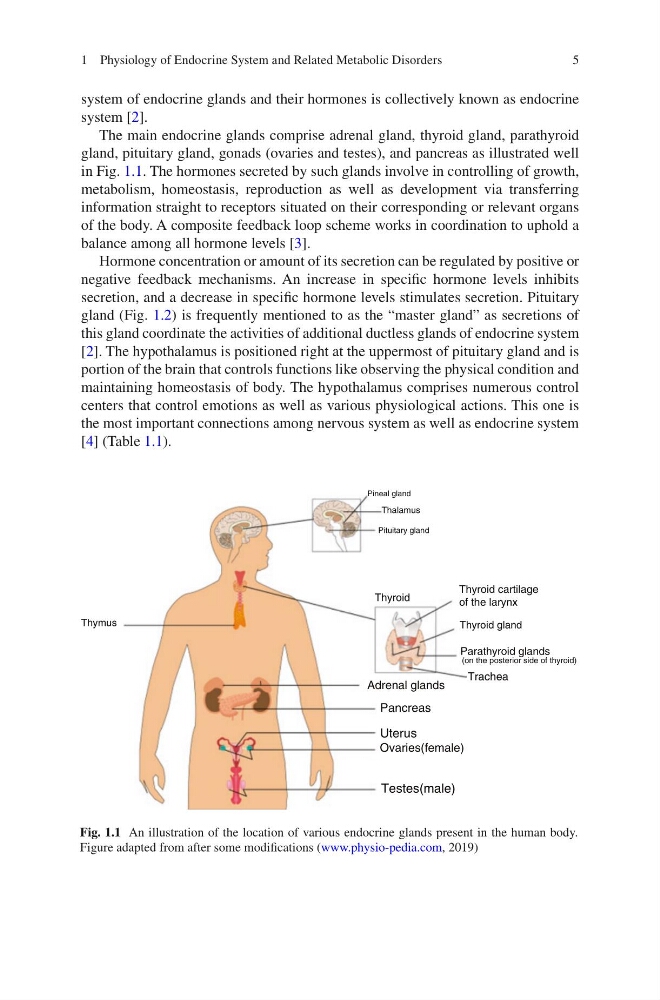
The main endocrine glands comprise adrenal gland, thyroid gland, parathyroid
gland, pituitary gland, gonads (ovaries and testes), and pancreas as illustrated well
in Fig. 1.1. The hormones secreted by such glands involve in controlling of growth,
metabolism, homeostasis, reproduction as well as development via transferring
information straight to receptors situated on their corresponding or relevant organs
of the body. A composite feedback loop scheme works in coordination to uphold a
balance among all hormone levels [3].
Hormone concentration or amount of its secretion can be regulated by positive or
negative feedback mechanisms. An increase in specific hormone levels inhibits
secretion, and a decrease in specific hormone levels stimulates secretion. Pituitary
gland (Fig. 1.2) is frequently mentioned to as the “master gland” as secretions of
this gland coordinate the activities of additional ductless glands of endocrine system
[2]. The hypothalamus is positioned right at the uppermost of pituitary gland and is
portion of the brain that controls functions like observing the physical condition and
maintaining homeostasis of body. The hypothalamus comprises numerous control
centers that control emotions as well as various physiological actions. This one is
the most important connections among nervous system as well as endocrine system
[4] (Table 1.1).
Thymus
Pineal gland
Thalamus
Pituitary gland
Thyroid
Thyroid cartilage
of the larynx
Thyroid gland
Parathyroid glands
(on the posterior side of thyroid)
Trachea
Adrenal glands
Pancreas
Uterus
Ovaries(female)
Testes(male)
Fig. 1.1 An illustration of the location of various endocrine glands present in the human body.
Figure adapted from after some modifications (www.physio-pedia.com, 2019)
1 Physiology of Endocrine System and Related Metabolic Disorders
system of endocrine glands and their hormones is collectively known as endocrine
system [2].
The main endocrine glands comprise adrenal gland, thyroid gland, parathyroid
gland, pituitary gland, gonads (ovaries and testes), and pancreas as illustrated well
in Fig. 1.1. The hormones secreted by such glands involve in controlling of growth,
metabolism, homeostasis, reproduction as well as development via transferring
information straight to receptors situated on their corresponding or relevant organs
of the body. A composite feedback loop scheme works in coordination to uphold a
balance among all hormone levels [3].
Hormone concentration or amount of its secretion can be regulated by positive or
negative feedback mechanisms. An increase in specific hormone levels inhibits
secretion, and a decrease in specific hormone levels stimulates secretion. Pituitary
gland (Fig. 1.2) is frequently mentioned to as the “master gland” as secretions of
this gland coordinate the activities of additional ductless glands of endocrine system
[2]. The hypothalamus is positioned right at the uppermost of pituitary gland and is
portion of the brain that controls functions like observing the physical condition and
maintaining homeostasis of body. The hypothalamus comprises numerous control
centers that control emotions as well as various physiological actions. This one is
the most important connections among nervous system as well as endocrine system
[4] (Table 1.1).
Thymus
Pineal gland
Thalamus
Pituitary gland
Thyroid
Thyroid cartilage
of the larynx
Thyroid gland
Parathyroid glands
(on the posterior side of thyroid)
Trachea
Adrenal glands
Pancreas
Uterus
Ovaries(female)
Testes(male)
Fig. 1.1 An illustration of the location of various endocrine glands present in the human body.
Figure adapted from after some modifications (www.physio-pedia.com, 2019)
1 Physiology of Endocrine System and Related Metabolic Disorders