

in. (50 cm) and lamellae (E and Bt) to more than 79 in.
(200 cm).
The Roscommon, Deford, and Tobico soil series are
common Psammaquents on all of the Great Lakes, except
Lake Ontario. The Jeske soil series, a Typic Psammaquents
is shown in Fig. 5.18. Derived from glaciofluvial sediments
over sandstone bedrock, the Jeske soil series has a thin (3 in.;
8 cm) organic layer over pink sandy material (C horizon),
with weathered sandstone bedrock occurring at 28 in.
(70 cm).
The Quetico and Cosad soil series are common Udorthents in the GLCZ. The Quetico soil series (Fig. 5.19) is
derived from 7 in. (18 cm) of loamy, noncalcareous drift
over granite bedrock. The profile contains a thin organic
layer over dark brown Bw horizon. The underlying granite
bedrock is striated from the passing of the glacier.
Other common soils series common along the Great
Lakes are in the Quartzipsamments (Nordhouse) and
Endoaquents (Brevort) great groups. The Levasseur soil
series (Fig. 5.20) is an Aeric Endoaquents that is common
on Isle Royale and the Keweenaw Peninsula on Lake
Superior. It has formed from glaciofluvial deposits over the
Jacobsville sandstone. The profile is compressed into a thin
organic layer (O horizon) over a dark reddish gray E horizon
(upper two-third of shovel blade), and a dark yellowish
brown Bw horizon.
Entisols are roughly split in the mesic and frigid
soil-temperature classes. Entisols tend to be coarse-textured
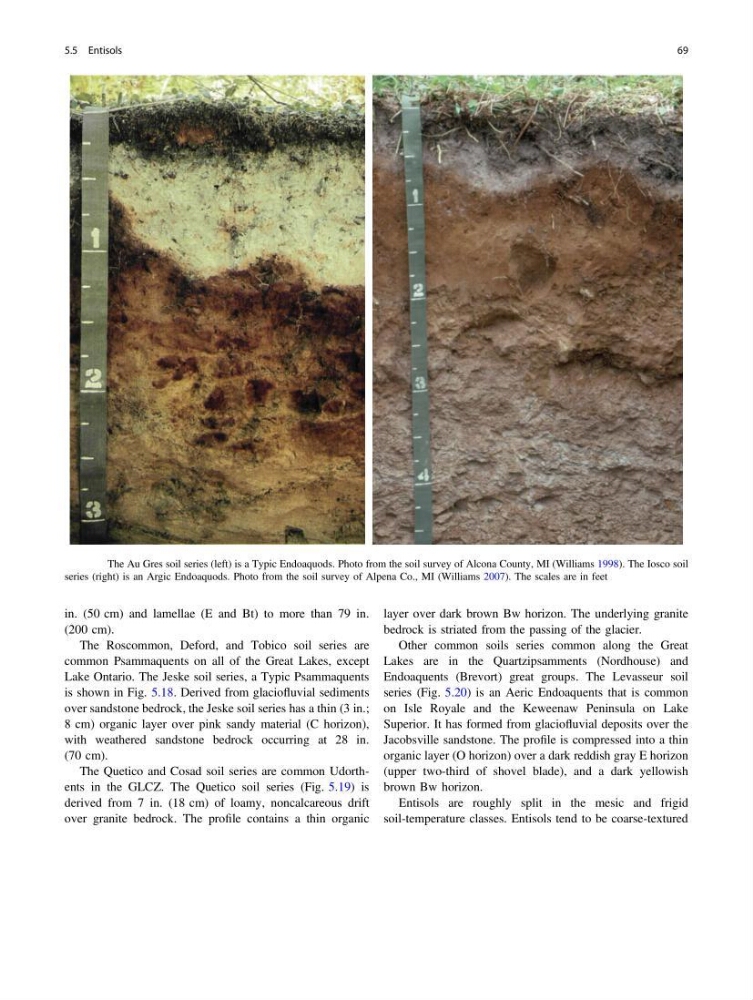
Fig. 5.7 The Au Gres soil series (left) is a Typic Endoaquods. Photo from the soil survey of Alcona County, MI (Williams 1998). The Iosco soil
series (right) is an Argic Endoaquods. Photo from the soil survey of Alpena Co., MI (Williams 2007). The scales are in feet
5.5 Entisols
69
(200 cm).
The Roscommon, Deford, and Tobico soil series are
common Psammaquents on all of the Great Lakes, except
Lake Ontario. The Jeske soil series, a Typic Psammaquents
is shown in Fig. 5.18. Derived from glaciofluvial sediments
over sandstone bedrock, the Jeske soil series has a thin (3 in.;
8 cm) organic layer over pink sandy material (C horizon),
with weathered sandstone bedrock occurring at 28 in.
(70 cm).
The Quetico and Cosad soil series are common Udorthents in the GLCZ. The Quetico soil series (Fig. 5.19) is
derived from 7 in. (18 cm) of loamy, noncalcareous drift
over granite bedrock. The profile contains a thin organic
layer over dark brown Bw horizon. The underlying granite
bedrock is striated from the passing of the glacier.
Other common soils series common along the Great
Lakes are in the Quartzipsamments (Nordhouse) and
Endoaquents (Brevort) great groups. The Levasseur soil
series (Fig. 5.20) is an Aeric Endoaquents that is common
on Isle Royale and the Keweenaw Peninsula on Lake
Superior. It has formed from glaciofluvial deposits over the
Jacobsville sandstone. The profile is compressed into a thin
organic layer (O horizon) over a dark reddish gray E horizon
(upper two-third of shovel blade), and a dark yellowish
brown Bw horizon.
Entisols are roughly split in the mesic and frigid
soil-temperature classes. Entisols tend to be coarse-textured
Fig. 5.7 The Au Gres soil series (left) is a Typic Endoaquods. Photo from the soil survey of Alcona County, MI (Williams 1998). The Iosco soil
series (right) is an Argic Endoaquods. Photo from the soil survey of Alpena Co., MI (Williams 2007). The scales are in feet
5.5 Entisols
69