

occur in the underlying sand to a depth of more than 80 in.
(203 cm).
The Sabattis soil series (Fig. 5.16) is a Histic Humaquepts that is common on till plains of Lake Superior. Formed
from loamy materials over sandy loam till, the Sabattis soil
series has a black Oa, a dark grayish brown AB, and a Bg
horizon to a depth of 21 in. (53 cm).
Nearly two thirds (61%) of the Inceptisols have a mesic
soil-temperature regime; the others (39%) have a frigid
soil-temperature class. Nearly two-thirds (65%) of the
Inceptisols in the GLCZ are in loamy (coarse-loamy,
fine-loamy, loamy, loamy-skeletal) particle-size classes.
More than three-quarters (81%) of the Great Lakes Inceptisols are in the mixed soil mineral class; and 75% are in
semiactive, active, or superactive CEC activity classes.
The vegetation on Inceptisols is variable, including temperate mixed forest (38%), lowland mixed forest (24%),
temperate broad-leaved forest (21%), lowland broad-leaved
forest (16%), and nonforested wetlands (2%). The predominant parent materials for Great Lakes Inceptisols include till
(39%), lacustrine-glaciolacustrine sediments (38%), alluvium (10%), and outwash (5.6%). Predominant landforms
include lake terrace-plains (39%), moraine-till plains (30%),
glacial lake benches (10%), alluvial fans-floodplains (9%),
and outwash plains (9%). Many Inceptisols have a cambic
horizon that requires < 5.3 kyr to form (see Figs. 4.16 and
4.17).
Analytical data for soil series representative of six of the
seven great groups of Inceptisols in the GLCZ are provided
in Table 5.3. The key properties are the presence of a cambic
horizon, or in the case of Sodus soil series a fragipan
(Bx) and the Newton soil series an umbric (Ap, A1, and A2)
horizon. The analytical properties of Inceptisols are quite
variable, since these soils represent early stages in soil
development.
5.5
Entisols
Nearly two-thirds (62%) of the Entisols in the Great Lakes
region are well-drained Psamments, Orthents, or Fluvents;
the remaining 38% are Aquents. Entisols are most common
on Lakes Michigan, Superior, and Huron and least common
on Lakes Ontario and Erie. The dominant great groups are
Udipsamments (36%), Psammaquents (22%), and Udorthents (18%).
The Plainfield, Oakville, Deer Park, Tyner, Colonie,
Elnora, Wurtsmith, and Eastport soil series are common
Udipsamments, occurring on all of the Great Lakes. The
Deer Park (Spodic), Plainfield (Typic), and Coloma
(Lamellic) soil series are shown in Fig. 5.17. The Deer Park
soil series (Fig. 5.17a) is derived from eolian materials (sand
dunes) or beach ridges and is composed of a thick, pale
brown E horizon over a brown spodic-like Bs horizon to a
depth of 38 in. (97 cm). The Plainfield soil series
(Fig. 5.17b) is formed from sandy outwash and contains a
dark brown A horizon, a brown Bw horizon (to 22 in.;
56 cm), a brown BC (transitional) horizon to 36 in. (91 cm),
and a yellowish brown C horizon. The Coloma soil series
(Fig. 5.17c) is derived from sandy till and features a thin,
very dark brown A horizon over brown Bw horizons to 20
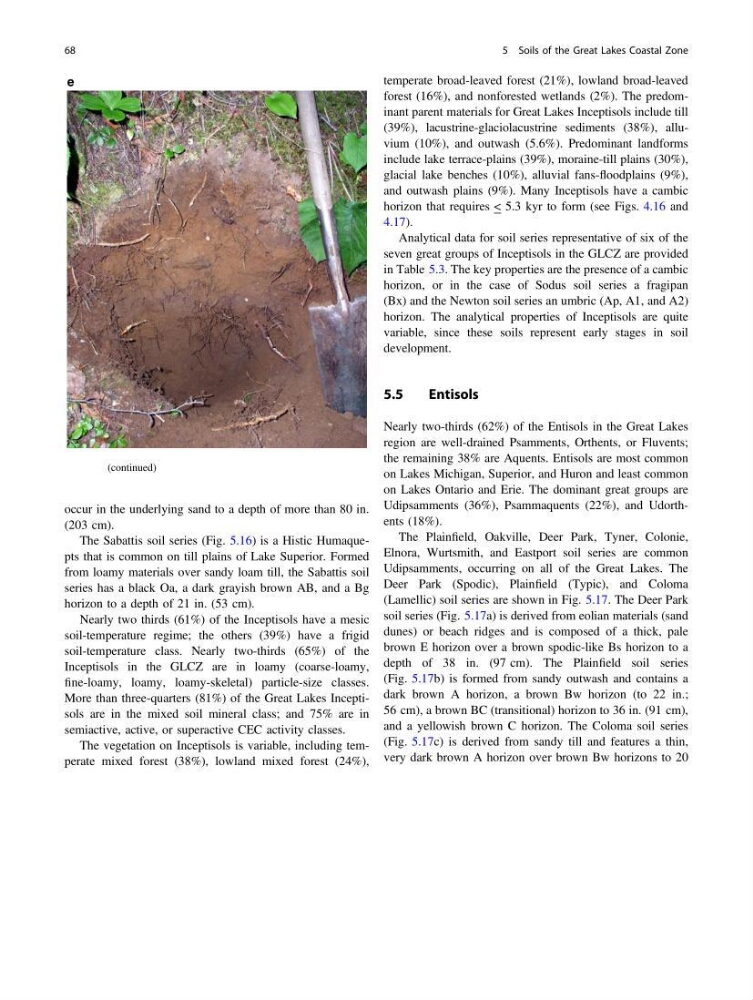
e
Fig. 5.6 (continued)
68
5 Soils of the Great Lakes Coastal Zone
(203 cm).
The Sabattis soil series (Fig. 5.16) is a Histic Humaquepts that is common on till plains of Lake Superior. Formed
from loamy materials over sandy loam till, the Sabattis soil
series has a black Oa, a dark grayish brown AB, and a Bg
horizon to a depth of 21 in. (53 cm).
Nearly two thirds (61%) of the Inceptisols have a mesic
soil-temperature regime; the others (39%) have a frigid
soil-temperature class. Nearly two-thirds (65%) of the
Inceptisols in the GLCZ are in loamy (coarse-loamy,
fine-loamy, loamy, loamy-skeletal) particle-size classes.
More than three-quarters (81%) of the Great Lakes Inceptisols are in the mixed soil mineral class; and 75% are in
semiactive, active, or superactive CEC activity classes.
The vegetation on Inceptisols is variable, including temperate mixed forest (38%), lowland mixed forest (24%),
temperate broad-leaved forest (21%), lowland broad-leaved
forest (16%), and nonforested wetlands (2%). The predominant parent materials for Great Lakes Inceptisols include till
(39%), lacustrine-glaciolacustrine sediments (38%), alluvium (10%), and outwash (5.6%). Predominant landforms
include lake terrace-plains (39%), moraine-till plains (30%),
glacial lake benches (10%), alluvial fans-floodplains (9%),
and outwash plains (9%). Many Inceptisols have a cambic
horizon that requires < 5.3 kyr to form (see Figs. 4.16 and
4.17).
Analytical data for soil series representative of six of the
seven great groups of Inceptisols in the GLCZ are provided
in Table 5.3. The key properties are the presence of a cambic
horizon, or in the case of Sodus soil series a fragipan
(Bx) and the Newton soil series an umbric (Ap, A1, and A2)
horizon. The analytical properties of Inceptisols are quite
variable, since these soils represent early stages in soil
development.
5.5
Entisols
Nearly two-thirds (62%) of the Entisols in the Great Lakes
region are well-drained Psamments, Orthents, or Fluvents;
the remaining 38% are Aquents. Entisols are most common
on Lakes Michigan, Superior, and Huron and least common
on Lakes Ontario and Erie. The dominant great groups are
Udipsamments (36%), Psammaquents (22%), and Udorthents (18%).
The Plainfield, Oakville, Deer Park, Tyner, Colonie,
Elnora, Wurtsmith, and Eastport soil series are common
Udipsamments, occurring on all of the Great Lakes. The
Deer Park (Spodic), Plainfield (Typic), and Coloma
(Lamellic) soil series are shown in Fig. 5.17. The Deer Park
soil series (Fig. 5.17a) is derived from eolian materials (sand
dunes) or beach ridges and is composed of a thick, pale
brown E horizon over a brown spodic-like Bs horizon to a
depth of 38 in. (97 cm). The Plainfield soil series
(Fig. 5.17b) is formed from sandy outwash and contains a
dark brown A horizon, a brown Bw horizon (to 22 in.;
56 cm), a brown BC (transitional) horizon to 36 in. (91 cm),
and a yellowish brown C horizon. The Coloma soil series
(Fig. 5.17c) is derived from sandy till and features a thin,
very dark brown A horizon over brown Bw horizons to 20
e
Fig. 5.6 (continued)
68
5 Soils of the Great Lakes Coastal Zone