

construct great-group names. An Endoaqualf features a high
water table; a Quartzipsamment is derived from quartz-rich
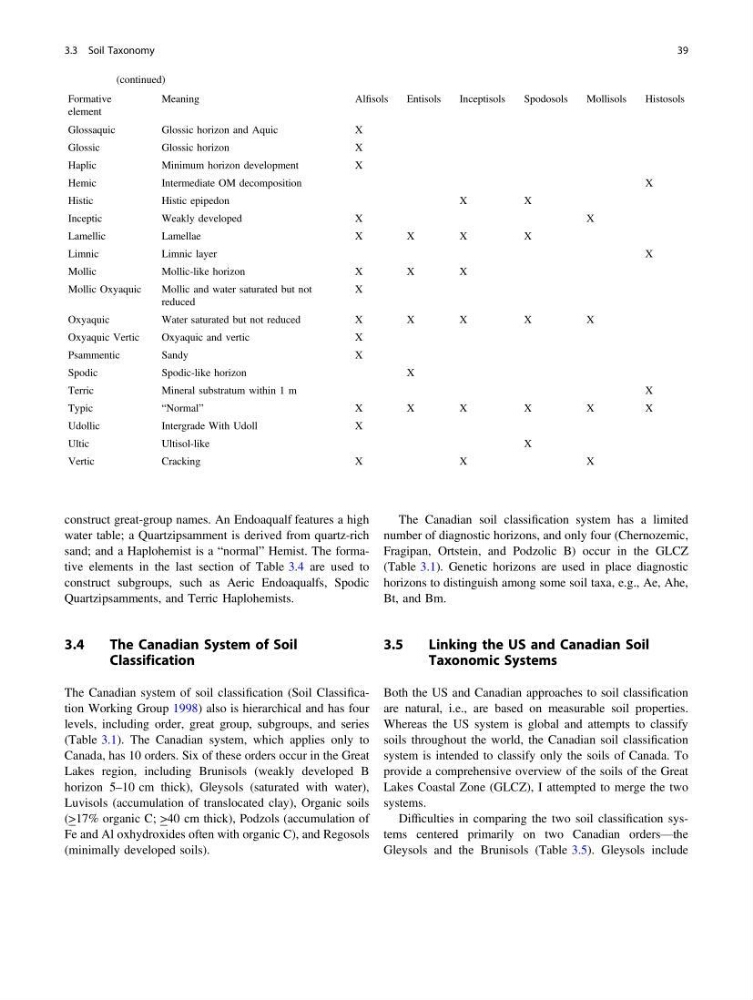
sand; and a Haplohemist is a “normal” Hemist. The formative elements in the last section of Table 3.4 are used to
construct subgroups, such as Aeric Endoaqualfs, Spodic
Quartzipsamments, and Terric Haplohemists.
3.4
The Canadian System of Soil
Classification
The Canadian system of soil classification (Soil Classification Working Group 1998) also is hierarchical and has four
levels, including order, great group, subgroups, and series
(Table 3.1). The Canadian system, which applies only to
Canada, has 10 orders. Six of these orders occur in the Great
Lakes region, including Brunisols (weakly developed B
horizon 5–10 cm thick), Gleysols (saturated with water),
Luvisols (accumulation of translocated clay), Organic soils
(>17% organic C; >40 cm thick), Podzols (accumulation of
Fe and Al oxhydroxides often with organic C), and Regosols
(minimally developed soils).
The Canadian soil classification system has a limited
number of diagnostic horizons, and only four (Chernozemic,
Fragipan, Ortstein, and Podzolic B) occur in the GLCZ
(Table 3.1). Genetic horizons are used in place diagnostic
horizons to distinguish among some soil taxa, e.g., Ae, Ahe,
Bt, and Bm.
3.5
Linking the US and Canadian Soil
Taxonomic Systems
Both the US and Canadian approaches to soil classification
are natural, i.e., are based on measurable soil properties.
Whereas the US system is global and attempts to classify
soils throughout the world, the Canadian soil classification
system is intended to classify only the soils of Canada. To
provide a comprehensive overview of the soils of the Great
Lakes Coastal Zone (GLCZ), I attempted to merge the two
systems.
Difficulties in comparing the two soil classification systems centered primarily on two Canadian orders—the
Gleysols and the Brunisols (Table 3.5). Gleysols include
Table 3.4 (continued)
Formative
element
Meaning
Alfisols
Entisols
Inceptisols
Spodosols
Mollisols
Histosols
Glossaquic
Glossic horizon and Aquic
X
Glossic
Glossic horizon
X
Haplic
Minimum horizon development
X
Hemic
Intermediate OM decomposition
X
Histic
Histic epipedon
X
X
Inceptic
Weakly developed
X
X
Lamellic
Lamellae
X
X
X
X
Limnic
Limnic layer
X
Mollic
Mollic-like horizon
X
X
X
Mollic Oxyaquic
Mollic and water saturated but not
reduced
X
Oxyaquic
Water saturated but not reduced
X
X
X
X
X
Oxyaquic Vertic
Oxyaquic and vertic
X
Psammentic
Sandy
X
Spodic
Spodic-like horizon
X
Terric
Mineral substratum within 1 m
X
Typic
“Normal”
X
X
X
X
X
X
Udollic
Intergrade With Udoll
X
Ultic
Ultisol-like
X
Vertic
Cracking
X
X
X
3.3 Soil Taxonomy
39
water table; a Quartzipsamment is derived from quartz-rich
sand; and a Haplohemist is a “normal” Hemist. The formative elements in the last section of Table 3.4 are used to
construct subgroups, such as Aeric Endoaqualfs, Spodic
Quartzipsamments, and Terric Haplohemists.
3.4
The Canadian System of Soil
Classification
The Canadian system of soil classification (Soil Classification Working Group 1998) also is hierarchical and has four
levels, including order, great group, subgroups, and series
(Table 3.1). The Canadian system, which applies only to
Canada, has 10 orders. Six of these orders occur in the Great
Lakes region, including Brunisols (weakly developed B
horizon 5–10 cm thick), Gleysols (saturated with water),
Luvisols (accumulation of translocated clay), Organic soils
(>17% organic C; >40 cm thick), Podzols (accumulation of
Fe and Al oxhydroxides often with organic C), and Regosols
(minimally developed soils).
The Canadian soil classification system has a limited
number of diagnostic horizons, and only four (Chernozemic,
Fragipan, Ortstein, and Podzolic B) occur in the GLCZ
(Table 3.1). Genetic horizons are used in place diagnostic
horizons to distinguish among some soil taxa, e.g., Ae, Ahe,
Bt, and Bm.
3.5
Linking the US and Canadian Soil
Taxonomic Systems
Both the US and Canadian approaches to soil classification
are natural, i.e., are based on measurable soil properties.
Whereas the US system is global and attempts to classify
soils throughout the world, the Canadian soil classification
system is intended to classify only the soils of Canada. To
provide a comprehensive overview of the soils of the Great
Lakes Coastal Zone (GLCZ), I attempted to merge the two
systems.
Difficulties in comparing the two soil classification systems centered primarily on two Canadian orders—the
Gleysols and the Brunisols (Table 3.5). Gleysols include
Table 3.4 (continued)
Formative
element
Meaning
Alfisols
Entisols
Inceptisols
Spodosols
Mollisols
Histosols
Glossaquic
Glossic horizon and Aquic
X
Glossic
Glossic horizon
X
Haplic
Minimum horizon development
X
Hemic
Intermediate OM decomposition
X
Histic
Histic epipedon
X
X
Inceptic
Weakly developed
X
X
Lamellic
Lamellae
X
X
X
X
Limnic
Limnic layer
X
Mollic
Mollic-like horizon
X
X
X
Mollic Oxyaquic
Mollic and water saturated but not
reduced
X
Oxyaquic
Water saturated but not reduced
X
X
X
X
X
Oxyaquic Vertic
Oxyaquic and vertic
X
Psammentic
Sandy
X
Spodic
Spodic-like horizon
X
Terric
Mineral substratum within 1 m
X
Typic
“Normal”
X
X
X
X
X
X
Udollic
Intergrade With Udoll
X
Ultic
Ultisol-like
X
Vertic
Cracking
X
X
X
3.3 Soil Taxonomy
39