

Aquolls, Aquepts, and Aquents saturated by a water table
from below (Endo-) or from above (Epi-) in Soil Taxonomy.
Brunisols include Udolls and Udepts with good drainage and
Aquolls and Aquepts with imperfect drainage.
3.6
Conclusions
More than three-quarters (79%) of the soils of the Great
Lakes Coastal Zone have been identified, classified, and
mapped. Soil Taxonomy (US) and The Canadian System of
Soil Classification have been to classify the soils of the
region. Whereas ST is a global system, the Canadian
approach is strictly national. However, both schemes are
natural systems that delineate soils based on their properties
rather than their presumed genesis. Both systems are hierarchical, with ST having six levels and the Canadian system
having four. Both approaches map soil series and soil
associations. ST uses diagnostic horizons for taxonomic
levels; the Canadian system employs genetic and some
diagnostic horizons. Whereas ST uses formative elements to
build soil taxonomic names, the Canadian system employs
two levels of word modifiers. The two systems are somewhat
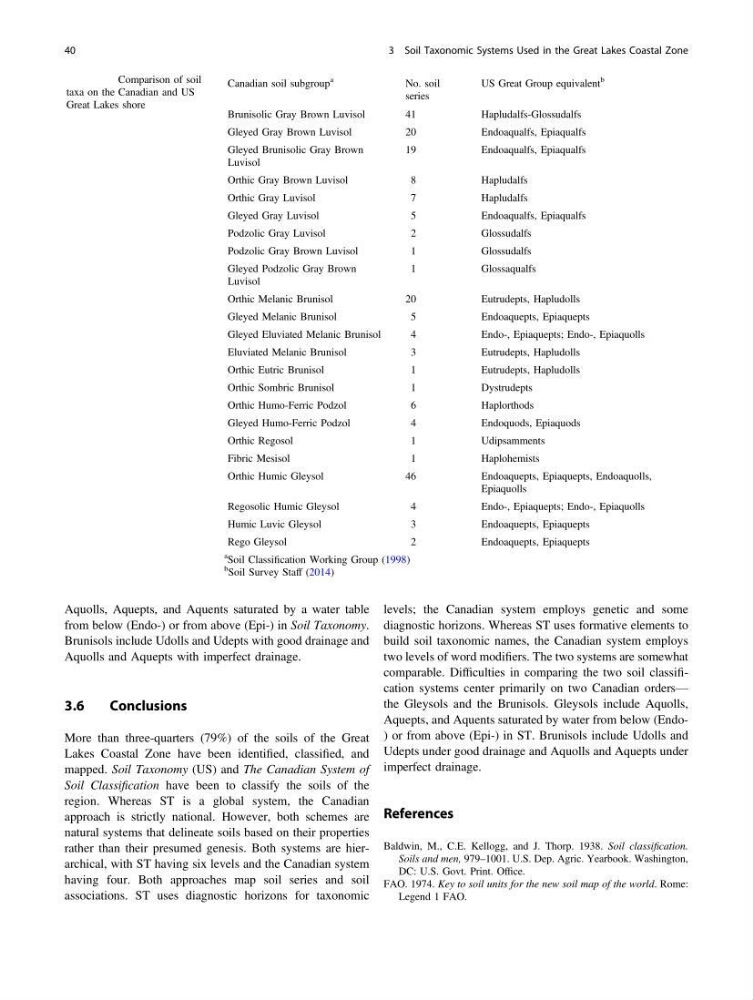
comparable. Difficulties in comparing the two soil classification systems center primarily on two Canadian orders—
the Gleysols and the Brunisols. Gleysols include Aquolls,
Aquepts, and Aquents saturated by water from below (Endo) or from above (Epi-) in ST. Brunisols include Udolls and
Udepts under good drainage and Aquolls and Aquepts under
imperfect drainage.
References
Baldwin, M., C.E. Kellogg, and J. Thorp. 1938. Soil classification.
Soils and men, 979–1001. U.S. Dep. Agric. Yearbook. Washington,
DC: U.S. Govt. Print. Office.
FAO. 1974. Key to soil units for the new soil map of the world. Rome:
Legend 1 FAO.
Table 3.5 Comparison of soil
taxa on the Canadian and US
Great Lakes shore
Canadian soil subgroup
a
No. soil
series
US Great Group equivalent
b
Brunisolic Gray Brown Luvisol
41
Hapludalfs-Glossudalfs
Gleyed Gray Brown Luvisol
20
Endoaqualfs, Epiaqualfs
Gleyed Brunisolic Gray Brown
Luvisol
19
Endoaqualfs, Epiaqualfs
Orthic Gray Brown Luvisol
8
Hapludalfs
Orthic Gray Luvisol
7
Hapludalfs
Gleyed Gray Luvisol
5
Endoaqualfs, Epiaqualfs
Podzolic Gray Luvisol
2
Glossudalfs
Podzolic Gray Brown Luvisol
1
Glossudalfs
Gleyed Podzolic Gray Brown
Luvisol
1
Glossaqualfs
Orthic Melanic Brunisol
20
Eutrudepts, Hapludolls
Gleyed Melanic Brunisol
5
Endoaquepts, Epiaquepts
Gleyed Eluviated Melanic Brunisol
4
Endo-, Epiaquepts; Endo-, Epiaquolls
Eluviated Melanic Brunisol
3
Eutrudepts, Hapludolls
Orthic Eutric Brunisol
1
Eutrudepts, Hapludolls
Orthic Sombric Brunisol
1
Dystrudepts
Orthic Humo-Ferric Podzol
6
Haplorthods
Gleyed Humo-Ferric Podzol
4
Endoquods, Epiaquods
Orthic Regosol
1
Udipsamments
Fibric Mesisol
1
Haplohemists
Orthic Humic Gleysol
46
Endoaquepts, Epiaquepts, Endoaquolls,
Epiaquolls
Regosolic Humic Gleysol
4
Endo-, Epiaquepts; Endo-, Epiaquolls
Humic Luvic Gleysol
3
Endoaquepts, Epiaquepts
Rego Gleysol
2
Endoaquepts, Epiaquepts
a Soil Classification Working Group (1998)
b
Soil Survey Staff (2014)
40
3 Soil Taxonomic Systems Used in the Great Lakes Coastal Zone
from below (Endo-) or from above (Epi-) in Soil Taxonomy.
Brunisols include Udolls and Udepts with good drainage and
Aquolls and Aquepts with imperfect drainage.
3.6
Conclusions
More than three-quarters (79%) of the soils of the Great
Lakes Coastal Zone have been identified, classified, and
mapped. Soil Taxonomy (US) and The Canadian System of
Soil Classification have been to classify the soils of the
region. Whereas ST is a global system, the Canadian
approach is strictly national. However, both schemes are
natural systems that delineate soils based on their properties
rather than their presumed genesis. Both systems are hierarchical, with ST having six levels and the Canadian system
having four. Both approaches map soil series and soil
associations. ST uses diagnostic horizons for taxonomic
levels; the Canadian system employs genetic and some
diagnostic horizons. Whereas ST uses formative elements to
build soil taxonomic names, the Canadian system employs
two levels of word modifiers. The two systems are somewhat
comparable. Difficulties in comparing the two soil classification systems center primarily on two Canadian orders—
the Gleysols and the Brunisols. Gleysols include Aquolls,
Aquepts, and Aquents saturated by water from below (Endo) or from above (Epi-) in ST. Brunisols include Udolls and
Udepts under good drainage and Aquolls and Aquepts under
imperfect drainage.
References
Baldwin, M., C.E. Kellogg, and J. Thorp. 1938. Soil classification.
Soils and men, 979–1001. U.S. Dep. Agric. Yearbook. Washington,
DC: U.S. Govt. Print. Office.
FAO. 1974. Key to soil units for the new soil map of the world. Rome:
Legend 1 FAO.
Table 3.5 Comparison of soil
taxa on the Canadian and US
Great Lakes shore
Canadian soil subgroup
a
No. soil
series
US Great Group equivalent
b
Brunisolic Gray Brown Luvisol
41
Hapludalfs-Glossudalfs
Gleyed Gray Brown Luvisol
20
Endoaqualfs, Epiaqualfs
Gleyed Brunisolic Gray Brown
Luvisol
19
Endoaqualfs, Epiaqualfs
Orthic Gray Brown Luvisol
8
Hapludalfs
Orthic Gray Luvisol
7
Hapludalfs
Gleyed Gray Luvisol
5
Endoaqualfs, Epiaqualfs
Podzolic Gray Luvisol
2
Glossudalfs
Podzolic Gray Brown Luvisol
1
Glossudalfs
Gleyed Podzolic Gray Brown
Luvisol
1
Glossaqualfs
Orthic Melanic Brunisol
20
Eutrudepts, Hapludolls
Gleyed Melanic Brunisol
5
Endoaquepts, Epiaquepts
Gleyed Eluviated Melanic Brunisol
4
Endo-, Epiaquepts; Endo-, Epiaquolls
Eluviated Melanic Brunisol
3
Eutrudepts, Hapludolls
Orthic Eutric Brunisol
1
Eutrudepts, Hapludolls
Orthic Sombric Brunisol
1
Dystrudepts
Orthic Humo-Ferric Podzol
6
Haplorthods
Gleyed Humo-Ferric Podzol
4
Endoquods, Epiaquods
Orthic Regosol
1
Udipsamments
Fibric Mesisol
1
Haplohemists
Orthic Humic Gleysol
46
Endoaquepts, Epiaquepts, Endoaquolls,
Epiaquolls
Regosolic Humic Gleysol
4
Endo-, Epiaquepts; Endo-, Epiaquolls
Humic Luvic Gleysol
3
Endoaquepts, Epiaquepts
Rego Gleysol
2
Endoaquepts, Epiaquepts
a Soil Classification Working Group (1998)
b
Soil Survey Staff (2014)
40
3 Soil Taxonomic Systems Used in the Great Lakes Coastal Zone