

the following consonants of order names. For the six soil
orders found in the Great Lakes region, alf is used for
Alfisols, the base-enriched soils with an argillic horizon; ent
is used for the Entisols, which lack a diagnostic subsurface
horizon; ept is used for Inceptisols, which feature minimal
soil development and often contain a cambic horizon; od is
used for Spodosols, the acid forest soils enriched in Al and
Fe complexed with humus; oll is used for Mollisols, which
contain a thick, dark-colored, base-rich surface horizon; and
ist is used for Histosols, the organic soils.
The formative elements listed in the upper part of
Table 3.4 are used to construct suborder names. An Aqualf
is a wet Alfisol; a Psamment is a sandy Entisol, and a Hemist
is a Histosol containing organic materials of intermediate
decomposition. The formative elements listed in the middle
of Table 3.4 are used to build upon the suborder names and
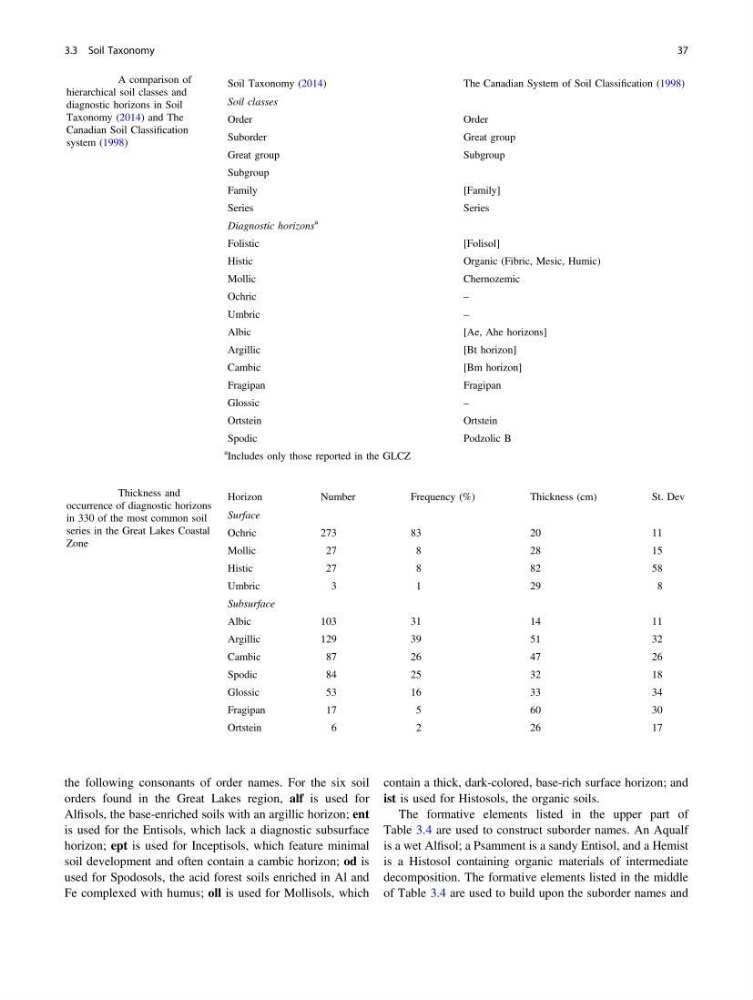
Table 3.2 A comparison of
hierarchical soil classes and
diagnostic horizons in Soil
Taxonomy (2014) and The
Canadian Soil Classification
system (1998)
Soil Taxonomy (2014)
The Canadian System of Soil Classification (1998)
Soil classes
Order
Order
Suborder
Great group
Great group
Subgroup
Subgroup
Family
[Family]
Series
Series
Diagnostic horizons
a
Folistic
[Folisol]
Histic
Organic (Fibric, Mesic, Humic)
Mollic
Chernozemic
Ochric
–
Umbric
–
Albic
[Ae, Ahe horizons]
Argillic
[Bt horizon]
Cambic
[Bm horizon]
Fragipan
Fragipan
Glossic
–
Ortstein
Ortstein
Spodic
Podzolic B
a Includes only those reported in the GLCZ
Table 3.3 Thickness and
occurrence of diagnostic horizons
in 330 of the most common soil
series in the Great Lakes Coastal
Zone
Horizon
Number
Frequency (%)
Thickness (cm)
St. Dev
Surface
Ochric
273
83
20
11
Mollic
27
8
28
15
Histic
27
8
82
58
Umbric
3
1
29
8
Subsurface
Albic
103
31
14
11
Argillic
129
39
51
32
Cambic
87
26
47
26
Spodic
84
25
32
18
Glossic
53
16
33
34
Fragipan
17
5
60
30
Ortstein
6
2
26
17
3.3 Soil Taxonomy
37
orders found in the Great Lakes region, alf is used for
Alfisols, the base-enriched soils with an argillic horizon; ent
is used for the Entisols, which lack a diagnostic subsurface
horizon; ept is used for Inceptisols, which feature minimal
soil development and often contain a cambic horizon; od is
used for Spodosols, the acid forest soils enriched in Al and
Fe complexed with humus; oll is used for Mollisols, which
contain a thick, dark-colored, base-rich surface horizon; and
ist is used for Histosols, the organic soils.
The formative elements listed in the upper part of
Table 3.4 are used to construct suborder names. An Aqualf
is a wet Alfisol; a Psamment is a sandy Entisol, and a Hemist
is a Histosol containing organic materials of intermediate
decomposition. The formative elements listed in the middle
of Table 3.4 are used to build upon the suborder names and
Table 3.2 A comparison of
hierarchical soil classes and
diagnostic horizons in Soil
Taxonomy (2014) and The
Canadian Soil Classification
system (1998)
Soil Taxonomy (2014)
The Canadian System of Soil Classification (1998)
Soil classes
Order
Order
Suborder
Great group
Great group
Subgroup
Subgroup
Family
[Family]
Series
Series
Diagnostic horizons
a
Folistic
[Folisol]
Histic
Organic (Fibric, Mesic, Humic)
Mollic
Chernozemic
Ochric
–
Umbric
–
Albic
[Ae, Ahe horizons]
Argillic
[Bt horizon]
Cambic
[Bm horizon]
Fragipan
Fragipan
Glossic
–
Ortstein
Ortstein
Spodic
Podzolic B
a Includes only those reported in the GLCZ
Table 3.3 Thickness and
occurrence of diagnostic horizons
in 330 of the most common soil
series in the Great Lakes Coastal
Zone
Horizon
Number
Frequency (%)
Thickness (cm)
St. Dev
Surface
Ochric
273
83
20
11
Mollic
27
8
28
15
Histic
27
8
82
58
Umbric
3
1
29
8
Subsurface
Albic
103
31
14
11
Argillic
129
39
51
32
Cambic
87
26
47
26
Spodic
84
25
32
18
Glossic
53
16
33
34
Fragipan
17
5
60
30
Ortstein
6
2
26
17
3.3 Soil Taxonomy
37