

Integrated Watershed Management Vis-a-Vis Water–Energy–Food Nexus
77
world [4, 20]. In the last decade, the need of water becomes so important because
of both population and economic growth. In 2019, it was reported that the world
population is around 7.75 billion. It is forecasted that the population growth would
increase to 9.7 billion in 2050 [4]. The consequence of this population growth is
a high pressure on the available water and energy system, because most regions
of the world have deficits in supply. Besides, the environmental junctures caused by
unsustainable water and energy use are expected as the most important threat, worldwide [19]. During the period in which world is bearing environmental and resource
stresses, connection between limited resources attracted the attention of researches.
Determining the connection between the main resource parts and enhancing their efficiency is considered as a win-win strategy for current, and more importantly, future
generation human well-being and environmental stability. Among these linkages, the
water–energy nexus has been quickly risen [88]. The popularity of the concept could
be traced back to the World Economic Forum in 2008, where the global challenges
in terms of economic growth were identified from the water–energy nexus viewpoint
[19, 84]. Water and energy are multifaceted problems with many parts changing their
supply and demand. Water and energy sources are twisted and are both important for
economic growth. The relationship between water and energy resources can be developed into the concept of the water–energy nexus (WEN) [22]. WEN describes the
undeniable linkage between water and energy, which is the basis of clever community substructure [4, 49]. Scientist claim that informed water and energy planning
and recognition of potential choices for both policy and technology can be supported
better by the WEN analysis. Healy et al. [31] stated that it is expected this process
can help policy makers and resource managers for conservation and stability of
water and energy. Energy and water are interconnected because these elements are
main consumers of one another. Water plays an important role in almost every stage
of energy development, consisting of the exploitation, production and processing
of fossil fuels, electricity generation, extraction, treatment and processing of waste
from energy-related measures. At the same time, energy is needed to lift, move,
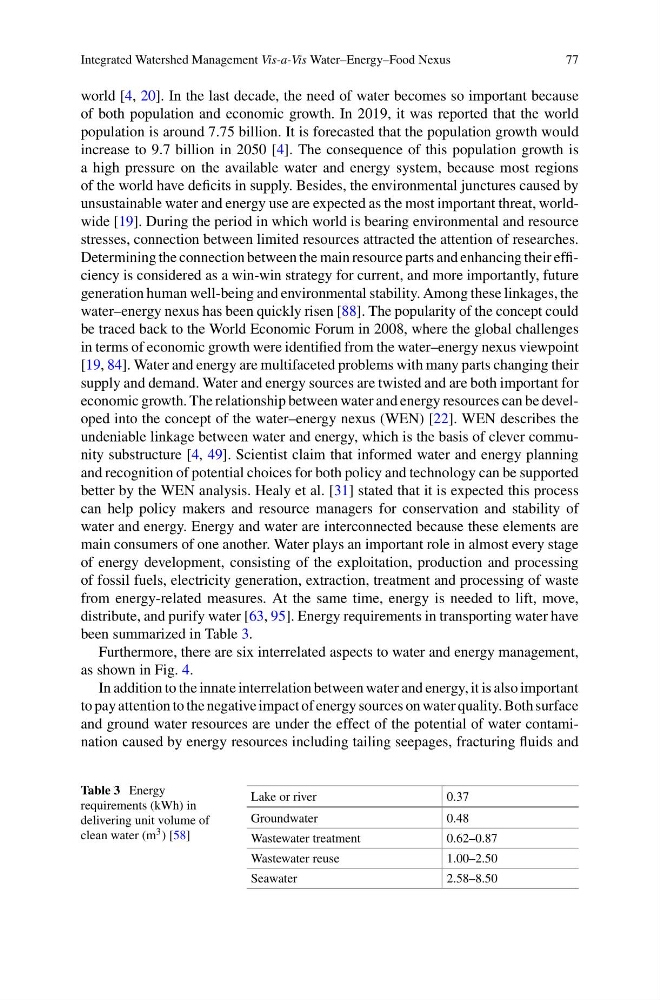
distribute, and purify water [63, 95]. Energy requirements in transporting water have
been summarized in Table 3.
Furthermore, there are six interrelated aspects to water and energy management,
as shown in Fig. 4.
In addition to the innate interrelation between water and energy, it is also important
to pay attention to the negative impact of energy sources on water quality. Both surface
and ground water resources are under the effect of the potential of water contamination caused by energy resources including tailing seepages, fracturing fluids and
Table 3 Energy
requirements (kWh) in
delivering unit volume of
clean water (m 3 ) [58]
Lake or river
0.37
Groundwater
0.48
Wastewater treatment
0.62–0.87
Wastewater reuse
1.00–2.50
Seawater
2.58–8.50
77
world [4, 20]. In the last decade, the need of water becomes so important because
of both population and economic growth. In 2019, it was reported that the world
population is around 7.75 billion. It is forecasted that the population growth would
increase to 9.7 billion in 2050 [4]. The consequence of this population growth is
a high pressure on the available water and energy system, because most regions
of the world have deficits in supply. Besides, the environmental junctures caused by
unsustainable water and energy use are expected as the most important threat, worldwide [19]. During the period in which world is bearing environmental and resource
stresses, connection between limited resources attracted the attention of researches.
Determining the connection between the main resource parts and enhancing their efficiency is considered as a win-win strategy for current, and more importantly, future
generation human well-being and environmental stability. Among these linkages, the
water–energy nexus has been quickly risen [88]. The popularity of the concept could
be traced back to the World Economic Forum in 2008, where the global challenges
in terms of economic growth were identified from the water–energy nexus viewpoint
[19, 84]. Water and energy are multifaceted problems with many parts changing their
supply and demand. Water and energy sources are twisted and are both important for
economic growth. The relationship between water and energy resources can be developed into the concept of the water–energy nexus (WEN) [22]. WEN describes the
undeniable linkage between water and energy, which is the basis of clever community substructure [4, 49]. Scientist claim that informed water and energy planning
and recognition of potential choices for both policy and technology can be supported
better by the WEN analysis. Healy et al. [31] stated that it is expected this process
can help policy makers and resource managers for conservation and stability of
water and energy. Energy and water are interconnected because these elements are
main consumers of one another. Water plays an important role in almost every stage
of energy development, consisting of the exploitation, production and processing
of fossil fuels, electricity generation, extraction, treatment and processing of waste
from energy-related measures. At the same time, energy is needed to lift, move,
distribute, and purify water [63, 95]. Energy requirements in transporting water have
been summarized in Table 3.
Furthermore, there are six interrelated aspects to water and energy management,
as shown in Fig. 4.
In addition to the innate interrelation between water and energy, it is also important
to pay attention to the negative impact of energy sources on water quality. Both surface
and ground water resources are under the effect of the potential of water contamination caused by energy resources including tailing seepages, fracturing fluids and
Table 3 Energy
requirements (kWh) in
delivering unit volume of
clean water (m 3 ) [58]
Lake or river
0.37
Groundwater
0.48
Wastewater treatment
0.62–0.87
Wastewater reuse
1.00–2.50
Seawater
2.58–8.50