

The German Capability Index—An Operationalization of Sen’s …
173
X Min = Min{x(i, j, k)|i in I, j in J, k in K }
X Max = Max{x(i, j, k)|i in I, j in J, k in K },
i (functionings) = i = 1…I = 9, j (income class) = j = 1…J = 9), k (household
type) = k = 1…K = 6.
In the second step, we calculate A
1 :
A
1
i, j,k =
ln
x i, j,k
− ln(X Min )
ln(X Max ) − ln(X Min )
.
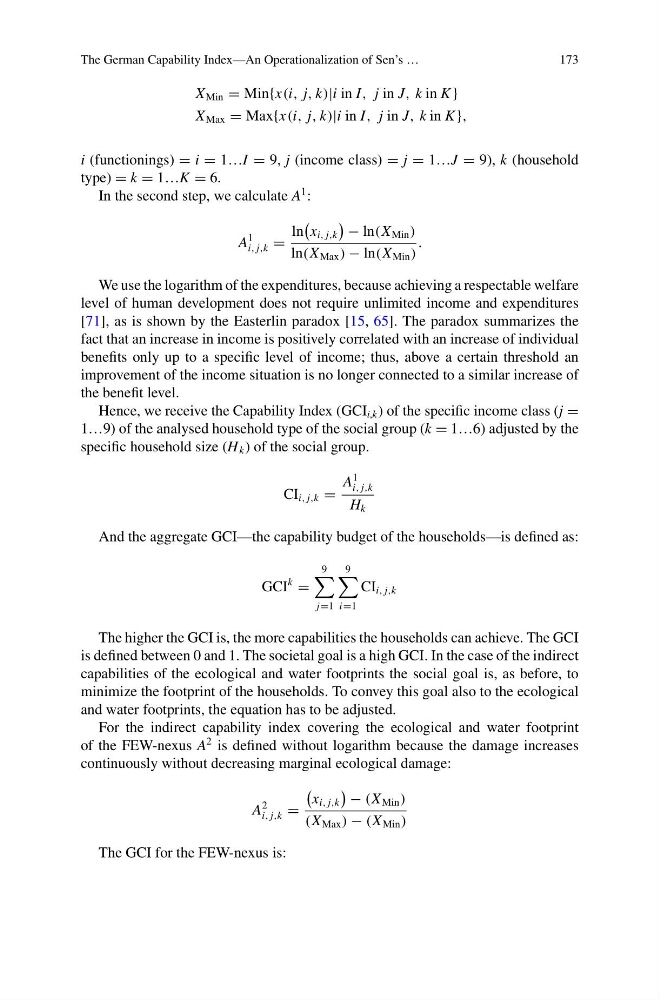
We use the logarithm of the expenditures, because achieving a respectable welfare
level of human development does not require unlimited income and expenditures
[71], as is shown by the Easterlin paradox [15, 65]. The paradox summarizes the
fact that an increase in income is positively correlated with an increase of individual
benefits only up to a specific level of income; thus, above a certain threshold an
improvement of the income situation is no longer connected to a similar increase of
the benefit level.
Hence, we receive the Capability Index (GCI i,k ) of the specific income class (j =
1…9) of the analysed household type of the social group (k = 1…6) adjusted by the
specific household size (H k ) of the social group.
CI i, j,k =
A
1
i, j,k
H k
And the aggregate GCI—the capability budget of the households—is defined as:
GCI
k
=
9
j=1
9
i=1
CI i, j,k
The higher the GCI is, the more capabilities the households can achieve. The GCI
is defined between 0 and 1. The societal goal is a high GCI. In the case of the indirect
capabilities of the ecological and water footprints the social goal is, as before, to
minimize the footprint of the households. To convey this goal also to the ecological
and water footprints, the equation has to be adjusted.
For the indirect capability index covering the ecological and water footprint
of the FEW-nexus A
2 is defined without logarithm because the damage increases
continuously without decreasing marginal ecological damage:
A
2
i, j,k =
x i, j,k
− (X Min )
(X Max ) − (X Min )
The GCI for the FEW-nexus is:
173
X Min = Min{x(i, j, k)|i in I, j in J, k in K }
X Max = Max{x(i, j, k)|i in I, j in J, k in K },
i (functionings) = i = 1…I = 9, j (income class) = j = 1…J = 9), k (household
type) = k = 1…K = 6.
In the second step, we calculate A
1 :
A
1
i, j,k =
ln
x i, j,k
− ln(X Min )
ln(X Max ) − ln(X Min )
.
We use the logarithm of the expenditures, because achieving a respectable welfare
level of human development does not require unlimited income and expenditures
[71], as is shown by the Easterlin paradox [15, 65]. The paradox summarizes the
fact that an increase in income is positively correlated with an increase of individual
benefits only up to a specific level of income; thus, above a certain threshold an
improvement of the income situation is no longer connected to a similar increase of
the benefit level.
Hence, we receive the Capability Index (GCI i,k ) of the specific income class (j =
1…9) of the analysed household type of the social group (k = 1…6) adjusted by the
specific household size (H k ) of the social group.
CI i, j,k =
A
1
i, j,k
H k
And the aggregate GCI—the capability budget of the households—is defined as:
GCI
k
=
9
j=1
9
i=1
CI i, j,k
The higher the GCI is, the more capabilities the households can achieve. The GCI
is defined between 0 and 1. The societal goal is a high GCI. In the case of the indirect
capabilities of the ecological and water footprints the social goal is, as before, to
minimize the footprint of the households. To convey this goal also to the ecological
and water footprints, the equation has to be adjusted.
For the indirect capability index covering the ecological and water footprint
of the FEW-nexus A
2 is defined without logarithm because the damage increases
continuously without decreasing marginal ecological damage:
A
2
i, j,k =
x i, j,k
− (X Min )
(X Max ) − (X Min )
The GCI for the FEW-nexus is: