

174
H. Schlör et al.
GCI
FEW
i, j,k = 1 −
A
2
i, j,k
H k
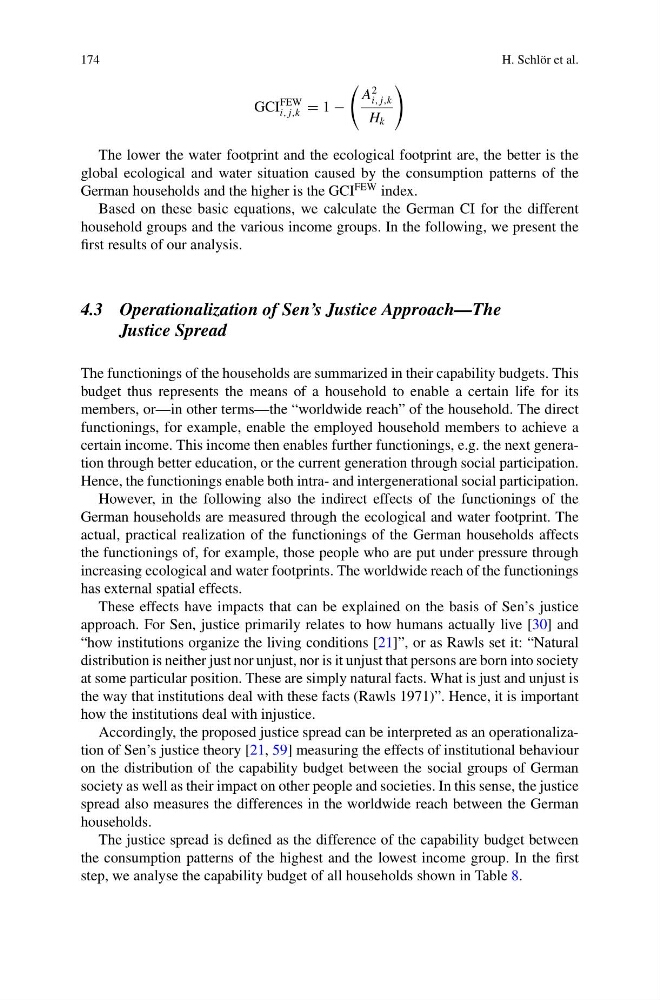
The lower the water footprint and the ecological footprint are, the better is the
global ecological and water situation caused by the consumption patterns of the
German households and the higher is the GCI
FEW index.
Based on these basic equations, we calculate the German CI for the different
household groups and the various income groups. In the following, we present the
first results of our analysis.
4.3 Operationalization of Sen’s Justice Approach—The
Justice Spread
The functionings of the households are summarized in their capability budgets. This
budget thus represents the means of a household to enable a certain life for its
members, or—in other terms—the “worldwide reach” of the household. The direct
functionings, for example, enable the employed household members to achieve a
certain income. This income then enables further functionings, e.g. the next generation through better education, or the current generation through social participation.
Hence, the functionings enable both intra- and intergenerational social participation.
However, in the following also the indirect effects of the functionings of the
German households are measured through the ecological and water footprint. The
actual, practical realization of the functionings of the German households affects
the functionings of, for example, those people who are put under pressure through
increasing ecological and water footprints. The worldwide reach of the functionings
has external spatial effects.
These effects have impacts that can be explained on the basis of Sen’s justice
approach. For Sen, justice primarily relates to how humans actually live [30] and
“how institutions organize the living conditions [21]”, or as Rawls set it: “Natural
distribution is neither just nor unjust, nor is it unjust that persons are born into society
at some particular position. These are simply natural facts. What is just and unjust is
the way that institutions deal with these facts (Rawls 1971)”. Hence, it is important
how the institutions deal with injustice.
Accordingly, the proposed justice spread can be interpreted as an operationalization of Sen’s justice theory [21, 59] measuring the effects of institutional behaviour
on the distribution of the capability budget between the social groups of German
society as well as their impact on other people and societies. In this sense, the justice
spread also measures the differences in the worldwide reach between the German
households.
The justice spread is defined as the difference of the capability budget between
the consumption patterns of the highest and the lowest income group. In the first
step, we analyse the capability budget of all households shown in Table 8.
H. Schlör et al.
GCI
FEW
i, j,k = 1 −
A
2
i, j,k
H k
The lower the water footprint and the ecological footprint are, the better is the
global ecological and water situation caused by the consumption patterns of the
German households and the higher is the GCI
FEW index.
Based on these basic equations, we calculate the German CI for the different
household groups and the various income groups. In the following, we present the
first results of our analysis.
4.3 Operationalization of Sen’s Justice Approach—The
Justice Spread
The functionings of the households are summarized in their capability budgets. This
budget thus represents the means of a household to enable a certain life for its
members, or—in other terms—the “worldwide reach” of the household. The direct
functionings, for example, enable the employed household members to achieve a
certain income. This income then enables further functionings, e.g. the next generation through better education, or the current generation through social participation.
Hence, the functionings enable both intra- and intergenerational social participation.
However, in the following also the indirect effects of the functionings of the
German households are measured through the ecological and water footprint. The
actual, practical realization of the functionings of the German households affects
the functionings of, for example, those people who are put under pressure through
increasing ecological and water footprints. The worldwide reach of the functionings
has external spatial effects.
These effects have impacts that can be explained on the basis of Sen’s justice
approach. For Sen, justice primarily relates to how humans actually live [30] and
“how institutions organize the living conditions [21]”, or as Rawls set it: “Natural
distribution is neither just nor unjust, nor is it unjust that persons are born into society
at some particular position. These are simply natural facts. What is just and unjust is
the way that institutions deal with these facts (Rawls 1971)”. Hence, it is important
how the institutions deal with injustice.
Accordingly, the proposed justice spread can be interpreted as an operationalization of Sen’s justice theory [21, 59] measuring the effects of institutional behaviour
on the distribution of the capability budget between the social groups of German
society as well as their impact on other people and societies. In this sense, the justice
spread also measures the differences in the worldwide reach between the German
households.
The justice spread is defined as the difference of the capability budget between
the consumption patterns of the highest and the lowest income group. In the first
step, we analyse the capability budget of all households shown in Table 8.