

172
H. Schlör et al.
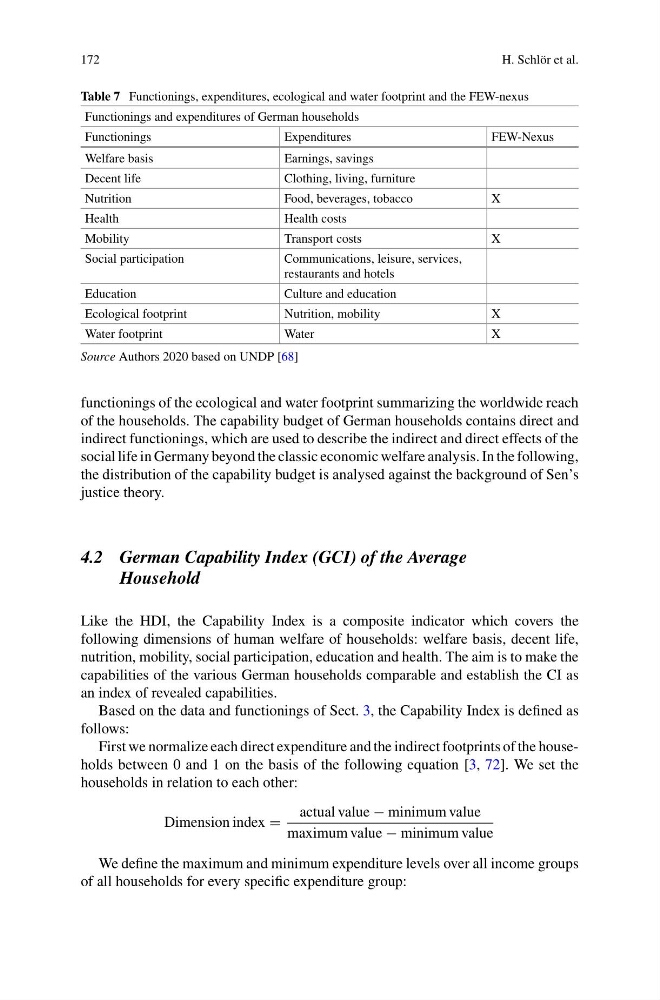
Table 7 Functionings, expenditures, ecological and water footprint and the FEW-nexus
Functionings and expenditures of German households
Functionings
Expenditures
FEW-Nexus
Welfare basis
Earnings, savings
Decent life
Clothing, living, furniture
Nutrition
Food, beverages, tobacco
X
Health
Health costs
Mobility
Transport costs
X
Social participation
Communications, leisure, services,
restaurants and hotels
Education
Culture and education
Ecological footprint
Nutrition, mobility
X
Water footprint
Water
X
Source Authors 2020 based on UNDP [68]
functionings of the ecological and water footprint summarizing the worldwide reach
of the households. The capability budget of German households contains direct and
indirect functionings, which are used to describe the indirect and direct effects of the
social life in Germany beyond the classic economic welfare analysis. In the following,
the distribution of the capability budget is analysed against the background of Sen’s
justice theory.
4.2 German Capability Index (GCI) of the Average
Household
Like the HDI, the Capability Index is a composite indicator which covers the
following dimensions of human welfare of households: welfare basis, decent life,
nutrition, mobility, social participation, education and health. The aim is to make the
capabilities of the various German households comparable and establish the CI as
an index of revealed capabilities.
Based on the data and functionings of Sect. 3, the Capability Index is defined as
follows:
First we normalize each direct expenditure and the indirect footprints of the households between 0 and 1 on the basis of the following equation [3, 72]. We set the
households in relation to each other:
Dimension index =
actual value − minimum value
maximum value − minimum value
We define the maximum and minimum expenditure levels over all income groups
of all households for every specific expenditure group:
H. Schlör et al.
Table 7 Functionings, expenditures, ecological and water footprint and the FEW-nexus
Functionings and expenditures of German households
Functionings
Expenditures
FEW-Nexus
Welfare basis
Earnings, savings
Decent life
Clothing, living, furniture
Nutrition
Food, beverages, tobacco
X
Health
Health costs
Mobility
Transport costs
X
Social participation
Communications, leisure, services,
restaurants and hotels
Education
Culture and education
Ecological footprint
Nutrition, mobility
X
Water footprint
Water
X
Source Authors 2020 based on UNDP [68]
functionings of the ecological and water footprint summarizing the worldwide reach
of the households. The capability budget of German households contains direct and
indirect functionings, which are used to describe the indirect and direct effects of the
social life in Germany beyond the classic economic welfare analysis. In the following,
the distribution of the capability budget is analysed against the background of Sen’s
justice theory.
4.2 German Capability Index (GCI) of the Average
Household
Like the HDI, the Capability Index is a composite indicator which covers the
following dimensions of human welfare of households: welfare basis, decent life,
nutrition, mobility, social participation, education and health. The aim is to make the
capabilities of the various German households comparable and establish the CI as
an index of revealed capabilities.
Based on the data and functionings of Sect. 3, the Capability Index is defined as
follows:
First we normalize each direct expenditure and the indirect footprints of the households between 0 and 1 on the basis of the following equation [3, 72]. We set the
households in relation to each other:
Dimension index =
actual value − minimum value
maximum value − minimum value
We define the maximum and minimum expenditure levels over all income groups
of all households for every specific expenditure group: