

The Use of Biodigesters in the Treatment of Swine Manure …
115
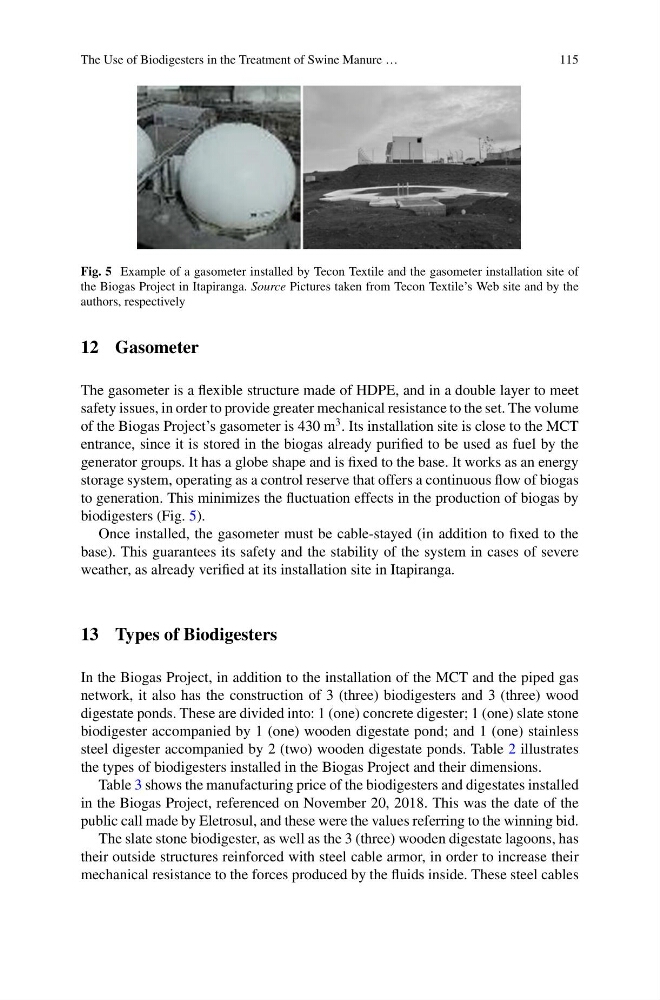
Fig. 5 Example of a gasometer installed by Tecon Textile and the gasometer installation site of
the Biogas Project in Itapiranga. Source Pictures taken from Tecon Textile’s Web site and by the
authors, respectively
12 Gasometer
The gasometer is a flexible structure made of HDPE, and in a double layer to meet
safety issues, in order to provide greater mechanical resistance to the set. The volume
of the Biogas Project’s gasometer is 430 m
3 . Its installation site is close to the MCT
entrance, since it is stored in the biogas already purified to be used as fuel by the
generator groups. It has a globe shape and is fixed to the base. It works as an energy
storage system, operating as a control reserve that offers a continuous flow of biogas
to generation. This minimizes the fluctuation effects in the production of biogas by
biodigesters (Fig. 5).
Once installed, the gasometer must be cable-stayed (in addition to fixed to the
base). This guarantees its safety and the stability of the system in cases of severe
weather, as already verified at its installation site in Itapiranga.
13 Types of Biodigesters
In the Biogas Project, in addition to the installation of the MCT and the piped gas
network, it also has the construction of 3 (three) biodigesters and 3 (three) wood
digestate ponds. These are divided into: 1 (one) concrete digester; 1 (one) slate stone
biodigester accompanied by 1 (one) wooden digestate pond; and 1 (one) stainless
steel digester accompanied by 2 (two) wooden digestate ponds. Table 2 illustrates
the types of biodigesters installed in the Biogas Project and their dimensions.
Table 3 shows the manufacturing price of the biodigesters and digestates installed
in the Biogas Project, referenced on November 20, 2018. This was the date of the
public call made by Eletrosul, and these were the values referring to the winning bid.
The slate stone biodigester, as well as the 3 (three) wooden digestate lagoons, has
their outside structures reinforced with steel cable armor, in order to increase their
mechanical resistance to the forces produced by the fluids inside. These steel cables
115
Fig. 5 Example of a gasometer installed by Tecon Textile and the gasometer installation site of
the Biogas Project in Itapiranga. Source Pictures taken from Tecon Textile’s Web site and by the
authors, respectively
12 Gasometer
The gasometer is a flexible structure made of HDPE, and in a double layer to meet
safety issues, in order to provide greater mechanical resistance to the set. The volume
of the Biogas Project’s gasometer is 430 m
3 . Its installation site is close to the MCT
entrance, since it is stored in the biogas already purified to be used as fuel by the
generator groups. It has a globe shape and is fixed to the base. It works as an energy
storage system, operating as a control reserve that offers a continuous flow of biogas
to generation. This minimizes the fluctuation effects in the production of biogas by
biodigesters (Fig. 5).
Once installed, the gasometer must be cable-stayed (in addition to fixed to the
base). This guarantees its safety and the stability of the system in cases of severe
weather, as already verified at its installation site in Itapiranga.
13 Types of Biodigesters
In the Biogas Project, in addition to the installation of the MCT and the piped gas
network, it also has the construction of 3 (three) biodigesters and 3 (three) wood
digestate ponds. These are divided into: 1 (one) concrete digester; 1 (one) slate stone
biodigester accompanied by 1 (one) wooden digestate pond; and 1 (one) stainless
steel digester accompanied by 2 (two) wooden digestate ponds. Table 2 illustrates
the types of biodigesters installed in the Biogas Project and their dimensions.
Table 3 shows the manufacturing price of the biodigesters and digestates installed
in the Biogas Project, referenced on November 20, 2018. This was the date of the
public call made by Eletrosul, and these were the values referring to the winning bid.
The slate stone biodigester, as well as the 3 (three) wooden digestate lagoons, has
their outside structures reinforced with steel cable armor, in order to increase their
mechanical resistance to the forces produced by the fluids inside. These steel cables