

114
R. de Castro Sobrosa Neto et al.
11 Gas Pipeline
In the Biogas Project, the set of materials and equipment (contained along its 11 km
in length), from the biogas production unit to its storage at the MCT plan, was considered as a gas pipeline. It included: compressors, filters, gas dryers, polyvinyl chloride (PVC) tubing, maneuver and control valves, high-density polyethylene (HDPE)
tubing, flare, etc. The compressors have the function of compressing the gas to
be sent from the biodigester to the substation, overcoming differences in level and
the distances that separate the production points and the point of conversion of the
biogas into electrical energy, the MCT. Gas filters and dryers aim to remove impurities present in biogas, especially sulfur and water, which when combined accelerates
the system corrosion as a whole. It is crucial to highlight that for biogas, the lower
the presence of water and sulfur the better the performance and durability of the
structure in its transport. Maneuver and control valves, in turn, are materials that
allow directing the biogas flow. They are capable of isolating sections for safety and
maintenance, directing the flow to prevent return to production plants, as well as
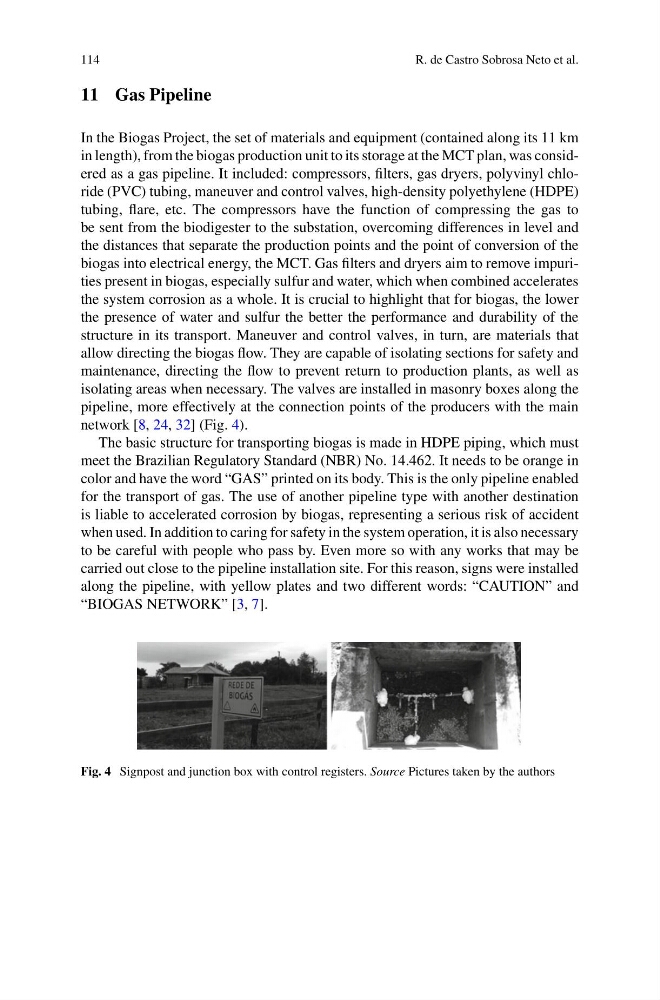
isolating areas when necessary. The valves are installed in masonry boxes along the
pipeline, more effectively at the connection points of the producers with the main
network [8, 24, 32] (Fig. 4).
The basic structure for transporting biogas is made in HDPE piping, which must
meet the Brazilian Regulatory Standard (NBR) No. 14.462. It needs to be orange in
color and have the word “GAS” printed on its body. This is the only pipeline enabled
for the transport of gas. The use of another pipeline type with another destination
is liable to accelerated corrosion by biogas, representing a serious risk of accident
when used. In addition to caring for safety in the system operation, it is also necessary
to be careful with people who pass by. Even more so with any works that may be
carried out close to the pipeline installation site. For this reason, signs were installed
along the pipeline, with yellow plates and two different words: “CAUTION” and
“BIOGAS NETWORK” [3, 7].
Fig. 4 Signpost and junction box with control registers. Source Pictures taken by the authors
R. de Castro Sobrosa Neto et al.
11 Gas Pipeline
In the Biogas Project, the set of materials and equipment (contained along its 11 km
in length), from the biogas production unit to its storage at the MCT plan, was considered as a gas pipeline. It included: compressors, filters, gas dryers, polyvinyl chloride (PVC) tubing, maneuver and control valves, high-density polyethylene (HDPE)
tubing, flare, etc. The compressors have the function of compressing the gas to
be sent from the biodigester to the substation, overcoming differences in level and
the distances that separate the production points and the point of conversion of the
biogas into electrical energy, the MCT. Gas filters and dryers aim to remove impurities present in biogas, especially sulfur and water, which when combined accelerates
the system corrosion as a whole. It is crucial to highlight that for biogas, the lower
the presence of water and sulfur the better the performance and durability of the
structure in its transport. Maneuver and control valves, in turn, are materials that
allow directing the biogas flow. They are capable of isolating sections for safety and
maintenance, directing the flow to prevent return to production plants, as well as
isolating areas when necessary. The valves are installed in masonry boxes along the
pipeline, more effectively at the connection points of the producers with the main
network [8, 24, 32] (Fig. 4).
The basic structure for transporting biogas is made in HDPE piping, which must
meet the Brazilian Regulatory Standard (NBR) No. 14.462. It needs to be orange in
color and have the word “GAS” printed on its body. This is the only pipeline enabled
for the transport of gas. The use of another pipeline type with another destination
is liable to accelerated corrosion by biogas, representing a serious risk of accident
when used. In addition to caring for safety in the system operation, it is also necessary
to be careful with people who pass by. Even more so with any works that may be
carried out close to the pipeline installation site. For this reason, signs were installed
along the pipeline, with yellow plates and two different words: “CAUTION” and
“BIOGAS NETWORK” [3, 7].
Fig. 4 Signpost and junction box with control registers. Source Pictures taken by the authors