

62
ancestors awoke, Punjil, Pallian and Karakarook had gone up above. They had departed from Deen Maar, which
remains sacred to our people to the present day (William Thomas [1969] cited in Smyth, 2004, p.6).
Additional to the spiritual connection to Country, Aboriginal people relied on their intimate knowledge of the environment, seasonal cycles and understanding of climatic events to ensure an adequate
food supply, including natural medicines and protective resources (O’Connor & Prober, 2010). This
knowledge was recorded over long-term and short-term cycles. Long term climate cycles were
recorded in the two sequences; the Mudong, or life cycle that stretches for 12 years, and the Garuwanga,
the Dreaming, a cycle that stretches between 12,000 to 20,000 years (Roös, 2014b; Kingsley, 2003)
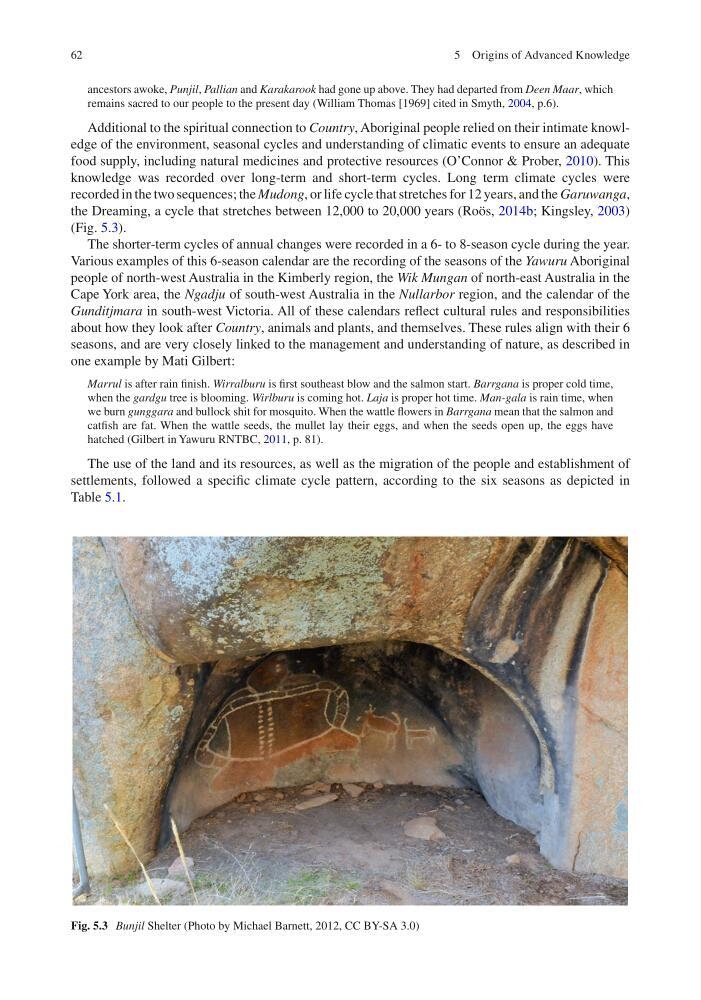
(Fig. 5.3).
The shorter-term cycles of annual changes were recorded in a 6- to 8-season cycle during the year.
Various examples of this 6-season calendar are the recording of the seasons of the Yawuru Aboriginal
people of north-west Australia in the Kimberly region, the Wik Mungan of north-east Australia in the
Cape York area, the Ngadju of south-west Australia in the Nullarbor region, and the calendar of the
Gunditjmara in south-west Victoria. All of these calendars reflect cultural rules and responsibilities
about how they look after Country, animals and plants, and themselves. These rules align with their 6
seasons, and are very closely linked to the management and understanding of nature, as described in
one example by Mati Gilbert:
Marrul is after rain finish. Wirralburu is first southeast blow and the salmon start. Barrgana is proper cold time,
when the gardgu tree is blooming. Wirlburu is coming hot. Laja is proper hot time. Man-gala is rain time, when
we burn gunggara and bullock shit for mosquito. When the wattle flowers in Barrgana mean that the salmon and
catfish are fat. When the wattle seeds, the mullet lay their eggs, and when the seeds open up, the eggs have
hatched (Gilbert in Yawuru RNTBC, 2011, p. 81).
The use of the land and its resources, as well as the migration of the people and establishment of
settlements, followed a specific climate cycle pattern, according to the six seasons as depicted in
Table 5.1.
Fig. 5.3 Bunjil Shelter (Photo by Michael Barnett, 2012, CC BY-SA 3.0)
5 Origins of Advanced Knowledge
ancestors awoke, Punjil, Pallian and Karakarook had gone up above. They had departed from Deen Maar, which
remains sacred to our people to the present day (William Thomas [1969] cited in Smyth, 2004, p.6).
Additional to the spiritual connection to Country, Aboriginal people relied on their intimate knowledge of the environment, seasonal cycles and understanding of climatic events to ensure an adequate
food supply, including natural medicines and protective resources (O’Connor & Prober, 2010). This
knowledge was recorded over long-term and short-term cycles. Long term climate cycles were
recorded in the two sequences; the Mudong, or life cycle that stretches for 12 years, and the Garuwanga,
the Dreaming, a cycle that stretches between 12,000 to 20,000 years (Roös, 2014b; Kingsley, 2003)
(Fig. 5.3).
The shorter-term cycles of annual changes were recorded in a 6- to 8-season cycle during the year.
Various examples of this 6-season calendar are the recording of the seasons of the Yawuru Aboriginal
people of north-west Australia in the Kimberly region, the Wik Mungan of north-east Australia in the
Cape York area, the Ngadju of south-west Australia in the Nullarbor region, and the calendar of the
Gunditjmara in south-west Victoria. All of these calendars reflect cultural rules and responsibilities
about how they look after Country, animals and plants, and themselves. These rules align with their 6
seasons, and are very closely linked to the management and understanding of nature, as described in
one example by Mati Gilbert:
Marrul is after rain finish. Wirralburu is first southeast blow and the salmon start. Barrgana is proper cold time,
when the gardgu tree is blooming. Wirlburu is coming hot. Laja is proper hot time. Man-gala is rain time, when
we burn gunggara and bullock shit for mosquito. When the wattle flowers in Barrgana mean that the salmon and
catfish are fat. When the wattle seeds, the mullet lay their eggs, and when the seeds open up, the eggs have
hatched (Gilbert in Yawuru RNTBC, 2011, p. 81).
The use of the land and its resources, as well as the migration of the people and establishment of
settlements, followed a specific climate cycle pattern, according to the six seasons as depicted in
Table 5.1.
Fig. 5.3 Bunjil Shelter (Photo by Michael Barnett, 2012, CC BY-SA 3.0)
5 Origins of Advanced Knowledge