

131
9.6.10 Gradients
Every time there is a transition from one space to another in nature, gradients are established. Change
happens gradually. For example, in an electric field the field strength changes the further it moves
away from the source, forming a gradient of intensity. In the flow of a river, gradients of turbulence
and velocity occur near the riverbank. The size of twigs in a tree varies in gradient from the centre of
the tree to the fine edge of the leaves. Gradients are visible in the element size growth of a nautilus
shell, formed over a period of growth (Alexander, 2001–2005a, p. 275), as depicted in Fig. 9.17.
9.6.11 Roughness
The smoothness of a crystal is interrupted by irregularities known as dislocations, with small increments of error that make it possible for the crystal to continue with the grid structure. Roughness
allows the crystals to continue their growth. Roughness appears in nature as a result of the interplay
between well-defined order and the constraints of three-dimensional space. An excellent example of
the roughness in creation of form is the varying groove sizes of the paper nautilus shell of the
Argonauta Argo, depicted in Fig. 9.18. As the octopus grows, the shell forms grooves in varying sizes
due to the nature of the space, resulting in a ‘roughness’. This force of irregularity happens to create
an end result of greater regularity and order. This roughness is also evident in the forming of stripes
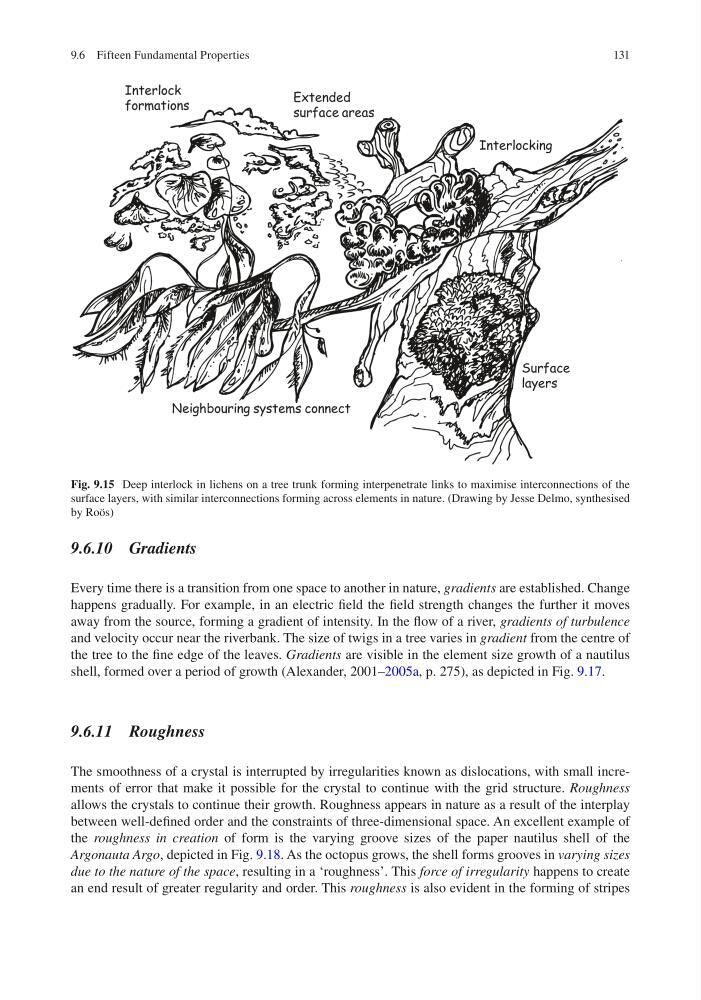
Fig. 9.15 Deep interlock in lichens on a tree trunk forming interpenetrate links to maximise interconnections of the
surface layers, with similar interconnections forming across elements in nature. (Drawing by Jesse Delmo, synthesised
by Roös)
9.6 Fifteen Fundamental Properties
9.6.10 Gradients
Every time there is a transition from one space to another in nature, gradients are established. Change
happens gradually. For example, in an electric field the field strength changes the further it moves
away from the source, forming a gradient of intensity. In the flow of a river, gradients of turbulence
and velocity occur near the riverbank. The size of twigs in a tree varies in gradient from the centre of
the tree to the fine edge of the leaves. Gradients are visible in the element size growth of a nautilus
shell, formed over a period of growth (Alexander, 2001–2005a, p. 275), as depicted in Fig. 9.17.
9.6.11 Roughness
The smoothness of a crystal is interrupted by irregularities known as dislocations, with small increments of error that make it possible for the crystal to continue with the grid structure. Roughness
allows the crystals to continue their growth. Roughness appears in nature as a result of the interplay
between well-defined order and the constraints of three-dimensional space. An excellent example of
the roughness in creation of form is the varying groove sizes of the paper nautilus shell of the
Argonauta Argo, depicted in Fig. 9.18. As the octopus grows, the shell forms grooves in varying sizes
due to the nature of the space, resulting in a ‘roughness’. This force of irregularity happens to create
an end result of greater regularity and order. This roughness is also evident in the forming of stripes
Fig. 9.15 Deep interlock in lichens on a tree trunk forming interpenetrate links to maximise interconnections of the
surface layers, with similar interconnections forming across elements in nature. (Drawing by Jesse Delmo, synthesised
by Roös)
9.6 Fifteen Fundamental Properties