

124
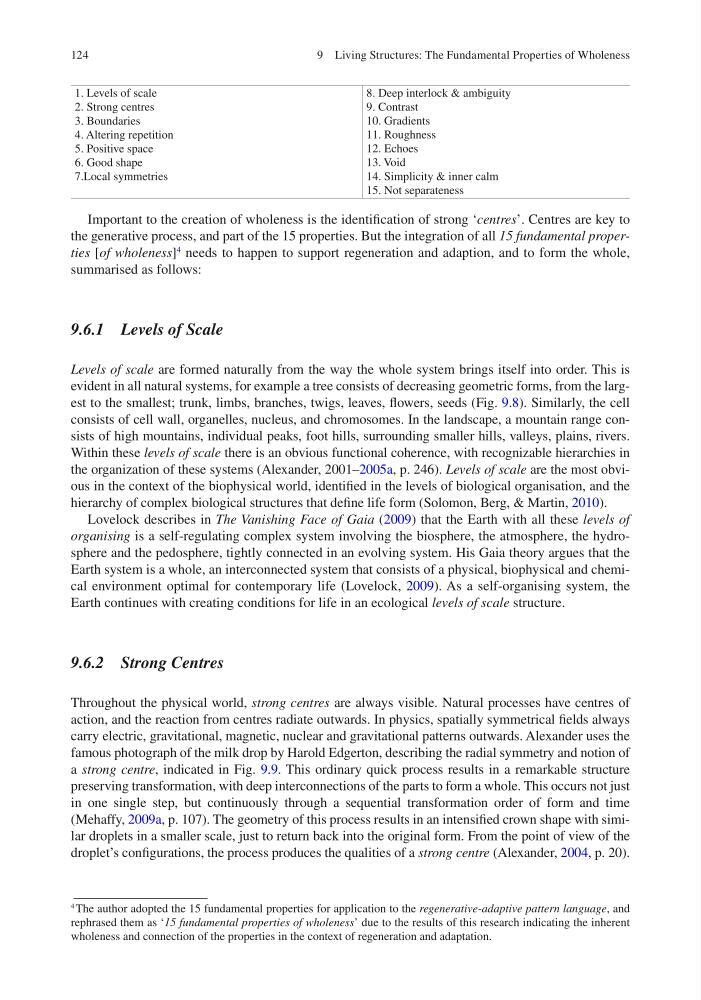
1. Levels of scale
2. Strong centres
3. Boundaries
4. Altering repetition
5. Positive space
6. Good shape
7.Local symmetries
8. Deep interlock & ambiguity
9. Contrast
10. Gradients
11. Roughness
12. Echoes
13. Void
14. Simplicity & inner calm
15. Not separateness
Important to the creation of wholeness is the identification of strong ‘centres’. Centres are key to
the generative process, and part of the 15 properties. But the integration of all 15 fundamental properties [of wholeness]
4
needs to happen to support regeneration and adaption, and to form the whole,
summarised as follows:
9.6.1 Levels of Scale
Levels of scale are formed naturally from the way the whole system brings itself into order. This is
evident in all natural systems, for example a tree consists of decreasing geometric forms, from the largest to the smallest; trunk, limbs, branches, twigs, leaves, flowers, seeds (Fig. 9.8). Similarly, the cell
consists of cell wall, organelles, nucleus, and chromosomes. In the landscape, a mountain range consists of high mountains, individual peaks, foot hills, surrounding smaller hills, valleys, plains, rivers.
Within these levels of scale there is an obvious functional coherence, with recognizable hierarchies in
the organization of these systems (Alexander, 2001–2005a, p. 246). Levels of scale are the most obvious in the context of the biophysical world, identified in the levels of biological organisation, and the
hierarchy of complex biological structures that define life form (Solomon, Berg, & Martin, 2010).
Lovelock describes in The Vanishing Face of Gaia (2009) that the Earth with all these levels of
organising is a self-regulating complex system involving the biosphere, the atmosphere, the hydrosphere and the pedosphere, tightly connected in an evolving system. His Gaia theory argues that the
Earth system is a whole, an interconnected system that consists of a physical, biophysical and chemical environment optimal for contemporary life (Lovelock, 2009). As a self- organising system, the
Earth continues with creating conditions for life in an ecological levels of scale structure.
9.6.2 Strong Centres
Throughout the physical world, strong centres are always visible. Natural processes have centres of
action, and the reaction from centres radiate outwards. In physics, spatially symmetrical fields always
carry electric, gravitational, magnetic, nuclear and gravitational patterns outwards. Alexander uses the
famous photograph of the milk drop by Harold Edgerton, describing the radial symmetry and notion of
a strong centre, indicated in Fig. 9.9. This ordinary quick process results in a remarkable structure
preserving transformation, with deep interconnections of the parts to form a whole. This occurs not just
in one single step, but continuously through a sequential transformation order of form and time
(Mehaffy, 2009a, p. 107). The geometry of this process results in an intensified crown shape with similar droplets in a smaller scale, just to return back into the original form. From the point of view of the
droplet’s configurations, the process produces the qualities of a strong centre (Alexander, 2004, p. 20).
4 The author adopted the 15 fundamental properties for application to the regenerative-adaptive pattern language, and
rephrased them as ‘15 fundamental properties of wholeness’ due to the results of this research indicating the inherent
wholeness and connection of the properties in the context of regeneration and adaptation.
9 Living Structures: The Fundamental Properties of Wholeness
1. Levels of scale
2. Strong centres
3. Boundaries
4. Altering repetition
5. Positive space
6. Good shape
7.Local symmetries
8. Deep interlock & ambiguity
9. Contrast
10. Gradients
11. Roughness
12. Echoes
13. Void
14. Simplicity & inner calm
15. Not separateness
Important to the creation of wholeness is the identification of strong ‘centres’. Centres are key to
the generative process, and part of the 15 properties. But the integration of all 15 fundamental properties [of wholeness]
4
needs to happen to support regeneration and adaption, and to form the whole,
summarised as follows:
9.6.1 Levels of Scale
Levels of scale are formed naturally from the way the whole system brings itself into order. This is
evident in all natural systems, for example a tree consists of decreasing geometric forms, from the largest to the smallest; trunk, limbs, branches, twigs, leaves, flowers, seeds (Fig. 9.8). Similarly, the cell
consists of cell wall, organelles, nucleus, and chromosomes. In the landscape, a mountain range consists of high mountains, individual peaks, foot hills, surrounding smaller hills, valleys, plains, rivers.
Within these levels of scale there is an obvious functional coherence, with recognizable hierarchies in
the organization of these systems (Alexander, 2001–2005a, p. 246). Levels of scale are the most obvious in the context of the biophysical world, identified in the levels of biological organisation, and the
hierarchy of complex biological structures that define life form (Solomon, Berg, & Martin, 2010).
Lovelock describes in The Vanishing Face of Gaia (2009) that the Earth with all these levels of
organising is a self-regulating complex system involving the biosphere, the atmosphere, the hydrosphere and the pedosphere, tightly connected in an evolving system. His Gaia theory argues that the
Earth system is a whole, an interconnected system that consists of a physical, biophysical and chemical environment optimal for contemporary life (Lovelock, 2009). As a self- organising system, the
Earth continues with creating conditions for life in an ecological levels of scale structure.
9.6.2 Strong Centres
Throughout the physical world, strong centres are always visible. Natural processes have centres of
action, and the reaction from centres radiate outwards. In physics, spatially symmetrical fields always
carry electric, gravitational, magnetic, nuclear and gravitational patterns outwards. Alexander uses the
famous photograph of the milk drop by Harold Edgerton, describing the radial symmetry and notion of
a strong centre, indicated in Fig. 9.9. This ordinary quick process results in a remarkable structure
preserving transformation, with deep interconnections of the parts to form a whole. This occurs not just
in one single step, but continuously through a sequential transformation order of form and time
(Mehaffy, 2009a, p. 107). The geometry of this process results in an intensified crown shape with similar droplets in a smaller scale, just to return back into the original form. From the point of view of the
droplet’s configurations, the process produces the qualities of a strong centre (Alexander, 2004, p. 20).
4 The author adopted the 15 fundamental properties for application to the regenerative-adaptive pattern language, and
rephrased them as ‘15 fundamental properties of wholeness’ due to the results of this research indicating the inherent
wholeness and connection of the properties in the context of regeneration and adaptation.
9 Living Structures: The Fundamental Properties of Wholeness