

108
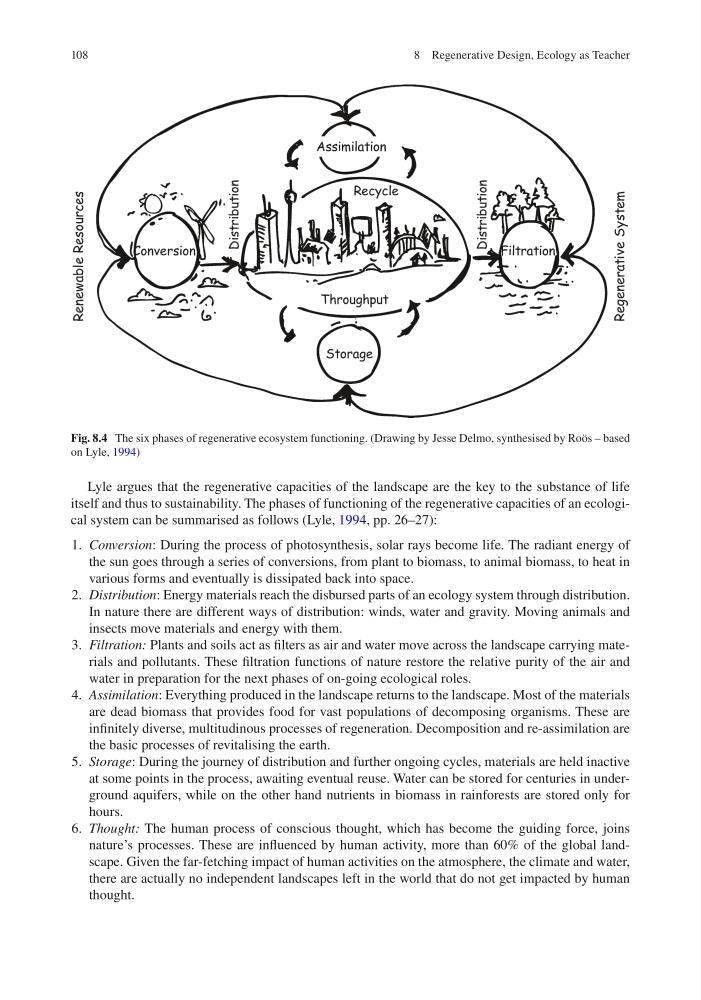
Lyle argues that the regenerative capacities of the landscape are the key to the substance of life
itself and thus to sustainability. The phases of functioning of the regenerative capacities of an ecological system can be summarised as follows (Lyle, 1994, pp. 26–27):
1. Conversion: During the process of photosynthesis, solar rays become life. The radiant energy of
the sun goes through a series of conversions, from plant to biomass, to animal biomass, to heat in
various forms and eventually is dissipated back into space.
2. Distribution: Energy materials reach the disbursed parts of an ecology system through distribution.
In nature there are different ways of distribution: winds, water and gravity. Moving animals and
insects move materials and energy with them.
3. Filtration: Plants and soils act as filters as air and water move across the landscape carrying materials and pollutants. These filtration functions of nature restore the relative purity of the air and
water in preparation for the next phases of on-going ecological roles.
4. Assimilation: Everything produced in the landscape returns to the landscape. Most of the materials
are dead biomass that provides food for vast populations of decomposing organisms. These are
infinitely diverse, multitudinous processes of regeneration. Decomposition and re-assimilation are
the basic processes of revitalising the earth.
5. Storage: During the journey of distribution and further ongoing cycles, materials are held inactive
at some points in the process, awaiting eventual reuse. Water can be stored for centuries in underground aquifers, while on the other hand nutrients in biomass in rainforests are stored only for
hours.
6. Thought: The human process of conscious thought, which has become the guiding force, joins
nature’s processes. These are influenced by human activity, more than 60% of the global landscape. Given the far-fetching impact of human activities on the atmosphere, the climate and water,
there are actually no independent landscapes left in the world that do not get impacted by human
thought.
Fig. 8.4 The six phases of regenerative ecosystem functioning. (Drawing by Jesse Delmo, synthesised by Roös – based
on Lyle, 1994)
8 Regenerative Design, Ecology as Teacher
Lyle argues that the regenerative capacities of the landscape are the key to the substance of life
itself and thus to sustainability. The phases of functioning of the regenerative capacities of an ecological system can be summarised as follows (Lyle, 1994, pp. 26–27):
1. Conversion: During the process of photosynthesis, solar rays become life. The radiant energy of
the sun goes through a series of conversions, from plant to biomass, to animal biomass, to heat in
various forms and eventually is dissipated back into space.
2. Distribution: Energy materials reach the disbursed parts of an ecology system through distribution.
In nature there are different ways of distribution: winds, water and gravity. Moving animals and
insects move materials and energy with them.
3. Filtration: Plants and soils act as filters as air and water move across the landscape carrying materials and pollutants. These filtration functions of nature restore the relative purity of the air and
water in preparation for the next phases of on-going ecological roles.
4. Assimilation: Everything produced in the landscape returns to the landscape. Most of the materials
are dead biomass that provides food for vast populations of decomposing organisms. These are
infinitely diverse, multitudinous processes of regeneration. Decomposition and re-assimilation are
the basic processes of revitalising the earth.
5. Storage: During the journey of distribution and further ongoing cycles, materials are held inactive
at some points in the process, awaiting eventual reuse. Water can be stored for centuries in underground aquifers, while on the other hand nutrients in biomass in rainforests are stored only for
hours.
6. Thought: The human process of conscious thought, which has become the guiding force, joins
nature’s processes. These are influenced by human activity, more than 60% of the global landscape. Given the far-fetching impact of human activities on the atmosphere, the climate and water,
there are actually no independent landscapes left in the world that do not get impacted by human
thought.
Fig. 8.4 The six phases of regenerative ecosystem functioning. (Drawing by Jesse Delmo, synthesised by Roös – based
on Lyle, 1994)
8 Regenerative Design, Ecology as Teacher