

109
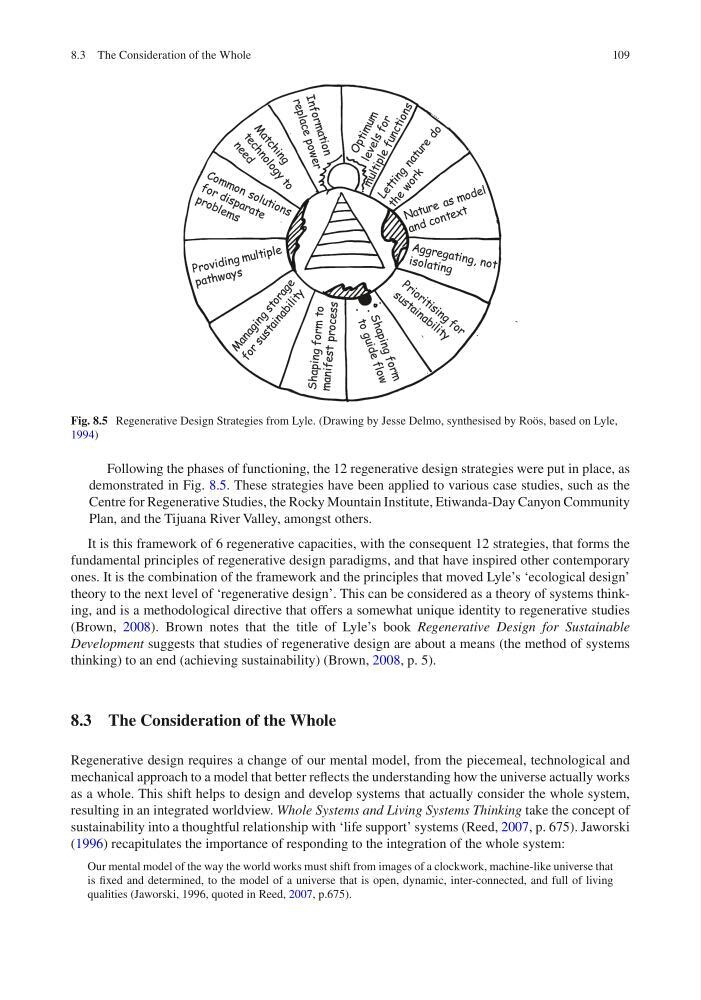
Following the phases of functioning, the 12 regenerative design strategies were put in place, as
demonstrated in Fig. 8.5. These strategies have been applied to various case studies, such as the
Centre for Regenerative Studies, the Rocky Mountain Institute, Etiwanda- Day Canyon Community
Plan, and the Tijuana River Valley, amongst others.
It is this framework of 6 regenerative capacities, with the consequent 12 strategies, that forms the
fundamental principles of regenerative design paradigms, and that have inspired other contemporary
ones. It is the combination of the framework and the principles that moved Lyle’s ‘ecological design’
theory to the next level of ‘regenerative design’. This can be considered as a theory of systems thinking, and is a methodological directive that offers a somewhat unique identity to regenerative studies
(Brown, 2008). Brown notes that the title of Lyle’s book Regenerative Design for Sustainable
Development suggests that studies of regenerative design are about a means (the method of systems
thinking) to an end (achieving sustainability) (Brown, 2008, p. 5).
8.3 The Consideration of the Whole
Regenerative design requires a change of our mental model, from the piecemeal, technological and
mechanical approach to a model that better reflects the understanding how the universe actually works
as a whole. This shift helps to design and develop systems that actually consider the whole system,
resulting in an integrated worldview. Whole Systems and Living Systems Thinking take the concept of
sustainability into a thoughtful relationship with ‘life support’ systems (Reed, 2007, p. 675). Jaworski
(1996) recapitulates the importance of responding to the integration of the whole system:
Our mental model of the way the world works must shift from images of a clockwork, machine- like universe that
is fixed and determined, to the model of a universe that is open, dynamic, inter- connected, and full of living
qualities (Jaworski, 1996, quoted in Reed, 2007, p.675).
Fig. 8.5 Regenerative Design Strategies from Lyle. (Drawing by Jesse Delmo, synthesised by Roös, based on Lyle,
1994)
8.3 The Consideration of the Whole
Following the phases of functioning, the 12 regenerative design strategies were put in place, as
demonstrated in Fig. 8.5. These strategies have been applied to various case studies, such as the
Centre for Regenerative Studies, the Rocky Mountain Institute, Etiwanda- Day Canyon Community
Plan, and the Tijuana River Valley, amongst others.
It is this framework of 6 regenerative capacities, with the consequent 12 strategies, that forms the
fundamental principles of regenerative design paradigms, and that have inspired other contemporary
ones. It is the combination of the framework and the principles that moved Lyle’s ‘ecological design’
theory to the next level of ‘regenerative design’. This can be considered as a theory of systems thinking, and is a methodological directive that offers a somewhat unique identity to regenerative studies
(Brown, 2008). Brown notes that the title of Lyle’s book Regenerative Design for Sustainable
Development suggests that studies of regenerative design are about a means (the method of systems
thinking) to an end (achieving sustainability) (Brown, 2008, p. 5).
8.3 The Consideration of the Whole
Regenerative design requires a change of our mental model, from the piecemeal, technological and
mechanical approach to a model that better reflects the understanding how the universe actually works
as a whole. This shift helps to design and develop systems that actually consider the whole system,
resulting in an integrated worldview. Whole Systems and Living Systems Thinking take the concept of
sustainability into a thoughtful relationship with ‘life support’ systems (Reed, 2007, p. 675). Jaworski
(1996) recapitulates the importance of responding to the integration of the whole system:
Our mental model of the way the world works must shift from images of a clockwork, machine- like universe that
is fixed and determined, to the model of a universe that is open, dynamic, inter- connected, and full of living
qualities (Jaworski, 1996, quoted in Reed, 2007, p.675).
Fig. 8.5 Regenerative Design Strategies from Lyle. (Drawing by Jesse Delmo, synthesised by Roös, based on Lyle,
1994)
8.3 The Consideration of the Whole