

107
of a diverse structure, with interactions among elements and species within the system that benefit the
whole; in this way, resilience is built into the structure (Lyle, 1994, p. 23).
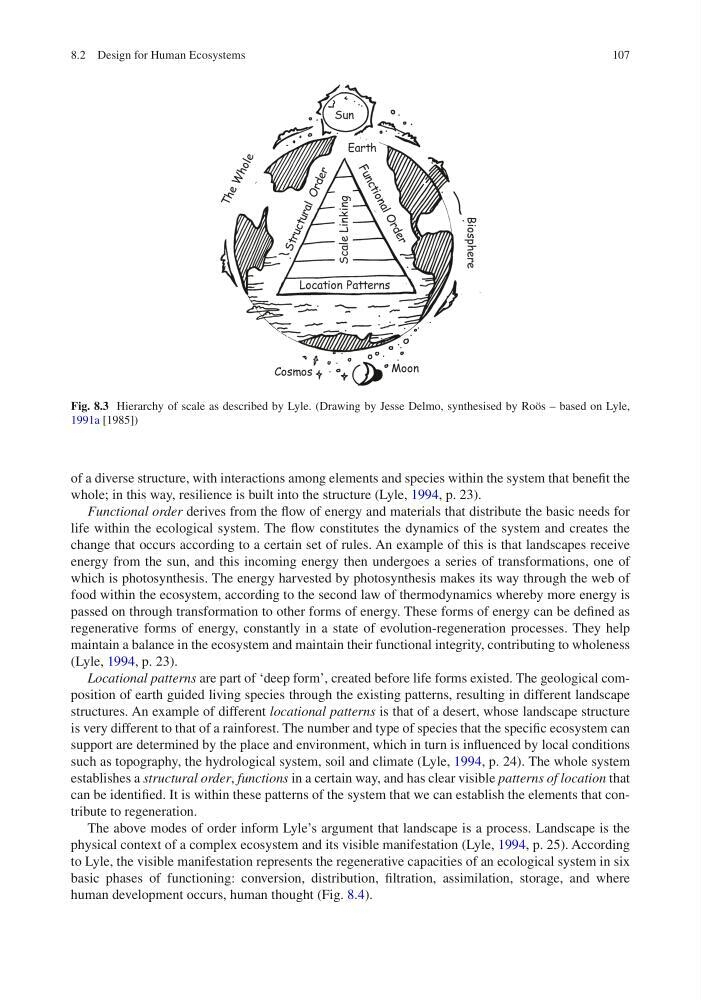
Functional order derives from the flow of energy and materials that distribute the basic needs for
life within the ecological system. The flow constitutes the dynamics of the system and creates the
change that occurs according to a certain set of rules. An example of this is that landscapes receive
energy from the sun, and this incoming energy then undergoes a series of transformations, one of
which is photosynthesis. The energy harvested by photosynthesis makes its way through the web of
food within the ecosystem, according to the second law of thermodynamics whereby more energy is
passed on through transformation to other forms of energy. These forms of energy can be defined as
regenerative forms of energy, constantly in a state of evolution-regeneration processes. They help
maintain a balance in the ecosystem and maintain their functional integrity, contributing to wholeness
(Lyle, 1994, p. 23).
Locational patterns are part of ‘deep form’, created before life forms existed. The geological composition of earth guided living species through the existing patterns, resulting in different landscape
structures. An example of different locational patterns is that of a desert, whose landscape structure
is very different to that of a rainforest. The number and type of species that the specific ecosystem can
support are determined by the place and environment, which in turn is influenced by local conditions
such as topography, the hydrological system, soil and climate (Lyle, 1994, p. 24). The whole system
establishes a structural order, functions in a certain way, and has clear visible patterns of location that
can be identified. It is within these patterns of the system that we can establish the elements that contribute to regeneration.
The above modes of order inform Lyle’s argument that landscape is a process. Landscape is the
physical context of a complex ecosystem and its visible manifestation (Lyle, 1994, p. 25). According
to Lyle, the visible manifestation represents the regenerative capacities of an ecological system in six
basic phases of functioning: conversion, distribution, filtration, assimilation, storage, and where
human development occurs, human thought (Fig. 8.4).
Fig. 8.3 Hierarchy of scale as described by Lyle. (Drawing by Jesse Delmo, synthesised by Roös – based on Lyle,
1991a [1985])
8.2 Design for Human Ecosystems
of a diverse structure, with interactions among elements and species within the system that benefit the
whole; in this way, resilience is built into the structure (Lyle, 1994, p. 23).
Functional order derives from the flow of energy and materials that distribute the basic needs for
life within the ecological system. The flow constitutes the dynamics of the system and creates the
change that occurs according to a certain set of rules. An example of this is that landscapes receive
energy from the sun, and this incoming energy then undergoes a series of transformations, one of
which is photosynthesis. The energy harvested by photosynthesis makes its way through the web of
food within the ecosystem, according to the second law of thermodynamics whereby more energy is
passed on through transformation to other forms of energy. These forms of energy can be defined as
regenerative forms of energy, constantly in a state of evolution-regeneration processes. They help
maintain a balance in the ecosystem and maintain their functional integrity, contributing to wholeness
(Lyle, 1994, p. 23).
Locational patterns are part of ‘deep form’, created before life forms existed. The geological composition of earth guided living species through the existing patterns, resulting in different landscape
structures. An example of different locational patterns is that of a desert, whose landscape structure
is very different to that of a rainforest. The number and type of species that the specific ecosystem can
support are determined by the place and environment, which in turn is influenced by local conditions
such as topography, the hydrological system, soil and climate (Lyle, 1994, p. 24). The whole system
establishes a structural order, functions in a certain way, and has clear visible patterns of location that
can be identified. It is within these patterns of the system that we can establish the elements that contribute to regeneration.
The above modes of order inform Lyle’s argument that landscape is a process. Landscape is the
physical context of a complex ecosystem and its visible manifestation (Lyle, 1994, p. 25). According
to Lyle, the visible manifestation represents the regenerative capacities of an ecological system in six
basic phases of functioning: conversion, distribution, filtration, assimilation, storage, and where
human development occurs, human thought (Fig. 8.4).
Fig. 8.3 Hierarchy of scale as described by Lyle. (Drawing by Jesse Delmo, synthesised by Roös – based on Lyle,
1991a [1985])
8.2 Design for Human Ecosystems