

96
(Darwin, 2003 [1861]) and the lesser known physiologist and biochemist Lawrence Henderson’s The
Fitness of the Environment (Henderson, 1913).
McHarg defined fit as a blend of these two scientific theories, where every organism, system, and
constitution are required to find the fittest environment to adapt to (McHarg & Steiner, 2006). Creative
fitting theory takes ecological planning to the next level: ecological design. McHarg further strengthened his theory in his definition of Ecological Design:
Ecological design follows planning and introduces the subject of form. There should be an intrinsically suitable
location, processes with appropriate materials, and forms. Design requires an informed designer with a visual
imagination, as well as graphic and creative skills. It selects for creative fitting revealed in intrinsic and expressive form (McHarg, 1967, p. 123).
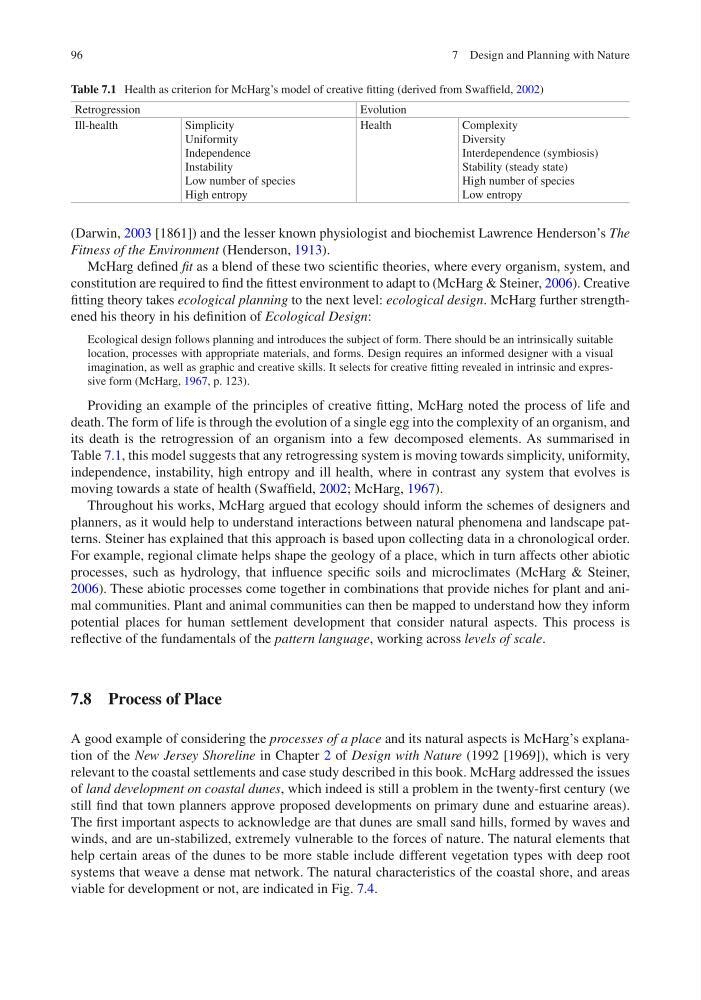
Providing an example of the principles of creative fitting, McHarg noted the process of life and
death. The form of life is through the evolution of a single egg into the complexity of an organism, and
its death is the retrogression of an organism into a few decomposed elements. As summarised in
Table 7.1, this model suggests that any retrogressing system is moving towards simplicity, uniformity,
independence, instability, high entropy and ill health, where in contrast any system that evolves is
moving towards a state of health (Swaffield, 2002; McHarg, 1967).
Throughout his works, McHarg argued that ecology should inform the schemes of designers and
planners, as it would help to understand interactions between natural phenomena and landscape patterns. Steiner has explained that this approach is based upon collecting data in a chronological order.
For example, regional climate helps shape the geology of a place, which in turn affects other abiotic
processes, such as hydrology, that influence specific soils and microclimates (McHarg & Steiner,
2006). These abiotic processes come together in combinations that provide niches for plant and animal communities. Plant and animal communities can then be mapped to understand how they inform
potential places for human settlement development that consider natural aspects. This process is
reflective of the fundamentals of the pattern language, working across levels of scale.
7.8 Process of Place
A good example of considering the processes of a place and its natural aspects is McHarg’s explanation of the New Jersey Shoreline in Chapter 2 of Design with Nature (1992 [1969]), which is very
relevant to the coastal settlements and case study described in this book. McHarg addressed the issues
of land development on coastal dunes, which indeed is still a problem in the twenty-first century (we
still find that town planners approve proposed developments on primary dune and estuarine areas).
The first important aspects to acknowledge are that dunes are small sand hills, formed by waves and
winds, and are un- stabilized, extremely vulnerable to the forces of nature. The natural elements that
help certain areas of the dunes to be more stable include different vegetation types with deep root
systems that weave a dense mat network. The natural characteristics of the coastal shore, and areas
viable for development or not, are indicated in Fig. 7.4.
Table 7.1 Health as criterion for McHarg’s model of creative fitting (derived from Swaffield, 2002)
Retrogression
Evolution
Ill- health
Simplicity
Uniformity
Independence
Instability
Low number of species
High entropy
Health
Complexity
Diversity
Interdependence (symbiosis)
Stability (steady state)
High number of species
Low entropy
7 Design and Planning with Nature
(Darwin, 2003 [1861]) and the lesser known physiologist and biochemist Lawrence Henderson’s The
Fitness of the Environment (Henderson, 1913).
McHarg defined fit as a blend of these two scientific theories, where every organism, system, and
constitution are required to find the fittest environment to adapt to (McHarg & Steiner, 2006). Creative
fitting theory takes ecological planning to the next level: ecological design. McHarg further strengthened his theory in his definition of Ecological Design:
Ecological design follows planning and introduces the subject of form. There should be an intrinsically suitable
location, processes with appropriate materials, and forms. Design requires an informed designer with a visual
imagination, as well as graphic and creative skills. It selects for creative fitting revealed in intrinsic and expressive form (McHarg, 1967, p. 123).
Providing an example of the principles of creative fitting, McHarg noted the process of life and
death. The form of life is through the evolution of a single egg into the complexity of an organism, and
its death is the retrogression of an organism into a few decomposed elements. As summarised in
Table 7.1, this model suggests that any retrogressing system is moving towards simplicity, uniformity,
independence, instability, high entropy and ill health, where in contrast any system that evolves is
moving towards a state of health (Swaffield, 2002; McHarg, 1967).
Throughout his works, McHarg argued that ecology should inform the schemes of designers and
planners, as it would help to understand interactions between natural phenomena and landscape patterns. Steiner has explained that this approach is based upon collecting data in a chronological order.
For example, regional climate helps shape the geology of a place, which in turn affects other abiotic
processes, such as hydrology, that influence specific soils and microclimates (McHarg & Steiner,
2006). These abiotic processes come together in combinations that provide niches for plant and animal communities. Plant and animal communities can then be mapped to understand how they inform
potential places for human settlement development that consider natural aspects. This process is
reflective of the fundamentals of the pattern language, working across levels of scale.
7.8 Process of Place
A good example of considering the processes of a place and its natural aspects is McHarg’s explanation of the New Jersey Shoreline in Chapter 2 of Design with Nature (1992 [1969]), which is very
relevant to the coastal settlements and case study described in this book. McHarg addressed the issues
of land development on coastal dunes, which indeed is still a problem in the twenty-first century (we
still find that town planners approve proposed developments on primary dune and estuarine areas).
The first important aspects to acknowledge are that dunes are small sand hills, formed by waves and
winds, and are un- stabilized, extremely vulnerable to the forces of nature. The natural elements that
help certain areas of the dunes to be more stable include different vegetation types with deep root
systems that weave a dense mat network. The natural characteristics of the coastal shore, and areas
viable for development or not, are indicated in Fig. 7.4.
Table 7.1 Health as criterion for McHarg’s model of creative fitting (derived from Swaffield, 2002)
Retrogression
Evolution
Ill- health
Simplicity
Uniformity
Independence
Instability
Low number of species
High entropy
Health
Complexity
Diversity
Interdependence (symbiosis)
Stability (steady state)
High number of species
Low entropy
7 Design and Planning with Nature