

265
Word of what happened got around very quickly. The geology-oceanography
graduate students assembled in the College bar to discuss the situation. Amid much
laughter at a fellow student’s misfortune, we tried to figure out whether or not the
Land Rover would be washed away after it became submerged under 30 or more
feet (9 m) of water that flowed into and out of inner Swansea Bay over a tidal cycle.
The next low tide was soon after midnight. Armed with flashlights a large group of
students followed the tide out. We couldn’t see the Land Rover. We laid down on the
sand looking for its profile against the hardly visible horizon, but it was nowhere to
be seen. The students who thought the vehicle would be washed away claimed their
winnings from our bet over the various possibilities. We staggered off to bed and
returned the following late morning to follow the tide out once more, but this time
in daylight.
No one had predicted what we found. The Land Rover was exactly where KC
had left it, but the roof was level with the surface of the blue clay and surrounding
it was an approximately two foot (60 cm)-wide, water-filled, vertical-walled moat.
The vehicle had not sunken into the blue clay due to its weight, but the tidal currents
associated with the rising and/or falling tide had eroded out a rectangular-shaped
hole into which the entire Land Rover fit very neatly. We realized that the large
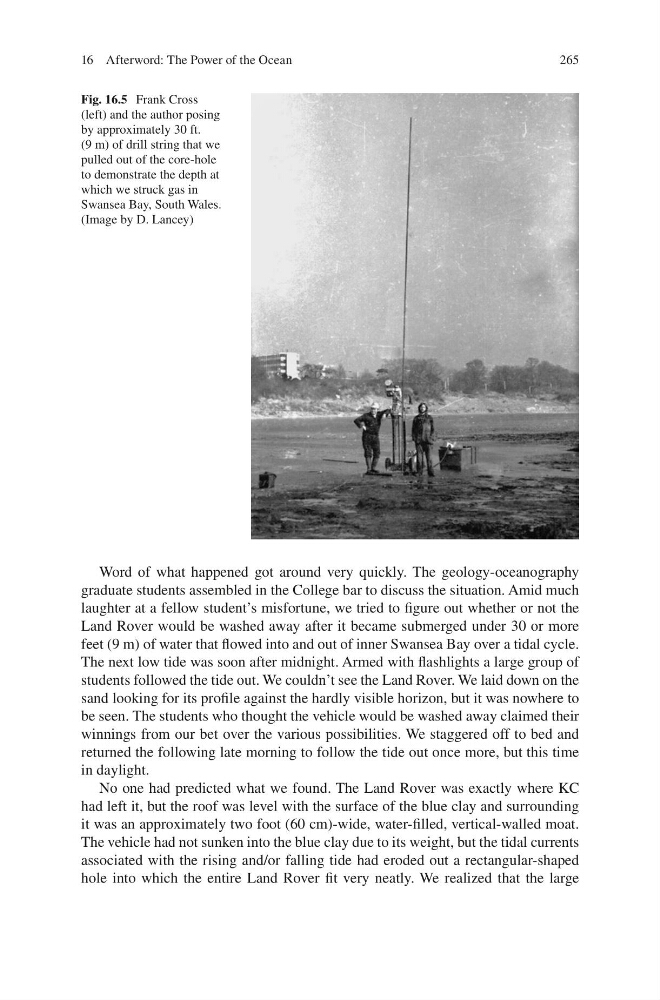
Fig. 16.5 Frank Cross
(left) and the author posing
by approximately 30 ft.
(9 m) of drill string that we
pulled out of the core-hole
to demonstrate the depth at
which we struck gas in
Swansea Bay, South Wales.
(Image by D. Lancey)
16 Afterword: The Power of the Ocean
Word of what happened got around very quickly. The geology-oceanography
graduate students assembled in the College bar to discuss the situation. Amid much
laughter at a fellow student’s misfortune, we tried to figure out whether or not the
Land Rover would be washed away after it became submerged under 30 or more
feet (9 m) of water that flowed into and out of inner Swansea Bay over a tidal cycle.
The next low tide was soon after midnight. Armed with flashlights a large group of
students followed the tide out. We couldn’t see the Land Rover. We laid down on the
sand looking for its profile against the hardly visible horizon, but it was nowhere to
be seen. The students who thought the vehicle would be washed away claimed their
winnings from our bet over the various possibilities. We staggered off to bed and
returned the following late morning to follow the tide out once more, but this time
in daylight.
No one had predicted what we found. The Land Rover was exactly where KC
had left it, but the roof was level with the surface of the blue clay and surrounding
it was an approximately two foot (60 cm)-wide, water-filled, vertical-walled moat.
The vehicle had not sunken into the blue clay due to its weight, but the tidal currents
associated with the rising and/or falling tide had eroded out a rectangular-shaped
hole into which the entire Land Rover fit very neatly. We realized that the large
Fig. 16.5 Frank Cross
(left) and the author posing
by approximately 30 ft.
(9 m) of drill string that we
pulled out of the core-hole
to demonstrate the depth at
which we struck gas in
Swansea Bay, South Wales.
(Image by D. Lancey)
16 Afterword: The Power of the Ocean