

264
my drilling program in the Bay, my graduate student colleagues and I experienced
an unusual example of the strength of tidal currents and their erosive capabilities.
A fellow student (I’ll call him KC after King Canute), who started a PhD at the
same time as I, was using geophysical approaches to map remotely the strata and
geologic structures underlying Swansea Bay and the adjacent Bristol Channel. One
afternoon, in the hope that we might strike gas once more, he decided to come out
and watch us drill a hole in the intertidal zone. KC arrived in a second departmental
Land Rover and he proceeded to drive across all of the various substrates that I
described above. He seemed to have no problems. Later that afternoon, Dave, Frank
and I packed up our gear as the tide turned and we got safely above the high tide line
where our Land Rover was parked. We departed while KC continued driving around
in the intertidal zone. It has been over 40 years, so what happened next is a little
fuzzy in my memory, much like the 40 year-old images that illustrate this essay.
Anyway, at some point KC stopped the vehicle on the blue clay that had begun to be
covered by sea water as the tide had turned. The water continued to rise, of course,
and KC decided to drive away. But the wheels spun as though he was on ice and no
matter what setting of the four-wheel drive he selected, the vehicle would not move.
Finally, the water got so high that he exited through a window and waded to shore
as the last light of day faded away.
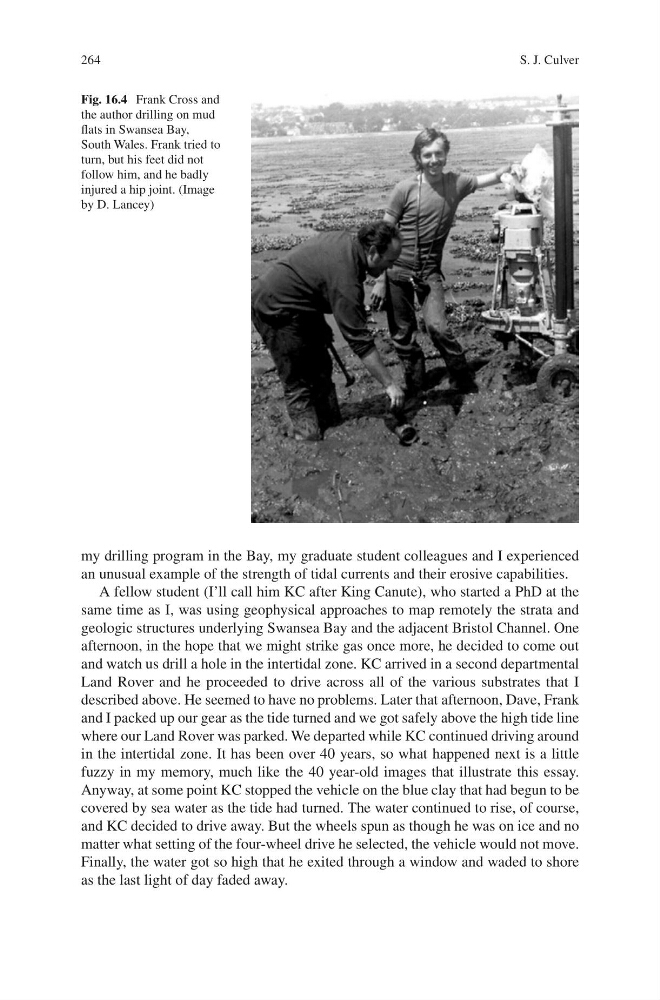
Fig. 16.4 Frank Cross and
the author drilling on mud
flats in Swansea Bay,
South Wales. Frank tried to
turn, but his feet did not
follow him, and he badly
injured a hip joint. (Image
by D. Lancey)
S. J. Culver
my drilling program in the Bay, my graduate student colleagues and I experienced
an unusual example of the strength of tidal currents and their erosive capabilities.
A fellow student (I’ll call him KC after King Canute), who started a PhD at the
same time as I, was using geophysical approaches to map remotely the strata and
geologic structures underlying Swansea Bay and the adjacent Bristol Channel. One
afternoon, in the hope that we might strike gas once more, he decided to come out
and watch us drill a hole in the intertidal zone. KC arrived in a second departmental
Land Rover and he proceeded to drive across all of the various substrates that I
described above. He seemed to have no problems. Later that afternoon, Dave, Frank
and I packed up our gear as the tide turned and we got safely above the high tide line
where our Land Rover was parked. We departed while KC continued driving around
in the intertidal zone. It has been over 40 years, so what happened next is a little
fuzzy in my memory, much like the 40 year-old images that illustrate this essay.
Anyway, at some point KC stopped the vehicle on the blue clay that had begun to be
covered by sea water as the tide had turned. The water continued to rise, of course,
and KC decided to drive away. But the wheels spun as though he was on ice and no
matter what setting of the four-wheel drive he selected, the vehicle would not move.
Finally, the water got so high that he exited through a window and waded to shore
as the last light of day faded away.
Fig. 16.4 Frank Cross and
the author drilling on mud
flats in Swansea Bay,
South Wales. Frank tried to
turn, but his feet did not
follow him, and he badly
injured a hip joint. (Image
by D. Lancey)
S. J. Culver