

248
(Fig. 14.13) throughout the Western Atlantic and Caribbean is devastating reef-fish
assemblages. Warm-water events are often regional in scale as well, though certainly influenced by global processes.
At global scales, the single greatest threat to corals is the rapid increase in carbon
dioxide (CO 2 ) in the Earth’s atmosphere, by more than 35% over the past century,
most of that in the past 50 years. The increase of CO 2 not only plays a major role
inducing climate change but has measurably increased the acidity of ocean waters.
The increase in acidity has multiple implications for organisms like corals that produce calcium-carbonate skeletons or shells. As oceans become more acidic, more
energy is required to build a skeleton or shell. This, of course, is occurring at the
same time that rising temperatures throughout the year are increasing metabolic
rates and thereby reducing accumulation of storage products essential for reproduction and for survival during times of additional stress such as bleaching events.
Compared to the magnitudes of increase in ocean acidity and decline in stratospheric ozone concentrations, the roughly 1°C increase in global temperatures to
date might seem inconsequential. However, the problem for corals, as well as for
humans, is that these changes build upon each other, are amplified in certain regions
of the world, and are dynamically influenced by natural events such as El Niño and
volcanic eruptions. An important lesson comes from the 1982–1983 mass coral
bleaching, which was associated with regional ocean warming and increased water
transparency driven by the El Niño conditions, amplified by the 3–4% reduction in
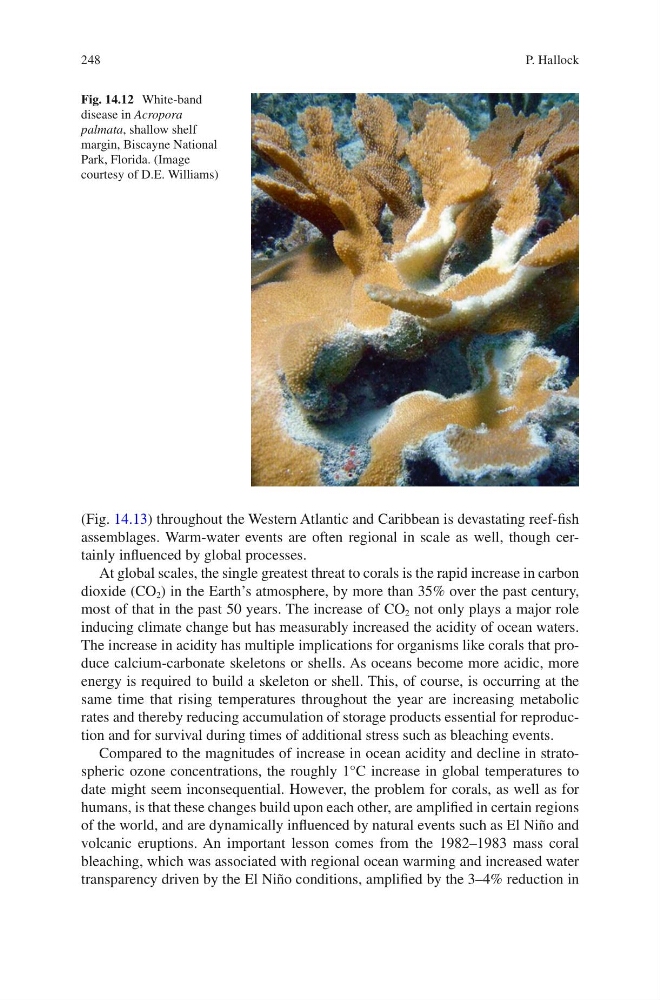
Fig. 14.12 White-band
disease in Acropora
palmata, shallow shelf
margin, Biscayne National
Park, Florida. (Image
courtesy of D.E. Williams)
P. Hallock
(Fig. 14.13) throughout the Western Atlantic and Caribbean is devastating reef-fish
assemblages. Warm-water events are often regional in scale as well, though certainly influenced by global processes.
At global scales, the single greatest threat to corals is the rapid increase in carbon
dioxide (CO 2 ) in the Earth’s atmosphere, by more than 35% over the past century,
most of that in the past 50 years. The increase of CO 2 not only plays a major role
inducing climate change but has measurably increased the acidity of ocean waters.
The increase in acidity has multiple implications for organisms like corals that produce calcium-carbonate skeletons or shells. As oceans become more acidic, more
energy is required to build a skeleton or shell. This, of course, is occurring at the
same time that rising temperatures throughout the year are increasing metabolic
rates and thereby reducing accumulation of storage products essential for reproduction and for survival during times of additional stress such as bleaching events.
Compared to the magnitudes of increase in ocean acidity and decline in stratospheric ozone concentrations, the roughly 1°C increase in global temperatures to
date might seem inconsequential. However, the problem for corals, as well as for
humans, is that these changes build upon each other, are amplified in certain regions
of the world, and are dynamically influenced by natural events such as El Niño and
volcanic eruptions. An important lesson comes from the 1982–1983 mass coral
bleaching, which was associated with regional ocean warming and increased water
transparency driven by the El Niño conditions, amplified by the 3–4% reduction in
Fig. 14.12 White-band
disease in Acropora
palmata, shallow shelf
margin, Biscayne National
Park, Florida. (Image
courtesy of D.E. Williams)
P. Hallock