

192
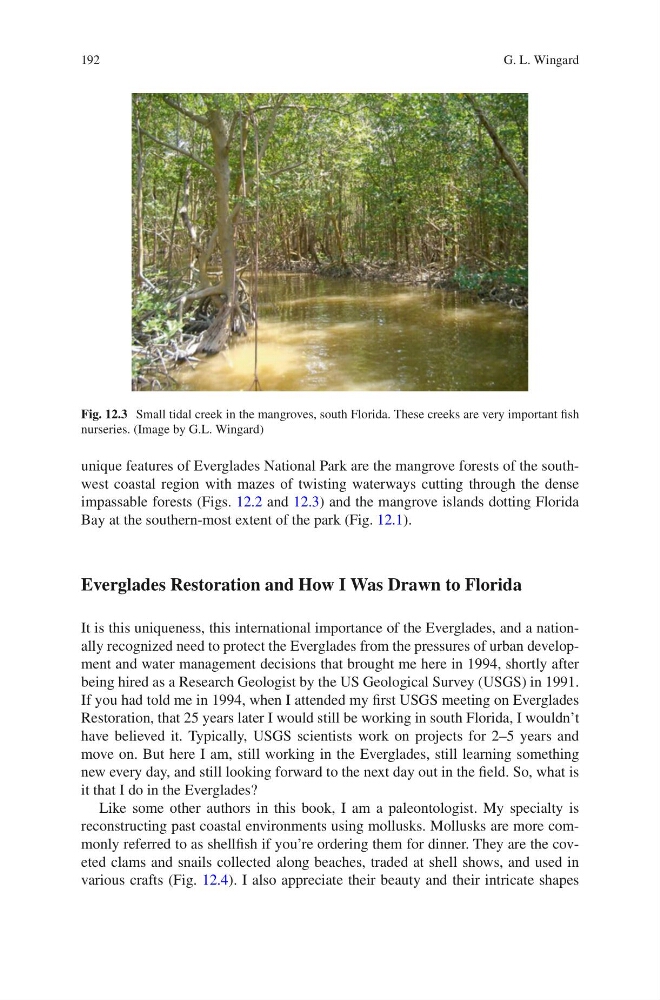
unique features of Everglades National Park are the mangrove forests of the southwest coastal region with mazes of twisting waterways cutting through the dense
impassable forests (Figs. 12.2 and 12.3) and the mangrove islands dotting Florida
Bay at the southern-most extent of the park (Fig. 12.1).
Everglades Restoration and How I Was Drawn to Florida
It is this uniqueness, this international importance of the Everglades, and a nationally recognized need to protect the Everglades from the pressures of urban development and water management decisions that brought me here in 1994, shortly after
being hired as a Research Geologist by the US Geological Survey (USGS) in 1991.
If you had told me in 1994, when I attended my first USGS meeting on Everglades
Restoration, that 25 years later I would still be working in south Florida, I wouldn’t
have believed it. Typically, USGS scientists work on projects for 2–5 years and
move on. But here I am, still working in the Everglades, still learning something
new every day, and still looking forward to the next day out in the field. So, what is
it that I do in the Everglades?
Like some other authors in this book, I am a paleontologist. My specialty is
reconstructing past coastal environments using mollusks. Mollusks are more commonly referred to as shellfish if you’re ordering them for dinner. They are the coveted clams and snails collected along beaches, traded at shell shows, and used in
various crafts (Fig. 12.4). I also appreciate their beauty and their intricate shapes
Fig. 12.3 Small tidal creek in the mangroves, south Florida. These creeks are very important fish
nurseries. (Image by G.L. Wingard)
G. L. Wingard
unique features of Everglades National Park are the mangrove forests of the southwest coastal region with mazes of twisting waterways cutting through the dense
impassable forests (Figs. 12.2 and 12.3) and the mangrove islands dotting Florida
Bay at the southern-most extent of the park (Fig. 12.1).
Everglades Restoration and How I Was Drawn to Florida
It is this uniqueness, this international importance of the Everglades, and a nationally recognized need to protect the Everglades from the pressures of urban development and water management decisions that brought me here in 1994, shortly after
being hired as a Research Geologist by the US Geological Survey (USGS) in 1991.
If you had told me in 1994, when I attended my first USGS meeting on Everglades
Restoration, that 25 years later I would still be working in south Florida, I wouldn’t
have believed it. Typically, USGS scientists work on projects for 2–5 years and
move on. But here I am, still working in the Everglades, still learning something
new every day, and still looking forward to the next day out in the field. So, what is
it that I do in the Everglades?
Like some other authors in this book, I am a paleontologist. My specialty is
reconstructing past coastal environments using mollusks. Mollusks are more commonly referred to as shellfish if you’re ordering them for dinner. They are the coveted clams and snails collected along beaches, traded at shell shows, and used in
various crafts (Fig. 12.4). I also appreciate their beauty and their intricate shapes
Fig. 12.3 Small tidal creek in the mangroves, south Florida. These creeks are very important fish
nurseries. (Image by G.L. Wingard)
G. L. Wingard