

193
and patterns, but when I pluck a seashell from the surf, its value to me is as a piece
of a puzzle. The puzzle I have spent much of my career putting together, is what did
south Florida look like before it was re-engineered by humans? My goal in understanding the past is to contribute to the restoration of damaged environments. To
understand and interpret the clues left behind by past life, however, we must first
understand the present (“the present is the key to the past”, a first principle,
Uniformitarianism, taught to all geology students) so I gather all the information I
can about living mollusks. Where do they live? If they are in water, how deep is it,
how salty, how clear? Do they live on sand, mud, or seagrasses? Each living mollusk
I find adds another piece to the puzzle and allows me to fill in the picture of the past
preserved in sediments.
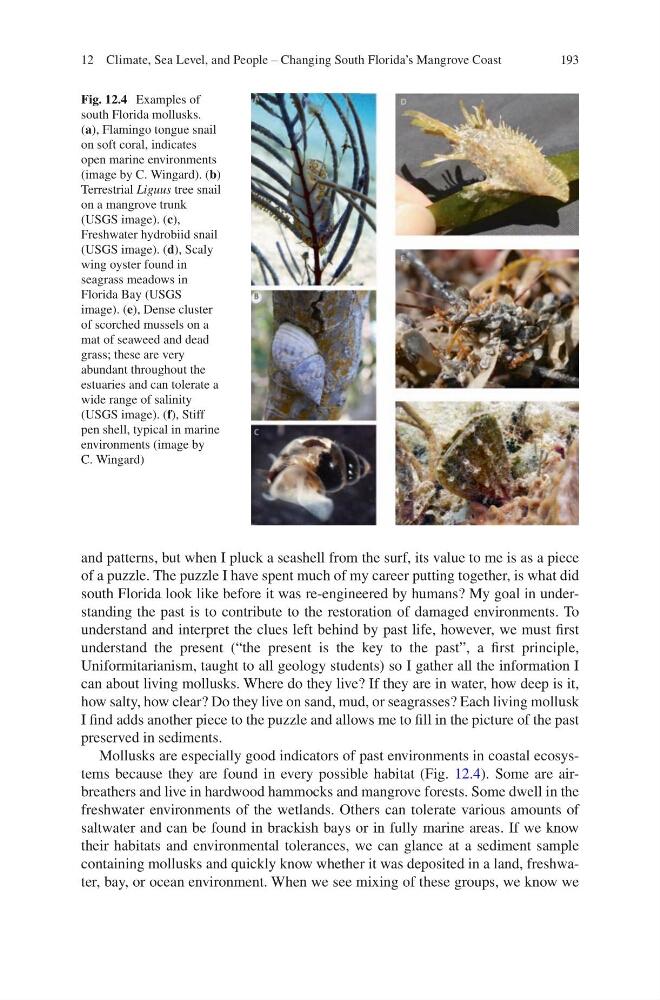
Mollusks are especially good indicators of past environments in coastal ecosystems because they are found in every possible habitat (Fig. 12.4). Some are airbreathers and live in hardwood hammocks and mangrove forests. Some dwell in the
freshwater environments of the wetlands. Others can tolerate various amounts of
saltwater and can be found in brackish bays or in fully marine areas. If we know
their habitats and environmental tolerances, we can glance at a sediment sample
containing mollusks and quickly know whether it was deposited in a land, freshwater, bay, or ocean environment. When we see mixing of these groups, we know we
Fig. 12.4 Examples of
south Florida mollusks.
(a), Flamingo tongue snail
on soft coral, indicates
open marine environments
(image by C. Wingard). (b)
Terrestrial Liguus tree snail
on a mangrove trunk
(USGS image). (c),
Freshwater hydrobiid snail
(USGS image). (d), Scaly
wing oyster found in
seagrass meadows in
Florida Bay (USGS
image). (e), Dense cluster
of scorched mussels on a
mat of seaweed and dead
grass; these are very
abundant throughout the
estuaries and can tolerate a
wide range of salinity
(USGS image). (f), Stiff
pen shell, typical in marine
environments (image by
C. Wingard)
12 Climate, Sea Level, and People – Changing South Florida’s Mangrove Coast
and patterns, but when I pluck a seashell from the surf, its value to me is as a piece
of a puzzle. The puzzle I have spent much of my career putting together, is what did
south Florida look like before it was re-engineered by humans? My goal in understanding the past is to contribute to the restoration of damaged environments. To
understand and interpret the clues left behind by past life, however, we must first
understand the present (“the present is the key to the past”, a first principle,
Uniformitarianism, taught to all geology students) so I gather all the information I
can about living mollusks. Where do they live? If they are in water, how deep is it,
how salty, how clear? Do they live on sand, mud, or seagrasses? Each living mollusk
I find adds another piece to the puzzle and allows me to fill in the picture of the past
preserved in sediments.
Mollusks are especially good indicators of past environments in coastal ecosystems because they are found in every possible habitat (Fig. 12.4). Some are airbreathers and live in hardwood hammocks and mangrove forests. Some dwell in the
freshwater environments of the wetlands. Others can tolerate various amounts of
saltwater and can be found in brackish bays or in fully marine areas. If we know
their habitats and environmental tolerances, we can glance at a sediment sample
containing mollusks and quickly know whether it was deposited in a land, freshwater, bay, or ocean environment. When we see mixing of these groups, we know we
Fig. 12.4 Examples of
south Florida mollusks.
(a), Flamingo tongue snail
on soft coral, indicates
open marine environments
(image by C. Wingard). (b)
Terrestrial Liguus tree snail
on a mangrove trunk
(USGS image). (c),
Freshwater hydrobiid snail
(USGS image). (d), Scaly
wing oyster found in
seagrass meadows in
Florida Bay (USGS
image). (e), Dense cluster
of scorched mussels on a
mat of seaweed and dead
grass; these are very
abundant throughout the
estuaries and can tolerate a
wide range of salinity
(USGS image). (f), Stiff
pen shell, typical in marine
environments (image by
C. Wingard)
12 Climate, Sea Level, and People – Changing South Florida’s Mangrove Coast