

5
extensive tills that were deposited under a great ice sheet in the northern states of the
US and in northwest Europe during the maximum advance of the last ice age
approximately 20,000–18,000 years ago.
But let’s get back to my little buff-colored rock. I looked at its surface under a
microscope and thought it might be a limestone. But it did not fizz when I dripped
a little dilute hydrochloric acid upon it. It was, in fact, dolostone, a rock that is similar in composition to limestone, but which contains magnesium. I would have preferred a limestone because limestones often contain fossils. However, limestones
that later become dolomitized can preserve fossils within them and so I was still
interested in this specimen. Just for the fun of it, I carried my rock to a paleontologist colleague who worked at the US Geological Survey in Washington, D.C. to
look for fossils. An expert in ancient molluscs (snails, clams and their relatives), he
processed it by quenching – alternating hot and cold until the rock fractured and
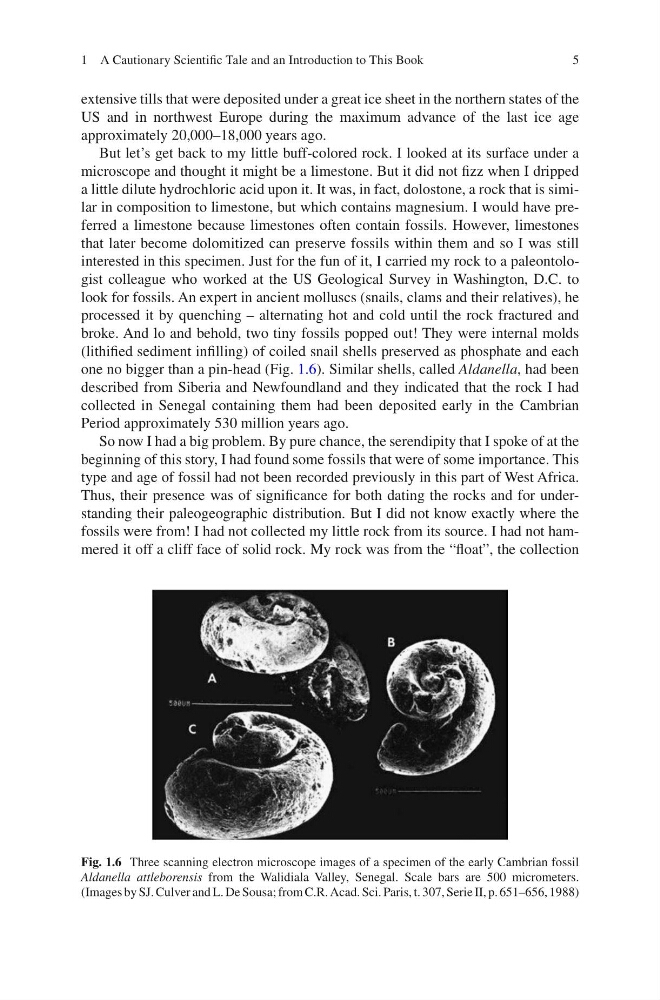
broke. And lo and behold, two tiny fossils popped out! They were internal molds
(lithified sediment infilling) of coiled snail shells preserved as phosphate and each
one no bigger than a pin-head (Fig. 1.6). Similar shells, called Aldanella, had been
described from Siberia and Newfoundland and they indicated that the rock I had
collected in Senegal containing them had been deposited early in the Cambrian
Period approximately 530 million years ago.
So now I had a big problem. By pure chance, the serendipity that I spoke of at the
beginning of this story, I had found some fossils that were of some importance. This
type and age of fossil had not been recorded previously in this part of West Africa.
Thus, their presence was of significance for both dating the rocks and for understanding their paleogeographic distribution. But I did not know exactly where the
fossils were from! I had not collected my little rock from its source. I had not hammered it off a cliff face of solid rock. My rock was from the “float”, the collection
Fig. 1.6 Three scanning electron microscope images of a specimen of the early Cambrian fossil
Aldanella attleborensis from the Walidiala Valley, Senegal. Scale bars are 500 micrometers.
(Images by SJ. Culver and L. De Sousa; from C.R. Acad. Sci. Paris, t. 307, Serie II, p. 651–656, 1988)
1 A Cautionary Scientific Tale and an Introduction to This Book
extensive tills that were deposited under a great ice sheet in the northern states of the
US and in northwest Europe during the maximum advance of the last ice age
approximately 20,000–18,000 years ago.
But let’s get back to my little buff-colored rock. I looked at its surface under a
microscope and thought it might be a limestone. But it did not fizz when I dripped
a little dilute hydrochloric acid upon it. It was, in fact, dolostone, a rock that is similar in composition to limestone, but which contains magnesium. I would have preferred a limestone because limestones often contain fossils. However, limestones
that later become dolomitized can preserve fossils within them and so I was still
interested in this specimen. Just for the fun of it, I carried my rock to a paleontologist colleague who worked at the US Geological Survey in Washington, D.C. to
look for fossils. An expert in ancient molluscs (snails, clams and their relatives), he
processed it by quenching – alternating hot and cold until the rock fractured and
broke. And lo and behold, two tiny fossils popped out! They were internal molds
(lithified sediment infilling) of coiled snail shells preserved as phosphate and each
one no bigger than a pin-head (Fig. 1.6). Similar shells, called Aldanella, had been
described from Siberia and Newfoundland and they indicated that the rock I had
collected in Senegal containing them had been deposited early in the Cambrian
Period approximately 530 million years ago.
So now I had a big problem. By pure chance, the serendipity that I spoke of at the
beginning of this story, I had found some fossils that were of some importance. This
type and age of fossil had not been recorded previously in this part of West Africa.
Thus, their presence was of significance for both dating the rocks and for understanding their paleogeographic distribution. But I did not know exactly where the
fossils were from! I had not collected my little rock from its source. I had not hammered it off a cliff face of solid rock. My rock was from the “float”, the collection
Fig. 1.6 Three scanning electron microscope images of a specimen of the early Cambrian fossil
Aldanella attleborensis from the Walidiala Valley, Senegal. Scale bars are 500 micrometers.
(Images by SJ. Culver and L. De Sousa; from C.R. Acad. Sci. Paris, t. 307, Serie II, p. 651–656, 1988)
1 A Cautionary Scientific Tale and an Introduction to This Book