

4
on the surface of the Earth today exhibits sediments with same characteristics as
those of shallow marine glacial environments. Thus, we use one of the basic tenets
of geology, “The Present is the Key to the Past”, to interpret the environment of
deposition of ancient rocks.
These interpretations are valuable. For example, while I was teaching at the
University of Sierra Leone, I studied late Precambrian conglomerates that had been
investigated for gold deposits. The general consensus was that the conglomerates,
poorly sorted sedimentary rocks composed, in this case, of sand, pebbles, cobbles
and boulders up to a meter across, were deposited on the beds of rivers during the
late Precambrian. Taking that idea a step further, it was thought that detrital gold
might be concentrated under the pebbles and cobbles as is the case with classic
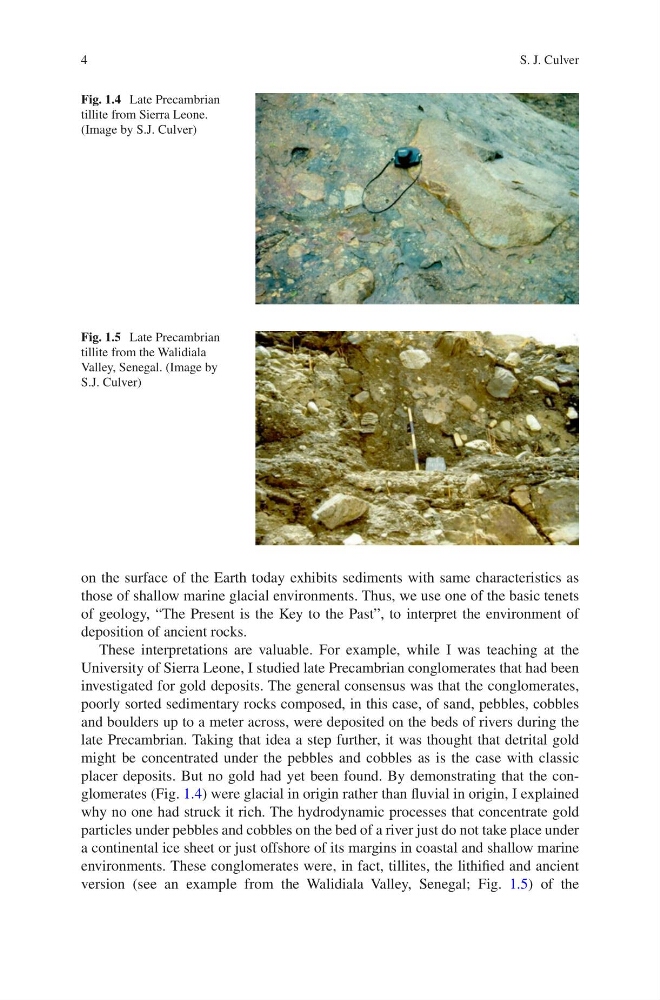
placer deposits. But no gold had yet been found. By demonstrating that the conglomerates (Fig. 1.4) were glacial in origin rather than fluvial in origin, I explained
why no one had struck it rich. The hydrodynamic processes that concentrate gold
particles under pebbles and cobbles on the bed of a river just do not take place under
a continental ice sheet or just offshore of its margins in coastal and shallow marine
environments. These conglomerates were, in fact, tillites, the lithified and ancient
version (see an example from the Walidiala Valley, Senegal; Fig. 1.5) of the
Fig. 1.4 Late Precambrian
tillite from Sierra Leone.
(Image by S.J. Culver)
Fig. 1.5 Late Precambrian
tillite from the Walidiala
Valley, Senegal. (Image by
S.J. Culver)
S. J. Culver
on the surface of the Earth today exhibits sediments with same characteristics as
those of shallow marine glacial environments. Thus, we use one of the basic tenets
of geology, “The Present is the Key to the Past”, to interpret the environment of
deposition of ancient rocks.
These interpretations are valuable. For example, while I was teaching at the
University of Sierra Leone, I studied late Precambrian conglomerates that had been
investigated for gold deposits. The general consensus was that the conglomerates,
poorly sorted sedimentary rocks composed, in this case, of sand, pebbles, cobbles
and boulders up to a meter across, were deposited on the beds of rivers during the
late Precambrian. Taking that idea a step further, it was thought that detrital gold
might be concentrated under the pebbles and cobbles as is the case with classic
placer deposits. But no gold had yet been found. By demonstrating that the conglomerates (Fig. 1.4) were glacial in origin rather than fluvial in origin, I explained
why no one had struck it rich. The hydrodynamic processes that concentrate gold
particles under pebbles and cobbles on the bed of a river just do not take place under
a continental ice sheet or just offshore of its margins in coastal and shallow marine
environments. These conglomerates were, in fact, tillites, the lithified and ancient
version (see an example from the Walidiala Valley, Senegal; Fig. 1.5) of the
Fig. 1.4 Late Precambrian
tillite from Sierra Leone.
(Image by S.J. Culver)
Fig. 1.5 Late Precambrian
tillite from the Walidiala
Valley, Senegal. (Image by
S.J. Culver)
S. J. Culver