

3
(maybe as little as 560) million years ago. At that time, in the late Precambrian
(modern terminology is Neoproterozoic), what is now West Africa, including the
countries of Liberia and Senegal, was located over the South Pole. Continental drift,
powered by the processes of plate tectonics, much later moved West Africa to its
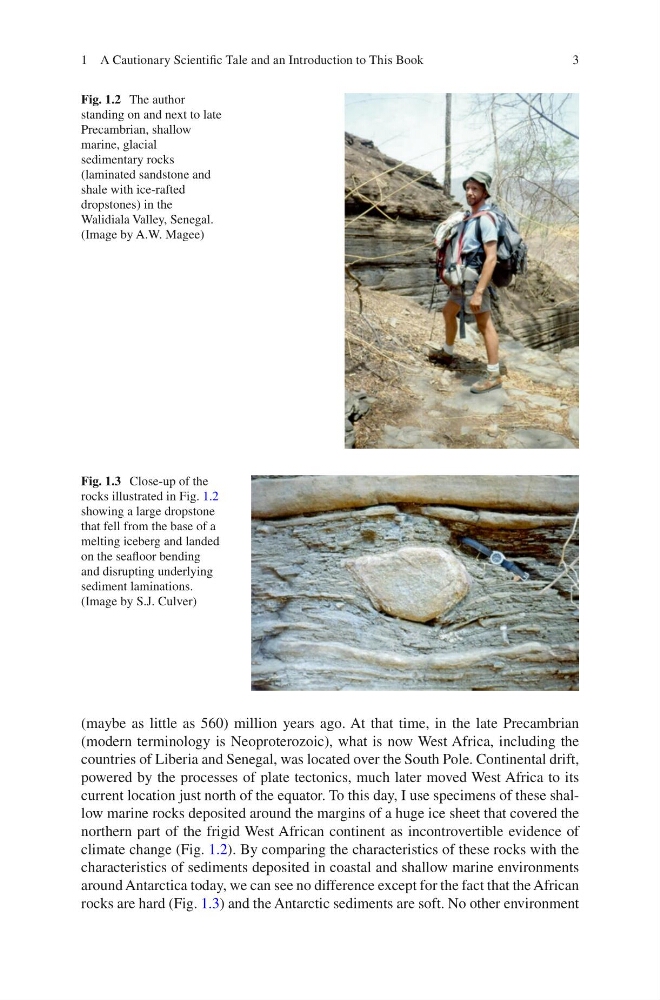
current location just north of the equator. To this day, I use specimens of these shallow marine rocks deposited around the margins of a huge ice sheet that covered the
northern part of the frigid West African continent as incontrovertible evidence of
climate change (Fig. 1.2). By comparing the characteristics of these rocks with the
characteristics of sediments deposited in coastal and shallow marine environments
around Antarctica today, we can see no difference except for the fact that the African
rocks are hard (Fig. 1.3) and the Antarctic sediments are soft. No other environment
Fig. 1.2 The author
standing on and next to late
Precambrian, shallow
marine, glacial
sedimentary rocks
(laminated sandstone and
shale with ice-rafted
dropstones) in the
Walidiala Valley, Senegal.
(Image by A.W. Magee)
Fig. 1.3 Close-up of the
rocks illustrated in Fig. 1.2
showing a large dropstone
that fell from the base of a
melting iceberg and landed
on the seafloor bending
and disrupting underlying
sediment laminations.
(Image by S.J. Culver)
1 A Cautionary Scientific Tale and an Introduction to This Book
(maybe as little as 560) million years ago. At that time, in the late Precambrian
(modern terminology is Neoproterozoic), what is now West Africa, including the
countries of Liberia and Senegal, was located over the South Pole. Continental drift,
powered by the processes of plate tectonics, much later moved West Africa to its
current location just north of the equator. To this day, I use specimens of these shallow marine rocks deposited around the margins of a huge ice sheet that covered the
northern part of the frigid West African continent as incontrovertible evidence of
climate change (Fig. 1.2). By comparing the characteristics of these rocks with the
characteristics of sediments deposited in coastal and shallow marine environments
around Antarctica today, we can see no difference except for the fact that the African
rocks are hard (Fig. 1.3) and the Antarctic sediments are soft. No other environment
Fig. 1.2 The author
standing on and next to late
Precambrian, shallow
marine, glacial
sedimentary rocks
(laminated sandstone and
shale with ice-rafted
dropstones) in the
Walidiala Valley, Senegal.
(Image by A.W. Magee)
Fig. 1.3 Close-up of the
rocks illustrated in Fig. 1.2
showing a large dropstone
that fell from the base of a
melting iceberg and landed
on the seafloor bending
and disrupting underlying
sediment laminations.
(Image by S.J. Culver)
1 A Cautionary Scientific Tale and an Introduction to This Book