

6
of loose rock of all sizes that had either fallen down the valley side under the force
of gravity or had been transported along the valley floor by running water during a
rainy season in the not too distant past. The 635 million year-old glacial rocks sat
directly upon older limestone and sandstone that together with 2 billion year-old
metamorphosed basement rock of granitic composition floored the valley. So, where
did my dolostone come from? Its source must have been from higher up the side of
the valley – but the sedimentary logs did not record any dolostone. With my student,
I had climbed up the valley side, which was partially covered by dense scrub, to
check his work and I too did not see any dolostone. Overlying, and therefore younger
than the glacial rocks, were red and green siltstones, with an interbedded approximately one meter-thick greyish colored chert, a very hard rock with the same composition as quartz. Overlying the siltstones was a much younger almost black rock
called diabase. This dark, hard, igneous rock, which had protected the underlying
sedimentary rocks from erosion, was intruded at shallow depths in the Earth’s crust
as a result of fracturing and faulting of rock during break-up of the supercontinent
Pangea early in the Jurassic Period approximately 190 million years ago. The region
that is now Senegal, Gambia, Guinea-Bissau, Guinea and Sierra Leone rifted away
from what is now eastern Florida and Georgia as the continents of Africa and North
America began their slow journeys that resulted in a 7000 kilometer-wide Atlantic
Ocean. Indeed, the rocks deep in the subsurface below the Everglades of Florida are
the same as those exposed on the surface in Sierra Leone today. If my rock was not
from the valley sides, then it must have been transported down the river valley. I
needed to go back to Senegal to walk up the valley to find the source, not of the
ephemeral river that carved the valley over tens of thousands of years, and perhaps
much longer, but of the fossils in my little buff-colored rock.
I wrote another proposal, this time to the National Science Foundation, and a
couple of years later I returned to the Walidiala Valley, this time with two colleagues
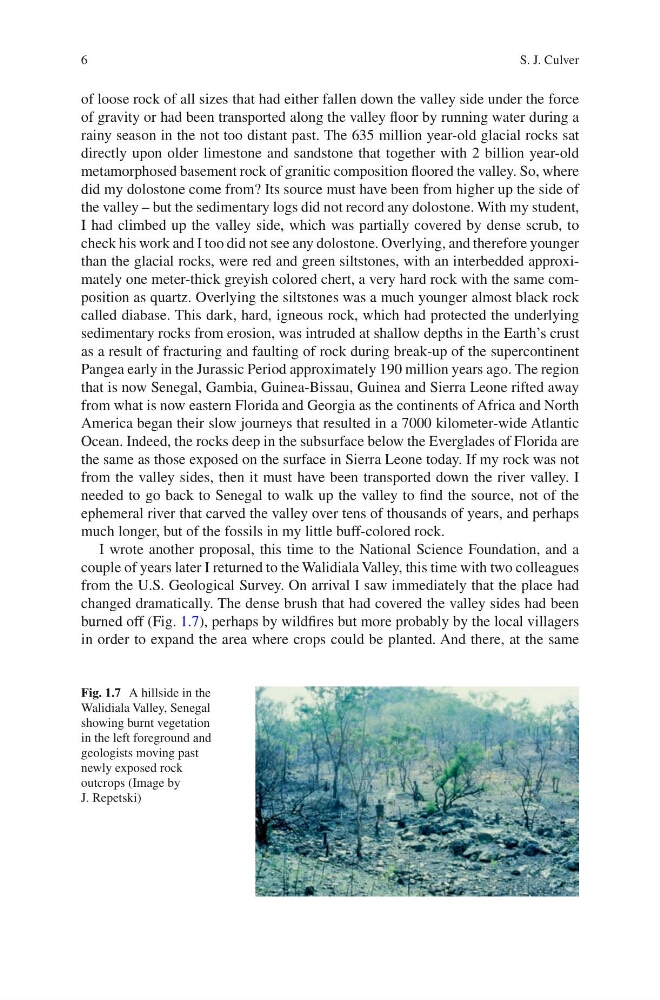
from the U.S. Geological Survey. On arrival I saw immediately that the place had
changed dramatically. The dense brush that had covered the valley sides had been
burned off (Fig. 1.7), perhaps by wildfires but more probably by the local villagers
in order to expand the area where crops could be planted. And there, at the same
Fig. 1.7 A hillside in the
Walidiala Valley, Senegal
showing burnt vegetation
in the left foreground and
geologists moving past
newly exposed rock
outcrops (Image by
J. Repetski)
S. J. Culver
of loose rock of all sizes that had either fallen down the valley side under the force
of gravity or had been transported along the valley floor by running water during a
rainy season in the not too distant past. The 635 million year-old glacial rocks sat
directly upon older limestone and sandstone that together with 2 billion year-old
metamorphosed basement rock of granitic composition floored the valley. So, where
did my dolostone come from? Its source must have been from higher up the side of
the valley – but the sedimentary logs did not record any dolostone. With my student,
I had climbed up the valley side, which was partially covered by dense scrub, to
check his work and I too did not see any dolostone. Overlying, and therefore younger
than the glacial rocks, were red and green siltstones, with an interbedded approximately one meter-thick greyish colored chert, a very hard rock with the same composition as quartz. Overlying the siltstones was a much younger almost black rock
called diabase. This dark, hard, igneous rock, which had protected the underlying
sedimentary rocks from erosion, was intruded at shallow depths in the Earth’s crust
as a result of fracturing and faulting of rock during break-up of the supercontinent
Pangea early in the Jurassic Period approximately 190 million years ago. The region
that is now Senegal, Gambia, Guinea-Bissau, Guinea and Sierra Leone rifted away
from what is now eastern Florida and Georgia as the continents of Africa and North
America began their slow journeys that resulted in a 7000 kilometer-wide Atlantic
Ocean. Indeed, the rocks deep in the subsurface below the Everglades of Florida are
the same as those exposed on the surface in Sierra Leone today. If my rock was not
from the valley sides, then it must have been transported down the river valley. I
needed to go back to Senegal to walk up the valley to find the source, not of the
ephemeral river that carved the valley over tens of thousands of years, and perhaps
much longer, but of the fossils in my little buff-colored rock.
I wrote another proposal, this time to the National Science Foundation, and a
couple of years later I returned to the Walidiala Valley, this time with two colleagues
from the U.S. Geological Survey. On arrival I saw immediately that the place had
changed dramatically. The dense brush that had covered the valley sides had been
burned off (Fig. 1.7), perhaps by wildfires but more probably by the local villagers
in order to expand the area where crops could be planted. And there, at the same
Fig. 1.7 A hillside in the
Walidiala Valley, Senegal
showing burnt vegetation
in the left foreground and
geologists moving past
newly exposed rock
outcrops (Image by
J. Repetski)
S. J. Culver