

5.4.4 Biological Properties
The saturated conditions and low oxygen content of many
Gley Soils provide difficult growing conditions for many
plants. Thus plants that are adapted to tolerate waterlogged
conditions often prevail in undrained Gley Soils. In areas of
native vegetation, water-tolerant plants include harakeke
(flax, Phormium tenax), ti kouka (cabbage tree, Cordyline
australis), kahikatea (white pine, Dacrycarpus dacrydioides), and pukatea (Laurelia novae-zealandiae), which
occur (or occurred before pastoralism) extensively on Gley
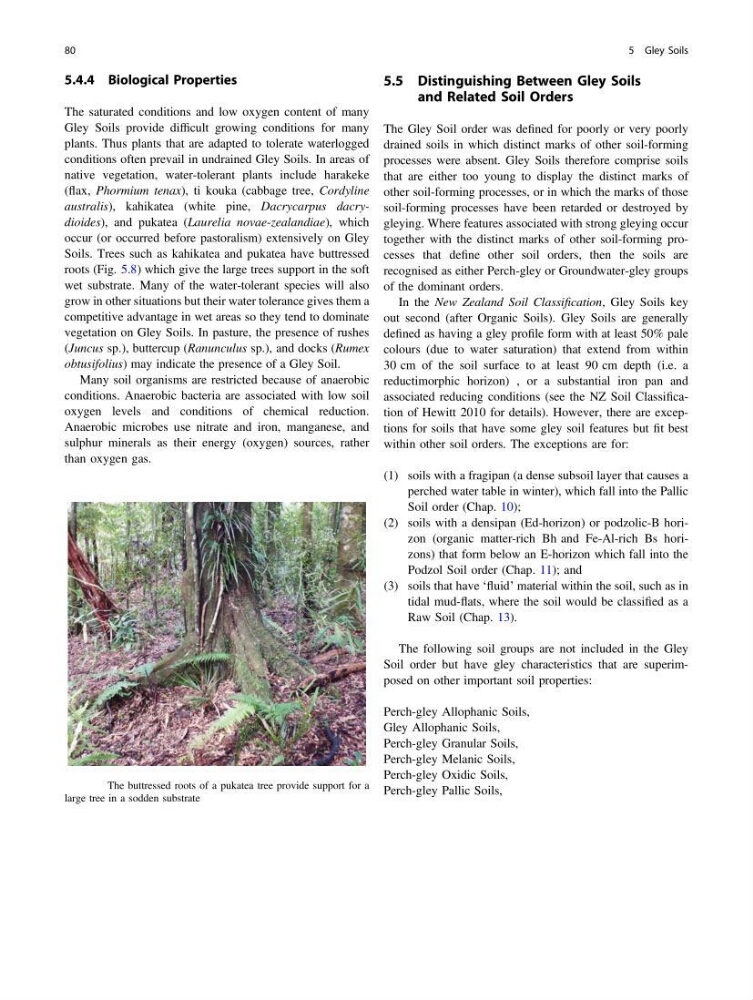
Soils. Trees such as kahikatea and pukatea have buttressed
roots (Fig. 5.8) which give the large trees support in the soft
wet substrate. Many of the water-tolerant species will also
grow in other situations but their water tolerance gives them a
competitive advantage in wet areas so they tend to dominate
vegetation on Gley Soils. In pasture, the presence of rushes
(Juncus sp.), buttercup (Ranunculus sp.), and docks (Rumex
obtusifolius) may indicate the presence of a Gley Soil.
Many soil organisms are restricted because of anaerobic
conditions. Anaerobic bacteria are associated with low soil
oxygen levels and conditions of chemical reduction.
Anaerobic microbes use nitrate and iron, manganese, and
sulphur minerals as their energy (oxygen) sources, rather
than oxygen gas.
5.5 Distinguishing Between Gley Soils
and Related Soil Orders
The Gley Soil order was defined for poorly or very poorly
drained soils in which distinct marks of other soil-forming
processes were absent. Gley Soils therefore comprise soils
that are either too young to display the distinct marks of
other soil-forming processes, or in which the marks of those
soil-forming processes have been retarded or destroyed by
gleying. Where features associated with strong gleying occur
together with the distinct marks of other soil-forming processes that define other soil orders, then the soils are
recognised as either Perch-gley or Groundwater-gley groups
of the dominant orders.
In the New Zealand Soil Classification, Gley Soils key
out second (after Organic Soils). Gley Soils are generally
defined as having a gley profile form with at least 50% pale
colours (due to water saturation) that extend from within
30 cm of the soil surface to at least 90 cm depth (i.e. a
reductimorphic horizon) , or a substantial iron pan and
associated reducing conditions (see the NZ Soil Classification of Hewitt 2010 for details). However, there are exceptions for soils that have some gley soil features but fit best
within other soil orders. The exceptions are for:
(1) soils with a fragipan (a dense subsoil layer that causes a
perched water table in winter), which fall into the Pallic
Soil order (Chap. 10);
(2) soils with a densipan (Ed-horizon) or podzolic-B horizon (organic matter-rich Bh and Fe-Al-rich Bs horizons) that form below an E-horizon which fall into the
Podzol Soil order (Chap. 11); and
(3) soils that have ‘fluid’ material within the soil, such as in
tidal mud-flats, where the soil would be classified as a
Raw Soil (Chap. 13).
The following soil groups are not included in the Gley
Soil order but have gley characteristics that are superimposed on other important soil properties:
Perch-gley Allophanic Soils,
Gley Allophanic Soils,
Perch-gley Granular Soils,
Perch-gley Melanic Soils,
Perch-gley Oxidic Soils,
Perch-gley Pallic Soils,
Fig. 5.8 The buttressed roots of a pukatea tree provide support for a
large tree in a sodden substrate
80
5 Gley Soils
The saturated conditions and low oxygen content of many
Gley Soils provide difficult growing conditions for many
plants. Thus plants that are adapted to tolerate waterlogged
conditions often prevail in undrained Gley Soils. In areas of
native vegetation, water-tolerant plants include harakeke
(flax, Phormium tenax), ti kouka (cabbage tree, Cordyline
australis), kahikatea (white pine, Dacrycarpus dacrydioides), and pukatea (Laurelia novae-zealandiae), which
occur (or occurred before pastoralism) extensively on Gley
Soils. Trees such as kahikatea and pukatea have buttressed
roots (Fig. 5.8) which give the large trees support in the soft
wet substrate. Many of the water-tolerant species will also
grow in other situations but their water tolerance gives them a
competitive advantage in wet areas so they tend to dominate
vegetation on Gley Soils. In pasture, the presence of rushes
(Juncus sp.), buttercup (Ranunculus sp.), and docks (Rumex
obtusifolius) may indicate the presence of a Gley Soil.
Many soil organisms are restricted because of anaerobic
conditions. Anaerobic bacteria are associated with low soil
oxygen levels and conditions of chemical reduction.
Anaerobic microbes use nitrate and iron, manganese, and
sulphur minerals as their energy (oxygen) sources, rather
than oxygen gas.
5.5 Distinguishing Between Gley Soils
and Related Soil Orders
The Gley Soil order was defined for poorly or very poorly
drained soils in which distinct marks of other soil-forming
processes were absent. Gley Soils therefore comprise soils
that are either too young to display the distinct marks of
other soil-forming processes, or in which the marks of those
soil-forming processes have been retarded or destroyed by
gleying. Where features associated with strong gleying occur
together with the distinct marks of other soil-forming processes that define other soil orders, then the soils are
recognised as either Perch-gley or Groundwater-gley groups
of the dominant orders.
In the New Zealand Soil Classification, Gley Soils key
out second (after Organic Soils). Gley Soils are generally
defined as having a gley profile form with at least 50% pale
colours (due to water saturation) that extend from within
30 cm of the soil surface to at least 90 cm depth (i.e. a
reductimorphic horizon) , or a substantial iron pan and
associated reducing conditions (see the NZ Soil Classification of Hewitt 2010 for details). However, there are exceptions for soils that have some gley soil features but fit best
within other soil orders. The exceptions are for:
(1) soils with a fragipan (a dense subsoil layer that causes a
perched water table in winter), which fall into the Pallic
Soil order (Chap. 10);
(2) soils with a densipan (Ed-horizon) or podzolic-B horizon (organic matter-rich Bh and Fe-Al-rich Bs horizons) that form below an E-horizon which fall into the
Podzol Soil order (Chap. 11); and
(3) soils that have ‘fluid’ material within the soil, such as in
tidal mud-flats, where the soil would be classified as a
Raw Soil (Chap. 13).
The following soil groups are not included in the Gley
Soil order but have gley characteristics that are superimposed on other important soil properties:
Perch-gley Allophanic Soils,
Gley Allophanic Soils,
Perch-gley Granular Soils,
Perch-gley Melanic Soils,
Perch-gley Oxidic Soils,
Perch-gley Pallic Soils,
Fig. 5.8 The buttressed roots of a pukatea tree provide support for a
large tree in a sodden substrate
80
5 Gley Soils