

Perch-gley Podzols,
Groundwater-gley Podzols,
Perch-gley Pumice Soils,
Gley Raw Soils, and
Perch-gley Ultic Soils.
As water saturation tends to slow biodegradation of organic matter there is an intergrade between Gley Soils and
Organic Soils. Gley Soils may contain high levels of organic
matter and include thin layers of peat, but they are predominantly formed in mineral material. Organic Soils in wet
conditions have at least 30 cm of peaty material within the
soil profile.
Gley Soils are also recognised where there is an
ironstone-pan within 30 cm of the soil surface and evidence
for reducing conditions in some part of the year.
5.6 Correlation with Other Classification
Systems
In the World Reference Base, gleyed soils are recognised at
the highest level as Gleysols. However, in Soil Taxonomy
gleyed soils are recognised mainly at the second level,
namely, suborder, through the presence of an aquic soil
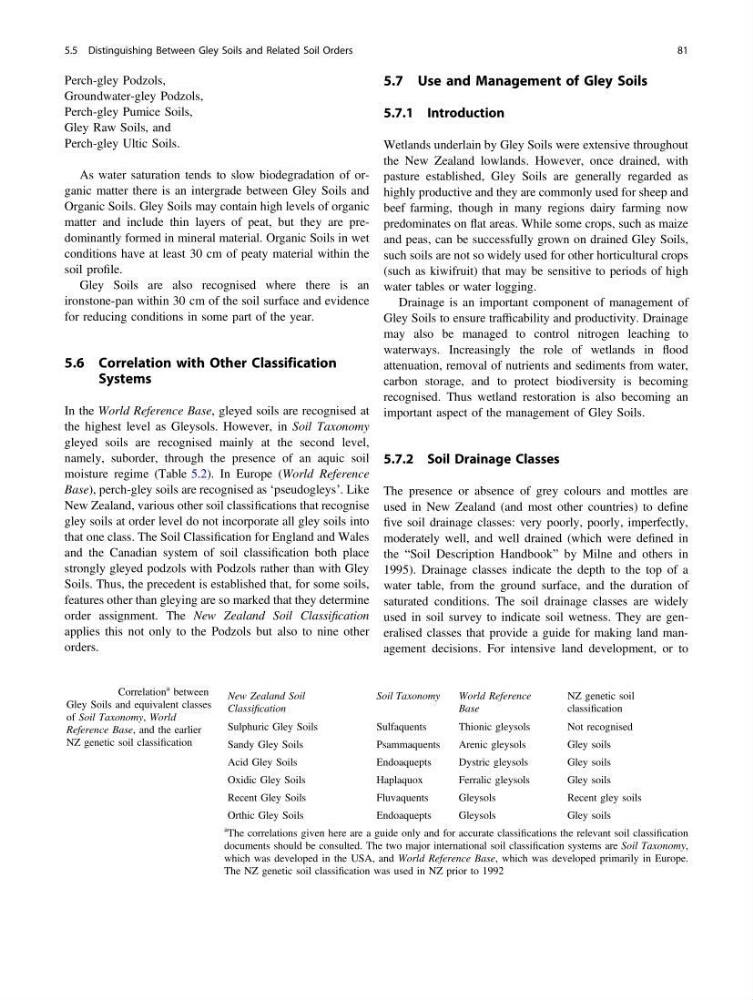
moisture regime (Table 5.2). In Europe (World Reference
Base), perch-gley soils are recognised as ‘pseudogleys’. Like
New Zealand, various other soil classifications that recognise
gley soils at order level do not incorporate all gley soils into
that one class. The Soil Classification for England and Wales
and the Canadian system of soil classification both place
strongly gleyed podzols with Podzols rather than with Gley
Soils. Thus, the precedent is established that, for some soils,
features other than gleying are so marked that they determine
order assignment. The New Zealand Soil Classification
applies this not only to the Podzols but also to nine other
orders.
5.7 Use and Management of Gley Soils
5.7.1 Introduction
Wetlands underlain by Gley Soils were extensive throughout
the New Zealand lowlands. However, once drained, with
pasture established, Gley Soils are generally regarded as
highly productive and they are commonly used for sheep and
beef farming, though in many regions dairy farming now
predominates on flat areas. While some crops, such as maize
and peas, can be successfully grown on drained Gley Soils,
such soils are not so widely used for other horticultural crops
(such as kiwifruit) that may be sensitive to periods of high
water tables or water logging.
Drainage is an important component of management of
Gley Soils to ensure trafficability and productivity. Drainage
may also be managed to control nitrogen leaching to
waterways. Increasingly the role of wetlands in flood
attenuation, removal of nutrients and sediments from water,
carbon storage, and to protect biodiversity is becoming
recognised. Thus wetland restoration is also becoming an
important aspect of the management of Gley Soils.
5.7.2 Soil Drainage Classes
The presence or absence of grey colours and mottles are
used in New Zealand (and most other countries) to define
five soil drainage classes: very poorly, poorly, imperfectly,
moderately well, and well drained (which were defined in
the “Soil Description Handbook” by Milne and others in
1995). Drainage classes indicate the depth to the top of a
water table, from the ground surface, and the duration of
saturated conditions. The soil drainage classes are widely
used in soil survey to indicate soil wetness. They are generalised classes that provide a guide for making land management decisions. For intensive land development, or to
Table 5.2 Correlation
a between
Gley Soils and equivalent classes
of Soil Taxonomy, World
Reference Base, and the earlier
NZ genetic soil classification
New Zealand Soil
Classification
Soil Taxonomy
World Reference
Base
NZ genetic soil
classification
Sulphuric Gley Soils
Sulfaquents
Thionic gleysols
Not recognised
Sandy Gley Soils
Psammaquents
Arenic gleysols
Gley soils
Acid Gley Soils
Endoaquepts
Dystric gleysols
Gley soils
Oxidic Gley Soils
Haplaquox
Ferralic gleysols
Gley soils
Recent Gley Soils
Fluvaquents
Gleysols
Recent gley soils
Orthic Gley Soils
Endoaquepts
Gleysols
Gley soils
a The correlations given here are a guide only and for accurate classifications the relevant soil classification
documents should be consulted. The two major international soil classification systems are Soil Taxonomy,
which was developed in the USA, and World Reference Base, which was developed primarily in Europe.
The NZ genetic soil classification was used in NZ prior to 1992
5.5 Distinguishing Between Gley Soils and Related Soil Orders
81
Groundwater-gley Podzols,
Perch-gley Pumice Soils,
Gley Raw Soils, and
Perch-gley Ultic Soils.
As water saturation tends to slow biodegradation of organic matter there is an intergrade between Gley Soils and
Organic Soils. Gley Soils may contain high levels of organic
matter and include thin layers of peat, but they are predominantly formed in mineral material. Organic Soils in wet
conditions have at least 30 cm of peaty material within the
soil profile.
Gley Soils are also recognised where there is an
ironstone-pan within 30 cm of the soil surface and evidence
for reducing conditions in some part of the year.
5.6 Correlation with Other Classification
Systems
In the World Reference Base, gleyed soils are recognised at
the highest level as Gleysols. However, in Soil Taxonomy
gleyed soils are recognised mainly at the second level,
namely, suborder, through the presence of an aquic soil
moisture regime (Table 5.2). In Europe (World Reference
Base), perch-gley soils are recognised as ‘pseudogleys’. Like
New Zealand, various other soil classifications that recognise
gley soils at order level do not incorporate all gley soils into
that one class. The Soil Classification for England and Wales
and the Canadian system of soil classification both place
strongly gleyed podzols with Podzols rather than with Gley
Soils. Thus, the precedent is established that, for some soils,
features other than gleying are so marked that they determine
order assignment. The New Zealand Soil Classification
applies this not only to the Podzols but also to nine other
orders.
5.7 Use and Management of Gley Soils
5.7.1 Introduction
Wetlands underlain by Gley Soils were extensive throughout
the New Zealand lowlands. However, once drained, with
pasture established, Gley Soils are generally regarded as
highly productive and they are commonly used for sheep and
beef farming, though in many regions dairy farming now
predominates on flat areas. While some crops, such as maize
and peas, can be successfully grown on drained Gley Soils,
such soils are not so widely used for other horticultural crops
(such as kiwifruit) that may be sensitive to periods of high
water tables or water logging.
Drainage is an important component of management of
Gley Soils to ensure trafficability and productivity. Drainage
may also be managed to control nitrogen leaching to
waterways. Increasingly the role of wetlands in flood
attenuation, removal of nutrients and sediments from water,
carbon storage, and to protect biodiversity is becoming
recognised. Thus wetland restoration is also becoming an
important aspect of the management of Gley Soils.
5.7.2 Soil Drainage Classes
The presence or absence of grey colours and mottles are
used in New Zealand (and most other countries) to define
five soil drainage classes: very poorly, poorly, imperfectly,
moderately well, and well drained (which were defined in
the “Soil Description Handbook” by Milne and others in
1995). Drainage classes indicate the depth to the top of a
water table, from the ground surface, and the duration of
saturated conditions. The soil drainage classes are widely
used in soil survey to indicate soil wetness. They are generalised classes that provide a guide for making land management decisions. For intensive land development, or to
Table 5.2 Correlation
a between
Gley Soils and equivalent classes
of Soil Taxonomy, World
Reference Base, and the earlier
NZ genetic soil classification
New Zealand Soil
Classification
Soil Taxonomy
World Reference
Base
NZ genetic soil
classification
Sulphuric Gley Soils
Sulfaquents
Thionic gleysols
Not recognised
Sandy Gley Soils
Psammaquents
Arenic gleysols
Gley soils
Acid Gley Soils
Endoaquepts
Dystric gleysols
Gley soils
Oxidic Gley Soils
Haplaquox
Ferralic gleysols
Gley soils
Recent Gley Soils
Fluvaquents
Gleysols
Recent gley soils
Orthic Gley Soils
Endoaquepts
Gleysols
Gley soils
a The correlations given here are a guide only and for accurate classifications the relevant soil classification
documents should be consulted. The two major international soil classification systems are Soil Taxonomy,
which was developed in the USA, and World Reference Base, which was developed primarily in Europe.
The NZ genetic soil classification was used in NZ prior to 1992
5.5 Distinguishing Between Gley Soils and Related Soil Orders
81