

Thus Gley Soils are generally fertile as they can retain and
make nutrients potentially available to plants.
A key feature of Gley Soils is the presence of anaerobic
conditions which means a number of compounds occur in
their chemically reduced form. Of particular note is nitrogen.
In anaerobic conditions, nitrate (NO
À
3 ) is reduced to nitrite
(NO
À
2 ) and then to nitrogen gas (N 2 ) as anaerobic microbes
utilise nitrates as an oxygen source. Thus, providing that
there is sufficient carbon in the soil, nitrate is less likely to be
leached from Gley Soils than other soils, as the nitrogen is
instead converted to nitrogen gas and returned to the atmosphere (which is 78% N 2 ). On the down side, some of the
nitrogen may also be returned to the atmosphere as nitrous
oxide (N 2 O), which is a greenhouse gas.
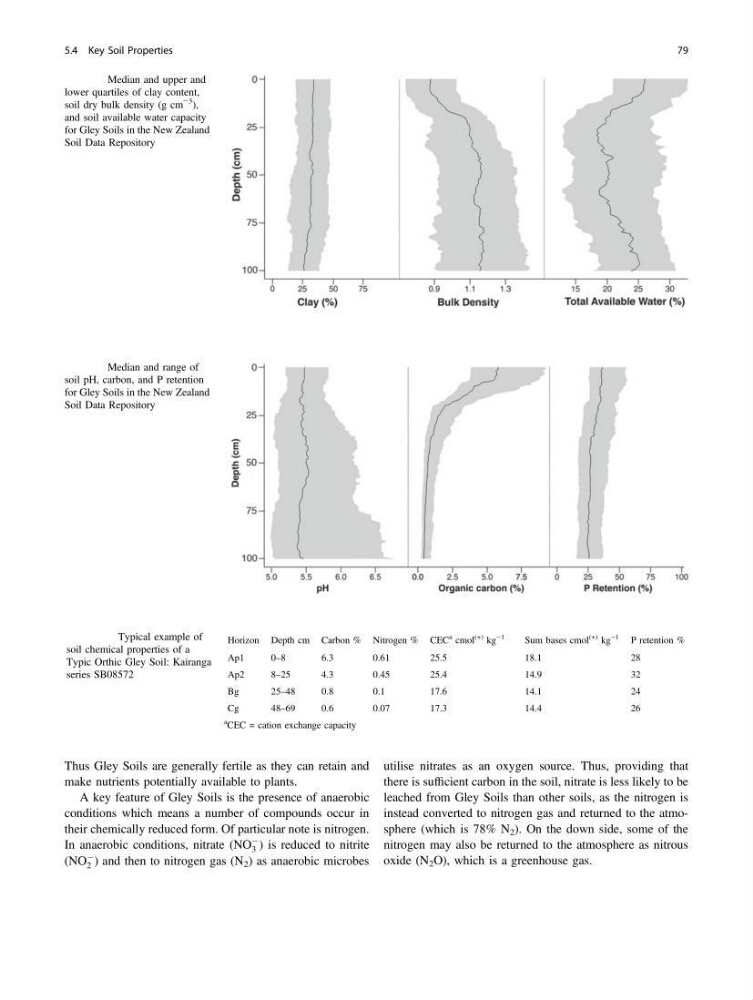
Fig. 5.6 Median and upper and
lower quartiles of clay content,
soil dry bulk density (g cm
−3
),
and soil available water capacity
for Gley Soils in the New Zealand
Soil Data Repository
Fig. 5.7 Median and range of
soil pH, carbon, and P retention
for Gley Soils in the New Zealand
Soil Data Repository
Table 5.1 Typical example of
soil chemical properties of a
Typic Orthic Gley Soil: Kairanga
series SB08572
Horizon Depth cm Carbon % Nitrogen % CEC
a cmol
(+) kg
−1
Sum bases cmol
(+) kg
−1
P retention %
Ap1
0–8
6.3
0.61
25.5
18.1
28
Ap2
8–25
4.3
0.45
25.4
14.9
32
Bg
25–48
0.8
0.1
17.6
14.1
24
Cg
48–69
0.6
0.07
17.3
14.4
26
a
CEC = cation exchange capacity
5.4 Key Soil Properties
79
make nutrients potentially available to plants.
A key feature of Gley Soils is the presence of anaerobic
conditions which means a number of compounds occur in
their chemically reduced form. Of particular note is nitrogen.
In anaerobic conditions, nitrate (NO
À
3 ) is reduced to nitrite
(NO
À
2 ) and then to nitrogen gas (N 2 ) as anaerobic microbes
utilise nitrates as an oxygen source. Thus, providing that
there is sufficient carbon in the soil, nitrate is less likely to be
leached from Gley Soils than other soils, as the nitrogen is
instead converted to nitrogen gas and returned to the atmosphere (which is 78% N 2 ). On the down side, some of the
nitrogen may also be returned to the atmosphere as nitrous
oxide (N 2 O), which is a greenhouse gas.
Fig. 5.6 Median and upper and
lower quartiles of clay content,
soil dry bulk density (g cm
−3
),
and soil available water capacity
for Gley Soils in the New Zealand
Soil Data Repository
Fig. 5.7 Median and range of
soil pH, carbon, and P retention
for Gley Soils in the New Zealand
Soil Data Repository
Table 5.1 Typical example of
soil chemical properties of a
Typic Orthic Gley Soil: Kairanga
series SB08572
Horizon Depth cm Carbon % Nitrogen % CEC
a cmol
(+) kg
−1
Sum bases cmol
(+) kg
−1
P retention %
Ap1
0–8
6.3
0.61
25.5
18.1
28
Ap2
8–25
4.3
0.45
25.4
14.9
32
Bg
25–48
0.8
0.1
17.6
14.1
24
Cg
48–69
0.6
0.07
17.3
14.4
26
a
CEC = cation exchange capacity
5.4 Key Soil Properties
79