

Brown Soils may contain a wide range of clay minerals
including mica/illite, and vermiculite.
Ferrihydrite is the main iron oxide mineral in Brown Soils
and has been described by Roger Parfitt and Cyril Childs.
Ferrihydrite has a net positive charge in acid situations, and so
has anion exchange properties, and provides the moderate to
high phosphate retention of many Brown Soils. Ferrihydrite is
related to allophane in being a nanocrystalline clay (with
structure in the nanoscale range 1–100 nm). Ferrihydrite is one
of the nanominerals comprising the diagnostic ‘allophanic soil
material’ in the New Zealand Soil Classification.
Volcanic materials, which are the most common source of
allophanic soil materials, are rare among greywacke rocks.
However, in greywacke rocks, allophane or associated
weathering products form by the rapid dissolution (by hydrolysis) of plagioclase or other feldspars, especially if they
have been pre-weathered within the rock. Weathering to
form allophanic materials is aided by strong leaching of
silicon (desilication) under moderately high rainfall and
good drainage to promote the synthesis of aluminium-rich
allophane (i.e. aluminium content > silicon content) and also
of ferrihydrite. The complexes of iron and aluminium
hydrous oxides, and organic matter, help to stabilise the soil
structure and thus generate the high soil porosity.
The alteration status of gravel or hard rock substrates is
usually fresh to moderately weathered, but highly weathered
rock (saprolite) occurs in some places. Some Brown Soils in
the Wellington region, and their extension into Marlborough, have a loess component overlying deeply weathered
greywacke with red colouration and significant kaolinite clay
(Chap. 16, Ultic Soils). The soil survey of the Taita catchment, on the margin of the Hutt Valley near Wellington,
provides an example of Brown Soils on deeply weathered
greywacke substrate and on subordinate colluvium and
loess.
4.4.2 Physical Properties
Brown Soils are mostly weakly to moderately weathered and
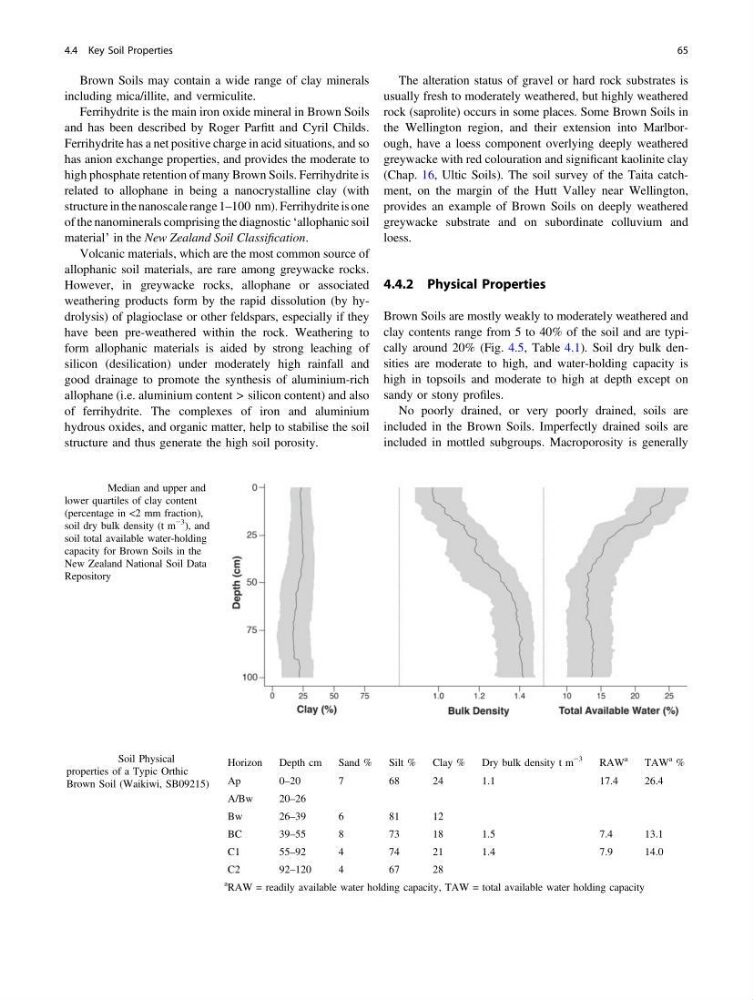
clay contents range from 5 to 40% of the soil and are typically around 20% (Fig. 4.5, Table 4.1). Soil dry bulk densities are moderate to high, and water-holding capacity is
high in topsoils and moderate to high at depth except on
sandy or stony profiles.
No poorly drained, or very poorly drained, soils are
included in the Brown Soils. Imperfectly drained soils are
included in mottled subgroups. Macroporosity is generally
Fig. 4.5 Median and upper and
lower quartiles of clay content
(percentage in <2 mm fraction),
soil dry bulk density (t m
−3
), and
soil total available water-holding
capacity for Brown Soils in the
New Zealand National Soil Data
Repository
Table 4.1 Soil Physical
properties of a Typic Orthic
Brown Soil (Waikiwi, SB09215)
Horizon
Depth cm
Sand %
Silt %
Clay %
Dry bulk density t m
−3
RAW
a
TAW
a %
Ap
0–20
7
68
24
1.1
17.4
26.4
A/Bw
20–26
Bw
26–39
6
81
12
BC
39–55
8
73
18
1.5
7.4
13.1
C1
55–92
4
74
21
1.4
7.9
14.0
C2
92–120
4
67
28
a RAW = readily available water holding capacity, TAW = total available water holding capacity
4.4 Key Soil Properties
65
including mica/illite, and vermiculite.
Ferrihydrite is the main iron oxide mineral in Brown Soils
and has been described by Roger Parfitt and Cyril Childs.
Ferrihydrite has a net positive charge in acid situations, and so
has anion exchange properties, and provides the moderate to
high phosphate retention of many Brown Soils. Ferrihydrite is
related to allophane in being a nanocrystalline clay (with
structure in the nanoscale range 1–100 nm). Ferrihydrite is one
of the nanominerals comprising the diagnostic ‘allophanic soil
material’ in the New Zealand Soil Classification.
Volcanic materials, which are the most common source of
allophanic soil materials, are rare among greywacke rocks.
However, in greywacke rocks, allophane or associated
weathering products form by the rapid dissolution (by hydrolysis) of plagioclase or other feldspars, especially if they
have been pre-weathered within the rock. Weathering to
form allophanic materials is aided by strong leaching of
silicon (desilication) under moderately high rainfall and
good drainage to promote the synthesis of aluminium-rich
allophane (i.e. aluminium content > silicon content) and also
of ferrihydrite. The complexes of iron and aluminium
hydrous oxides, and organic matter, help to stabilise the soil
structure and thus generate the high soil porosity.
The alteration status of gravel or hard rock substrates is
usually fresh to moderately weathered, but highly weathered
rock (saprolite) occurs in some places. Some Brown Soils in
the Wellington region, and their extension into Marlborough, have a loess component overlying deeply weathered
greywacke with red colouration and significant kaolinite clay
(Chap. 16, Ultic Soils). The soil survey of the Taita catchment, on the margin of the Hutt Valley near Wellington,
provides an example of Brown Soils on deeply weathered
greywacke substrate and on subordinate colluvium and
loess.
4.4.2 Physical Properties
Brown Soils are mostly weakly to moderately weathered and
clay contents range from 5 to 40% of the soil and are typically around 20% (Fig. 4.5, Table 4.1). Soil dry bulk densities are moderate to high, and water-holding capacity is
high in topsoils and moderate to high at depth except on
sandy or stony profiles.
No poorly drained, or very poorly drained, soils are
included in the Brown Soils. Imperfectly drained soils are
included in mottled subgroups. Macroporosity is generally
Fig. 4.5 Median and upper and
lower quartiles of clay content
(percentage in <2 mm fraction),
soil dry bulk density (t m
−3
), and
soil total available water-holding
capacity for Brown Soils in the
New Zealand National Soil Data
Repository
Table 4.1 Soil Physical
properties of a Typic Orthic
Brown Soil (Waikiwi, SB09215)
Horizon
Depth cm
Sand %
Silt %
Clay %
Dry bulk density t m
−3
RAW
a
TAW
a %
Ap
0–20
7
68
24
1.1
17.4
26.4
A/Bw
20–26
Bw
26–39
6
81
12
BC
39–55
8
73
18
1.5
7.4
13.1
C1
55–92
4
74
21
1.4
7.9
14.0
C2
92–120
4
67
28
a RAW = readily available water holding capacity, TAW = total available water holding capacity
4.4 Key Soil Properties
65