

moderate (10–14%) except in subsurface horizons of Firm
Brown Soils. Brown Soils have good infiltration capacity
provided they are not damaged by stock trampling or vehicle
compaction, which may occur, particularly when soils are
wet. Profile permeability ranges widely depending mainly on
the nature of the parent material. For example, soils on stony
colluvium on hill slopes are frequently moderately or rapidly
permeable, but soils on silty loess of firm strength, or soils
with pans, are likely to be slowly permeable. The Brown
Soils do not include soils that have prolonged perched water
tables, but mottled subgroups (with mottled profile form) are
included.
Compared with Pallic Soils, Brown Soils generally have a
favourable topsoil structure and aggregates are not readily
dispersed, as indicated by their oxide-dominated secondary
mineralogy and typically moderate phosphate retention.
Bypass flow is generally medium in Brown Soils. Root
exploration of the soil is generally favourable but may be
somewhat limited in soils with firm subsoil horizons, and
prevented by cemented pans or shallow coherent rock.
4.4.3 Chemical Properties
The chemical properties of Brown Soils, especially pH, base
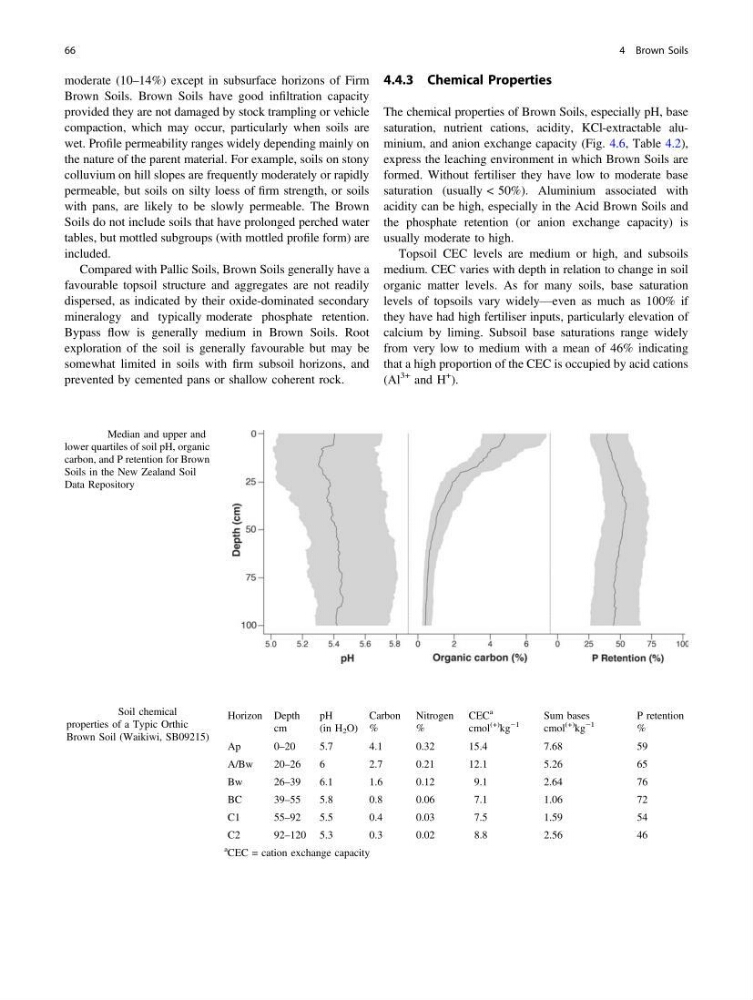
saturation, nutrient cations, acidity, KCl-extractable aluminium, and anion exchange capacity (Fig. 4.6, Table 4.2),
express the leaching environment in which Brown Soils are
formed. Without fertiliser they have low to moderate base
saturation (usually < 50%). Aluminium associated with
acidity can be high, especially in the Acid Brown Soils and
the phosphate retention (or anion exchange capacity) is
usually moderate to high.
Topsoil CEC levels are medium or high, and subsoils
medium. CEC varies with depth in relation to change in soil
organic matter levels. As for many soils, base saturation
levels of topsoils vary widely—even as much as 100% if
they have had high fertiliser inputs, particularly elevation of
calcium by liming. Subsoil base saturations range widely
from very low to medium with a mean of 46% indicating
that a high proportion of the CEC is occupied by acid cations
(Al
3+ and H
+
).
Fig. 4.6 Median and upper and
lower quartiles of soil pH, organic
carbon, and P retention for Brown
Soils in the New Zealand Soil
Data Repository
Table 4.2 Soil chemical
properties of a Typic Orthic
Brown Soil (Waikiwi, SB09215)
Horizon Depth
cm
pH
(in H 2 O)
Carbon
%
Nitrogen
%
CEC
a
cmol
(+)
kg
−1
Sum bases
cmol
(+)
kg
−1
P retention
%
Ap
0–20
5.7
4.1
0.32
15.4
7.68
59
A/Bw
20–26
6
2.7
0.21
12.1
5.26
65
Bw
26–39
6.1
1.6
0.12
9.1
2.64
76
BC
39–55
5.8
0.8
0.06
7.1
1.06
72
C1
55–92
5.5
0.4
0.03
7.5
1.59
54
C2
92–120 5.3
0.3
0.02
8.8
2.56
46
a CEC = cation exchange capacity
66
4 Brown Soils
Brown Soils. Brown Soils have good infiltration capacity
provided they are not damaged by stock trampling or vehicle
compaction, which may occur, particularly when soils are
wet. Profile permeability ranges widely depending mainly on
the nature of the parent material. For example, soils on stony
colluvium on hill slopes are frequently moderately or rapidly
permeable, but soils on silty loess of firm strength, or soils
with pans, are likely to be slowly permeable. The Brown
Soils do not include soils that have prolonged perched water
tables, but mottled subgroups (with mottled profile form) are
included.
Compared with Pallic Soils, Brown Soils generally have a
favourable topsoil structure and aggregates are not readily
dispersed, as indicated by their oxide-dominated secondary
mineralogy and typically moderate phosphate retention.
Bypass flow is generally medium in Brown Soils. Root
exploration of the soil is generally favourable but may be
somewhat limited in soils with firm subsoil horizons, and
prevented by cemented pans or shallow coherent rock.
4.4.3 Chemical Properties
The chemical properties of Brown Soils, especially pH, base
saturation, nutrient cations, acidity, KCl-extractable aluminium, and anion exchange capacity (Fig. 4.6, Table 4.2),
express the leaching environment in which Brown Soils are
formed. Without fertiliser they have low to moderate base
saturation (usually < 50%). Aluminium associated with
acidity can be high, especially in the Acid Brown Soils and
the phosphate retention (or anion exchange capacity) is
usually moderate to high.
Topsoil CEC levels are medium or high, and subsoils
medium. CEC varies with depth in relation to change in soil
organic matter levels. As for many soils, base saturation
levels of topsoils vary widely—even as much as 100% if
they have had high fertiliser inputs, particularly elevation of
calcium by liming. Subsoil base saturations range widely
from very low to medium with a mean of 46% indicating
that a high proportion of the CEC is occupied by acid cations
(Al
3+ and H
+
).
Fig. 4.6 Median and upper and
lower quartiles of soil pH, organic
carbon, and P retention for Brown
Soils in the New Zealand Soil
Data Repository
Table 4.2 Soil chemical
properties of a Typic Orthic
Brown Soil (Waikiwi, SB09215)
Horizon Depth
cm
pH
(in H 2 O)
Carbon
%
Nitrogen
%
CEC
a
cmol
(+)
kg
−1
Sum bases
cmol
(+)
kg
−1
P retention
%
Ap
0–20
5.7
4.1
0.32
15.4
7.68
59
A/Bw
20–26
6
2.7
0.21
12.1
5.26
65
Bw
26–39
6.1
1.6
0.12
9.1
2.64
76
BC
39–55
5.8
0.8
0.06
7.1
1.06
72
C1
55–92
5.5
0.4
0.03
7.5
1.59
54
C2
92–120 5.3
0.3
0.02
8.8
2.56
46
a CEC = cation exchange capacity
66
4 Brown Soils