

(termed ‘intergrading subgroups’). Brown Soil intergrades
include Mottled (to Gley Soils), Peaty (to Organic Soils),
and Immature (to Recent Soils), Firm (to Pallic Soils), Pallic
(to Pallic Soils), Placic (to Podzol Soils), and Allophanic (to
Allophanic Soils). Other subgroups depart in some specific
way from the soil group or soil order (Acidic, Aged, Calcareous, Firm, Humose, Mafic, Magnesic, Pedal, Sodic, or
Weathered).
4.1.4 Origin of the Soil Order Name
The Brown Soils correlate most closely with the ‘Yellow
brown earths’ of the former New Zealand genetic soil classification and the name was derived from that. ‘Brown soil’
also has international precedence. The term relates to the
Sols Bruns of France, Braunerden of Germany, Burozems of
Russia, and Cambissolos of Brazil.
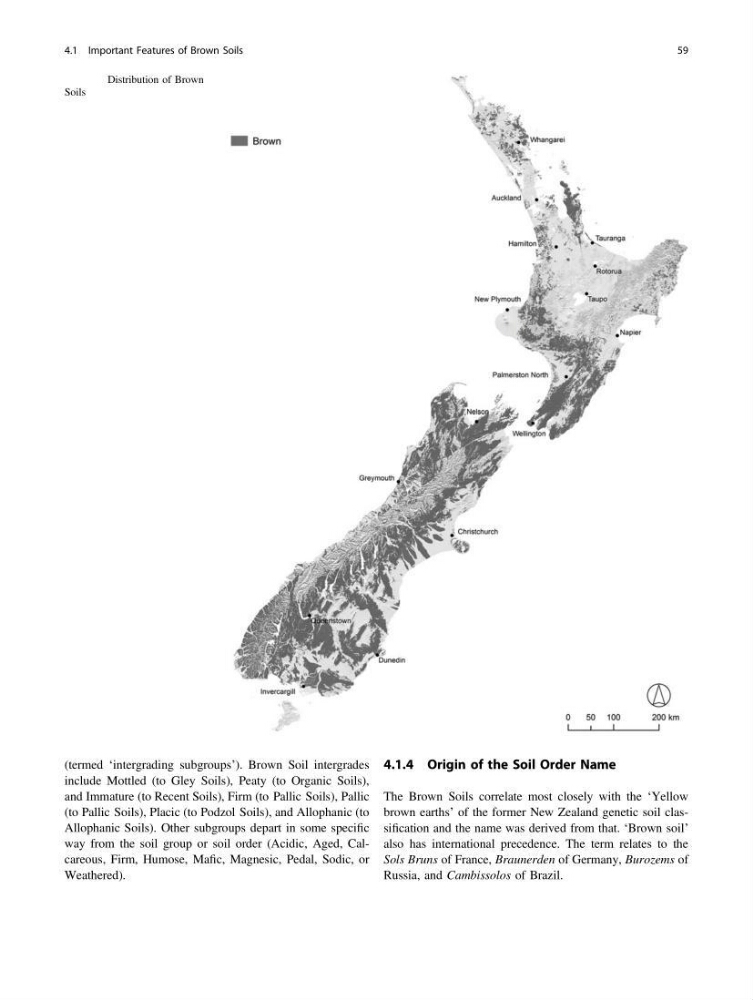
Fig. 4.2 Distribution of Brown
Soils
4.1 Important Features of Brown Soils
59
include Mottled (to Gley Soils), Peaty (to Organic Soils),
and Immature (to Recent Soils), Firm (to Pallic Soils), Pallic
(to Pallic Soils), Placic (to Podzol Soils), and Allophanic (to
Allophanic Soils). Other subgroups depart in some specific
way from the soil group or soil order (Acidic, Aged, Calcareous, Firm, Humose, Mafic, Magnesic, Pedal, Sodic, or
Weathered).
4.1.4 Origin of the Soil Order Name
The Brown Soils correlate most closely with the ‘Yellow
brown earths’ of the former New Zealand genetic soil classification and the name was derived from that. ‘Brown soil’
also has international precedence. The term relates to the
Sols Bruns of France, Braunerden of Germany, Burozems of
Russia, and Cambissolos of Brazil.
Fig. 4.2 Distribution of Brown
Soils
4.1 Important Features of Brown Soils
59