

4.1.2 Areas of Occurrence
Covering about 43% of the country, Brown Soils are New
Zealand’s most extensive soils, occurring on large areas of
the moist mountains, hills, and plains (Fig. 4.2). Brown
Soils form mainly on quartz- and feldspar-dominated parent
materials in places where summer drought is uncommon, but
which are not waterlogged in winter. Most Brown Soils
occur in areas with mean annual rainfall greater than about
800 mm in the South Island and more than about 1000
mm year
−1 in the North Island. Brown Soils may also occur
in lower rainfall areas where stony and sandy materials
occur. In stony or sandy soils, that have low water-holding
capacity, leaching (solutes carried by water flow through the
profile) may be sufficient for Brown Soil formation under a
relatively low rainfall (600–800 mm year
−1 ). Brown Soils
may also occur in lower rainfall areas on sites with low
evapotranspiration where leaching is thus relatively high.
4.1.3 Variation Within the Brown Soil Order
Brown Soils are extensive and comprise a wide variety of
soils encompassed by seven soil groups (Fig. 4.3) and 48
subgroups. The seven soil groups are as follows:
Allophanic Brown Soils—contain a relatively thin layer of
Allophanic soil material or allophanic material coating
grains,
Sandy Brown Soils—dominated by sand or loamy sand to
depth,
Oxidic Brown Soils—similar to Oxidic Soils but with significant weatherable minerals remaining,
Mafic Brown Soils—in materials derived from dark-coloured
(Fe- and Mg-rich) igneous (including volcanic) rocks,
Acid Brown Soils—strongly or extremely acid,
Firm Brown Soils—slightly firm or stronger B-horizon soil
strength, apedal subsurface horizon, and
Orthic Brown Soils—other Brown Soils.
In some cases the allophane in Allophanic Brown Soils is
the result of thin layers of tephra where the soils are intergrading towards the Allophanic Soils of the central North
Island or Taranaki. However, in many Allophanic Brown
Soils, the allophanic material is not derived from weathering
of tephra, but from weathering of greywacke or schist (or
deposits derived from these), mainly in mountain environments where rainfall is relatively high and drainage is good.
Because of the prominence of the Brown Soils there are
many (48) subgroups. Subgroups recognise transitions from
the Brown Soils to other related soil orders or soil groups
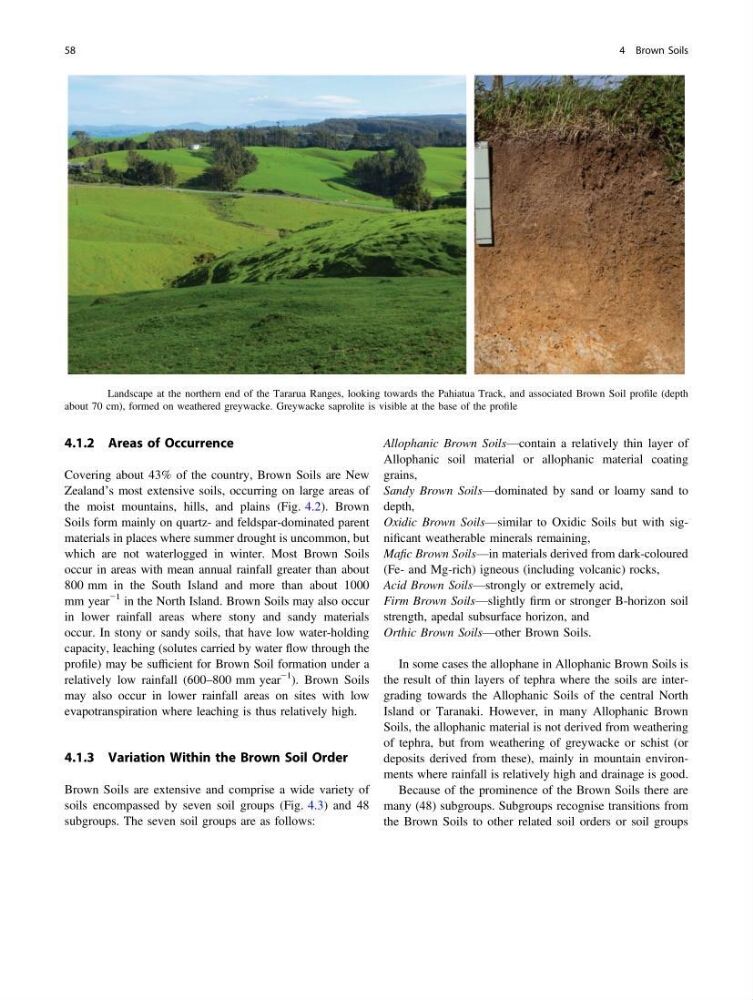
Fig. 4.1 Landscape at the northern end of the Tararua Ranges, looking towards the Pahiatua Track, and associated Brown Soil profile (depth
about 70 cm), formed on weathered greywacke. Greywacke saprolite is visible at the base of the profile
58
4 Brown Soils
Covering about 43% of the country, Brown Soils are New
Zealand’s most extensive soils, occurring on large areas of
the moist mountains, hills, and plains (Fig. 4.2). Brown
Soils form mainly on quartz- and feldspar-dominated parent
materials in places where summer drought is uncommon, but
which are not waterlogged in winter. Most Brown Soils
occur in areas with mean annual rainfall greater than about
800 mm in the South Island and more than about 1000
mm year
−1 in the North Island. Brown Soils may also occur
in lower rainfall areas where stony and sandy materials
occur. In stony or sandy soils, that have low water-holding
capacity, leaching (solutes carried by water flow through the
profile) may be sufficient for Brown Soil formation under a
relatively low rainfall (600–800 mm year
−1 ). Brown Soils
may also occur in lower rainfall areas on sites with low
evapotranspiration where leaching is thus relatively high.
4.1.3 Variation Within the Brown Soil Order
Brown Soils are extensive and comprise a wide variety of
soils encompassed by seven soil groups (Fig. 4.3) and 48
subgroups. The seven soil groups are as follows:
Allophanic Brown Soils—contain a relatively thin layer of
Allophanic soil material or allophanic material coating
grains,
Sandy Brown Soils—dominated by sand or loamy sand to
depth,
Oxidic Brown Soils—similar to Oxidic Soils but with significant weatherable minerals remaining,
Mafic Brown Soils—in materials derived from dark-coloured
(Fe- and Mg-rich) igneous (including volcanic) rocks,
Acid Brown Soils—strongly or extremely acid,
Firm Brown Soils—slightly firm or stronger B-horizon soil
strength, apedal subsurface horizon, and
Orthic Brown Soils—other Brown Soils.
In some cases the allophane in Allophanic Brown Soils is
the result of thin layers of tephra where the soils are intergrading towards the Allophanic Soils of the central North
Island or Taranaki. However, in many Allophanic Brown
Soils, the allophanic material is not derived from weathering
of tephra, but from weathering of greywacke or schist (or
deposits derived from these), mainly in mountain environments where rainfall is relatively high and drainage is good.
Because of the prominence of the Brown Soils there are
many (48) subgroups. Subgroups recognise transitions from
the Brown Soils to other related soil orders or soil groups
Fig. 4.1 Landscape at the northern end of the Tararua Ranges, looking towards the Pahiatua Track, and associated Brown Soil profile (depth
about 70 cm), formed on weathered greywacke. Greywacke saprolite is visible at the base of the profile
58
4 Brown Soils